RV furnace blower not working or making noise
Your RV furnace fan won't start, runs slow, or rumbles and squeals. Here is how to tell a dead blower from a lockout or a weak battery, and which noises mean stop.
 By Complete RV Guide team
Updated Oct 25, 2026
8 min read
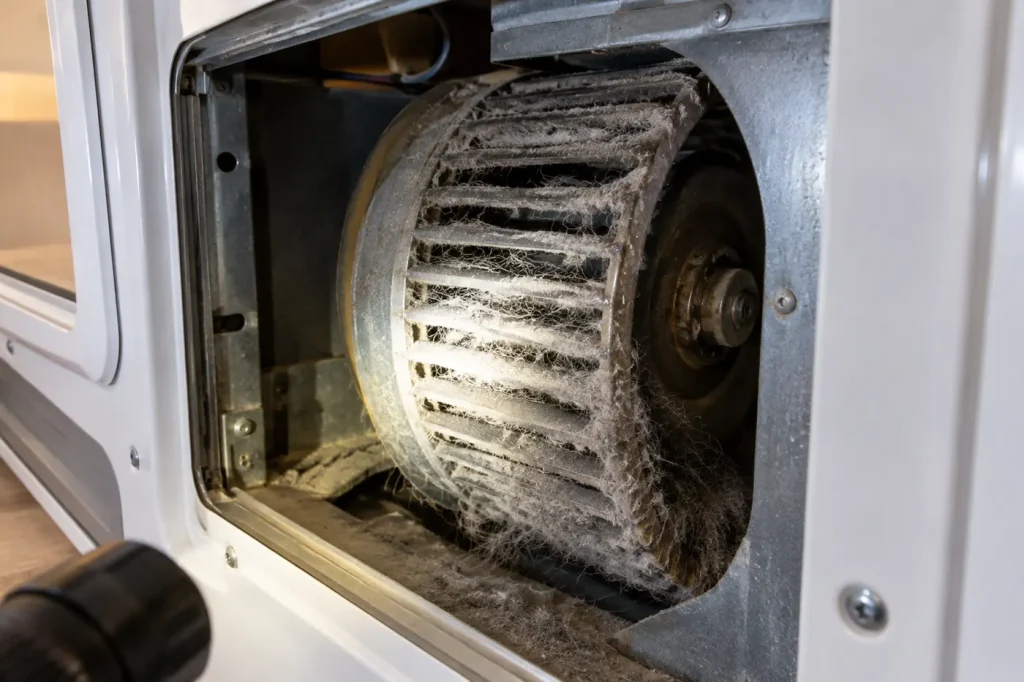
Quick answer
A blower that won't start is most often a fuse, the furnace switch, a lockout or a weak battery, so check those before the motor. A slow fan usually means low voltage or lint on the wheel. A fan that runs about 15 seconds before the spark or 90 seconds after the flame goes out is normal.
- Difficulty
- Moderate
- Time
- 15-60 min
- Parts cost
- Usually $0A blower motor or wheel varies by furnace model
What you'll need
- Multimeter
- Flashlight
- Spare fuses
- Vacuum with brush nozzle
- Screwdriver
Tool links go to Amazon. As an Amazon Associate we earn from qualifying purchases, at no extra cost to you.
Common symptoms
- The thermostat calls for heat and the fan never starts.
- The fan sounds slow and weak, and little air comes out of the vents.
- A deep rumble, a rattle, a squeal or a grinding sound comes from the furnace.
- The fan runs but only cold air comes out.
- The fan keeps running after the heat shuts off, or will not stop at all.
- The fan worked yesterday on shore power and is dead tonight on battery.
Quick checks before anything else
- The thermostat is on Heat and set a few degrees above room temperature.
- The on/off switch on the furnace itself is on.
- The furnace fuse or breaker on the 12V panel is good.
- The battery reads about 12.6 volts at rest.
- You waited at least 30 seconds after the call for heat before deciding the fan is dead.
- The return-air grille is clear of lint, pet hair and stored items.
Why is the RV furnace blower not working?
An RV furnace has one 12V motor with a fan wheel on each end. One wheel pulls outside air into the burner and pushes exhaust out. The other blows cabin air over the hot heat exchanger and into your ducts. The furnace will not light until that motor has proved airflow, so a blower problem is also a no-heat problem.
- No 12V power A blown fuse, a tripped breaker, the furnace switch off, or a dead battery. Nothing happens at all.
- Lockout After failed tries, many boards stop the fan on purpose. On Atwood furnaces it goes off after 3 minutes and stays off until you reset.
- Low voltage The motor turns slowly, moves too little air, and the sail switch never closes.
- Lint on the wheel Dust and pet hair on the room-air wheel make the motor drag and cut airflow.
- Damaged wheel or worn motor Rattles, grinding or squealing, a slow fan, or a motor that hums and won’t turn.
- Control board or relay The fan will not start with 12V present, or runs and never stops.
When the fan running alone is normal
A fan that runs without heat is not always a fault. These times come from the makers’ manuals, and your model may differ a little.
- Call for heatFan may take up to about 30 seconds to start
- PurgeAbout 15 seconds of fan only before the spark
- Burner lightsFan keeps running while it heats
- Thermostat satisfiedGas shuts off, fan runs 90 more seconds
- Fan still running after about 2 minutes?
Yes: look for a lockout, an open limit switch, or a stuck relay or board (steps 3 and 9).
No: that was a normal cool-down. Nothing to fix.
Step-by-step: fixing a dead, slow or noisy blower
We go from free checks to tech work. Turn off the furnace switch and 12V power before you put a hand or tool near the fan.
- Give it time to start Suburban’s SF manual says the motor will not start instantly and to allow about 30 seconds. Older Suburban furnaces with a time-delay relay take roughly 10 to 20 seconds, and Atwood mentions a slight delay too. If the fan starts within that window, the blower is fine.
-
Check the switch, fuse and breaker Make sure the power switch on the furnace is on. Then find the furnace fuse on the 12V panel and look for a broken metal strip inside. Replace it with one of the same amp rating. If the new fuse blows right away, stop: Suburban’s flow chart says to check for shorts and for parts drawing more current than normal, and a dragging motor can do that.
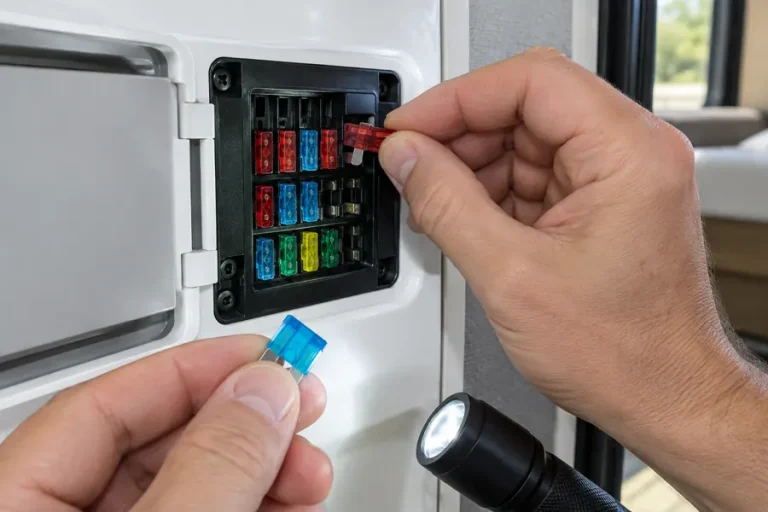
Replace a blown fuse with the same amp rating - Reset a lockout If the furnace failed to light earlier, the fan may be off on purpose. Atwood’s blower shuts off 3 minutes into a lockout and stays off until you reset the thermostat. Turn the thermostat off, wait, then back to Heat. On Atwood you can also turn the furnace power switch off and on.
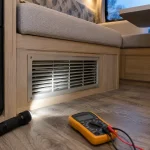
- Measure voltage at rest and with the fan running Suburban rates its furnaces for 10.5 to 13.5 volts. Its fan control boards wait in standby below 9.5 volts, so a weak battery can look like a dead blower. Suburban’s sail switch needs about 75% of normal fan speed to close. If the fan runs strong on shore power and weak on battery, the battery is the problem; see our guide to an RV battery not charging when plugged in.
-
Vacuum lint at the return air With the power off, vacuum the return-air grille and whatever you can reach behind it with a brush nozzle. Suburban says lint on the room-air blower wheel makes the motor drag and move too little air. Atwood and Dometic say pet hair, bedding and carpet lint mean more frequent cleaning. Cleaning the wheel itself usually means pulling the furnace, which is tech work.
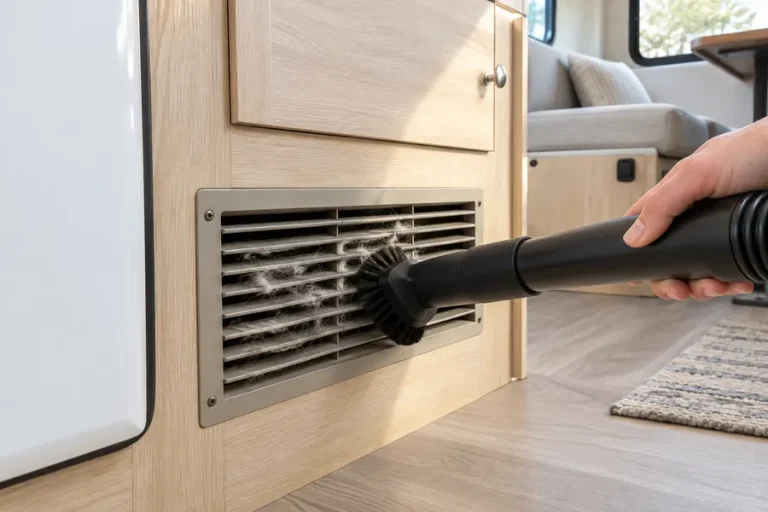
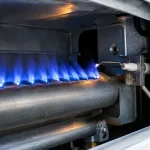
Lint on the grille and wheel slows the blower - Note when the rumble starts Start the furnace and listen. A noise that starts with the fan, before any ticking, comes from the motor or a wheel. A rumble that starts only after the burner lights comes from the combustion side. Suburban says the flame should be hard blue. A yellow or lazy flame means you should shut the furnace down, because the burner may need cleaning or replacing.
- Squeal, grind or rattle: stop and inspect A squeal or grind from the motor area often means a worn motor, and a rattle or scrape means something touching a wheel. Atwood warns that running the furnace with anything blocking the blower damages the wheel and causes overheating and cycling. The motor is permanently lubricated, per both makers, so do not oil it. Shut the furnace off and have the wheel and motor inspected.
- Check polarity after any wiring work If the fan got weak right after someone rewired the furnace or the battery, check the power leads. Suburban marks red as positive and yellow as negative, and says polarity must be right so the motor turns the correct way. A motor turning the wrong way still runs, but it does not move the air the furnace needs.
- Test for 12V at the motor Suburban’s flow chart checks for 12V at the furnace, at the power terminal on the board and at the red wire to the motor, then the ground wire on the terminal block. 12V at the motor with no spin means a bad motor. It says to replace the board only after confirming the motor works. A fan that never stops points to the time-delay relay or the fan control board.
- Leave motor and wheel replacement to a tech On Suburban furnaces, reaching the blower means turning off gas and power, disconnecting the gas line and pulling the furnace from its cabinet. Suburban’s steps end with a leak test on all fittings and a pressure drop test. Motors and wheels are model-specific, so read the model and serial number off the furnace label first.
Stop. A loud bang or whoomp when the burner lights is delayed ignition. Suburban and Atwood both say to shut the furnace down and call a service agency if it delays on ignition. Do the same for a yellow flame, soot at the outside vent, a propane smell or a CO alarm.
| What you hear or see | Likely cause | Steps |
|---|---|---|
| Nothing at all | Power, fuse, switch or lockout | 1, 2, 3 |
| Slow fan, weak air | Low voltage, lint, reversed wires | 4, 5, 8 |
| Noise from the moment the fan starts | Motor or wheel | 6, 7 |
| Rumble only once the burner lights | Burner or gas | 6 |
| Motor hums, won’t turn | Motor | 9, 10 |
| Fan never stops | Lockout, relay or board | 3, 9 |
Suburban vs Atwood (Dometic) blowers
Suburban. Fan control boards run the fan about 15 seconds before the spark and 90 seconds after the burner shuts off. After the third failed try to light, the fan runs 3 more minutes and stops. On older time-delay models the fan keeps running in lockout until you turn the thermostat off. Some other Suburban boards keep the fan running while the limit switch is open. Suburban’s spec sheet lists amp draws from 2.8 amps on small NT models to 9.5 amps on the NT-40.
Atwood and Dometic. After a lockout the fan goes off in 3 minutes and stays off until you reset. The board LED shows one flash for a limit switch or airflow problem. Dometic’s DF manual lists these causes when the furnace won’t light and the fan won’t turn on: a blown fuse, a tripped or off furnace-installed breaker switch (call a tech), low 12V power, a lockout, and blocked vents. Both brands say to wire the converter in parallel with the battery for steadier voltage. More on how the parts fit together is in our RV furnace repair guide.
Tools and parts for this fix
Only what this guide uses. For parts, match the part number in your unit's manual before you order.

Measures battery voltage at rest and with the fan running to spot a weak battery.
Check price on Amazon
Bussmann ATC blade fuse assortment
Replaces the furnace fuse on the 12V panel when the blower will not start.
Check price on Amazon
As an Amazon Associate we earn from qualifying purchases, at no extra cost to you.
When to call an RV tech
- A new fuse blows as soon as the fan starts.
- 12V reaches the motor and it hums or won’t turn.
- You hear grinding, scraping or a rattle from the wheel.
- The wheel needs cleaning or replacing and the furnace must come out.
- The fan never stops after the thermostat is satisfied.
- The flame is yellow, it bangs on lighting, or there is soot at the vent.
Common questions
What could be causing my RV furnace to make a rumbling noise?
First notice when it starts. A rumble from the moment the fan starts points to the motor, a dirty or damaged wheel, or something loose touching it. A rumble that starts only after the burner lights points to the flame, so check that it burns hard blue, and shut the furnace down if it is yellow or lazy. The manuals we read do not describe a rumble by name, so have a tech look at either kind.
What does a dying blower motor sound like?
Signs include a squeal or grinding from the motor, a fan that runs slower than it used to on a good battery, and a hum with no spin. A slow fan on a weak battery is not proof of a bad motor, so test voltage first. If 12V reaches the motor and it will not turn, the motor is bad.
Can an RV furnace work without a blower?
No. The same motor feeds combustion air to the burner and blows heat into the RV. The board will not open the gas valve until the sail switch proves airflow, so a dead blower means no heat at all.
Why does my RV furnace fan run but there is no heat?
For the first half minute or so that is normal: the fan purges the burner before the spark. If it blows cold the whole time, the burner is not lighting: check propane, voltage and the sail switch. Our guide to an RV furnace not working walks through it, and if the heat starts and then quits, see RV furnace keeps shutting off.
Can I replace my RV furnace blower motor myself?
Only if you can safely disconnect and reconnect the gas line. Suburban’s removal steps include disconnecting the gas supply and doing a leak test and pressure drop test afterward. Most owners leave that to a tech and handle the cleaning and voltage checks themselves.
Sources
- Suburban RV Furnace Service Manual (Airxcel/Suburban, dealer-hosted copy)
- Suburban Gas Furnaces User's Information Manual, SF-Q/SFV/SH series, PN 205881 (Forest River copy)
- Suburban SF-VHQ/SF-VHFQ Installation, Operation and Maintenance Instructions, PN 206010 (Forest River copy)
- Atwood (Dometic) Hydroflame AFM/AFMD Technical Installation Manual, Lit. 32471 (Forest River copy)
- Atwood Hydroflame AFS/AFM/AFL User's Information Manual, Lit. 31973 (Gulf Stream Coach copy)
- Dometic DF Series Furnace Operating Instructions, Form 33401 (Forest River copy)
- Dometic DFSA/DFSD/DFMD/DFLD/DFLA Furnace Operating Manual (Dometic)