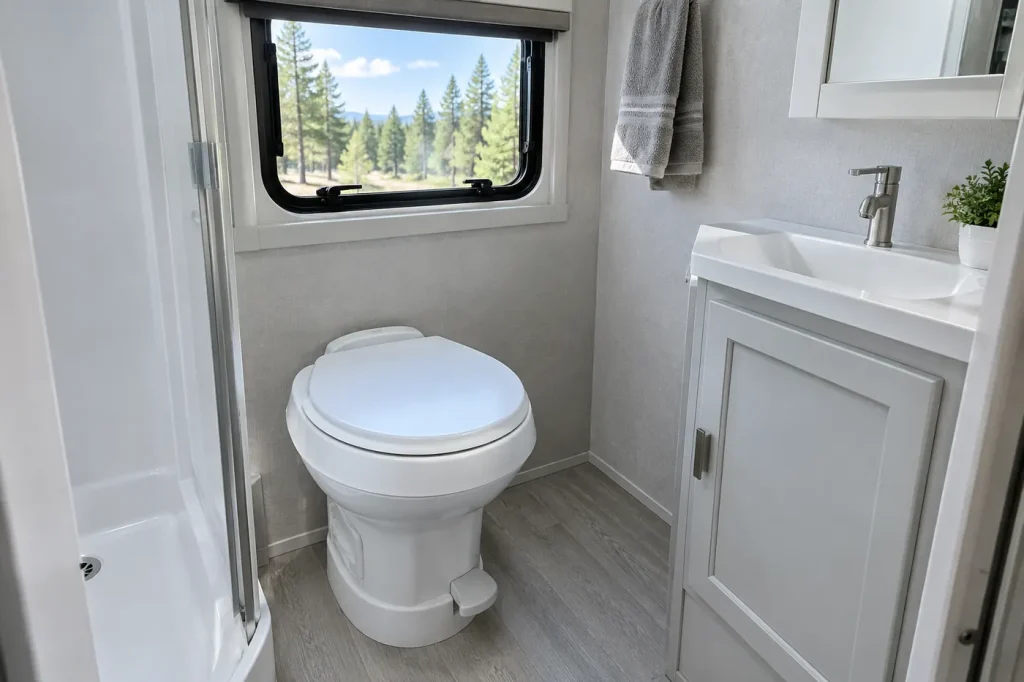
A bowl that won’t hold water, a weak flush, a puddle at the base or a sewer smell are the RV toilet problems we hear about most. The fix is usually a clean seal or a small kit, not a new toilet. This page covers how the toilet and tanks work, which parts fail, Dometic and Thetford specs, and where DIY should stop.
How does an RV toilet work?
Most RV toilets are gravity-flush toilets. The toilet sits on top of the black tank and takes water straight from your RV’s water system.
- Water waits at the valve. Water from the city hookup or pump reaches a valve on the back of the toilet that opens when you press the pedal.
- A half press adds water. On the Dometic 300, 310 and 320 and the Thetford Aqua-Magic V, pressing the pedal part way fills the bowl while the bottom stays closed.
- A full press flushes. Pressing all the way opens the flush ball (Dometic) or blade (Thetford) and rinses waste into the tank.
- A seal holds water in the bowl. When the ball or blade closes against its rubber seal, a little water stays in the bowl and blocks tank odors.
- The tanks hold and vent. The black tank holds toilet waste only; the gray tank takes sink and shower water. Each tank has a roof vent so sewer gas goes outside.
- Sensors read, valves dump. Most tank sensors are metal probes in the tank wall. At the dump station, open the black valve first, then the gray, so the gray water rinses the hose.
Which RV toilet parts fail, and what are the signs?
| Part | What it does | Sign it is failing |
|---|---|---|
| Bowl seal (flush ball or blade seal) | Holds water in the bowl and blocks odor | Bowl drains empty between uses; sewer smell |
| Water valve | Lets water into the bowl | Weak or no flow; water keeps running; drips behind the toilet |
| Vacuum breaker | Keeps toilet water from flowing back into your fresh water lines | Water sprays or drips from the back during a flush |
| Floor flange seal | Seals the toilet to the pipe into the black tank | Wet floor at the base; odor near the floor |
| Tank sensors | Show how full each tank is | Reads full right after you dump |
| Tank vent and dump valves | Let gas out and empty the tanks | Gurgling or smell inside; a stiff dump handle or drips with the valve closed |
What should I check first when my RV toilet stops working?
- Water supply. Open the kitchen tap. If flow is weak there too, the problem is the water supply, not the toilet. If the pump is the cause, see our RV water pump guide.
- Inlet screen. Dometic says a clogged screen at the water valve inlet causes poor flow. Clean it with a cotton swab, but do not take the valve apart.
- Bowl seal. Paper and hard water minerals on the seal are a common reason the bowl won’t hold water. Dometic says to press and release the pedal slowly several times, then clean the ball and the underside of the seal with a soft brush.
- Lubrication. For a stiff pedal, Thetford says to apply a light film of its seal lubricant or silicone spray to the blade or ball, and no other spray lubricant.
- Leak source. Shine a flashlight behind the toilet while someone flushes. Water at the back points to the supply line, water valve or vacuum breaker. Water only at the floor points to the floor flange seal.
- Water in the bowl. Dometic says to keep about 1 inch of water in the bowl so tank odors stay out.
Safety first. Sewer gas from the black tank contains hydrogen sulfide and methane, and breathing it in a closed space can make you sick. Open a window and run the vent fan while you work. Wear rubber gloves and eye protection, and turn off the water before you repair the toilet. Never put automotive antifreeze in the toilet or water lines; both makers call for RV (potable) antifreeze only.
RV toilet specs to know
These numbers come from the makers’ manuals. Your exact model may differ, so check the label and manual on your toilet.
| Spec | Dometic 300, 310, 320 | Thetford Aqua-Magic V |
|---|---|---|
| Water pressure | 30 to 100 psi static (310 and 320) | See your model’s manual |
| Water flow | 3.0 to 5.0 gallons per minute (gpm) recommended; 2.0 gpm minimum (310 and 320) | At least 10 quarts (9.5 liters) per minute |
| Water connection | 1/2 inch NPT (pipe thread) fitting (310 and 320) | 3/8 inch inside diameter supply line with good flow |
| How long to flush | About 1 to 2 seconds for liquids; for solids, until the bowl rinses clean | Hold the pedal fully down; a good flush takes 2 to 3 seconds |
| Water left in the bowl | About 1 inch | See your model’s manual |
| Floor flange | 3 inch inside diameter, 1/4 to 7/16 inch thick (310 and 320) | Flange top 7/16 inch above the floor; Thetford spacers adjust it |
| Mounting nuts | 30 to 40 inch-pounds; do not overtighten (310 and 320) | Tighten until stable; do not overtighten |
| Refill after a flush | 310, 311, 320, 321: trickle for up to 20 minutes is normal; past 30 minutes, replace the water valve | See your model’s manual |
Dometic vs Thetford: how are RV toilets different?
Most US RVs have a Dometic or a Thetford toilet. Dometic’s toilets came from its SeaLand line. The 300, 310 and 320 are ceramic bowls on a plastic base that close with a flush ball. Dometic says not to separate the bowl from the base or remove the pedal, and that the flush ball seal and snap-in water valve can be replaced with the toilet still on the floor.
The Thetford Aqua-Magic V is a lighter plastic toilet common in travel trailers. It comes in high and low profiles, with a pedal or hand lever, and closes with a blade or ball seal.
The checks above apply to both. The difference is parts: seals, water valves, vacuum breakers and flange seals are made for each model, and Thetford asks you to state high or low profile. Write down the model and code from the toilet’s label before you order.
When should you call an RV tech for toilet repair?
- Soft or stained floor. A soft spot around the toilet can mean water has reached the subfloor.
- A black tank that won’t drain. If it stays full with the valve open and a soak hasn’t helped, the valve or pipe may need to come apart.
- A broken dump valve with a full tank. Forcing it can crack the valve or spill waste.
- Freeze damage. Dometic says white stress marks in the water valve’s freeze damage window mean it froze and needs replacing.
- Smell after a new seal. It can mean a cracked tank or blocked vent.
Shops bill by the hour, so doing the cheap checks first means less time on the clock.
Common questions
How do I stop my RV toilet seal from leaking?
Clean it first. Dometic says hard water minerals on the flush ball or seal cause slow leaks, so rinse it by working the pedal, then brush the ball and seal. Dometic also says to reshape a seal by pressing it against the ball with a finger, then letting 1 quart of hot tap water cool in the closed bowl. If it still leaks, replace the seal with the kit for your model.
Are RV toilet seals the same as regular toilet seals?
No. An RV toilet has a bowl seal around the flush ball or blade, which a house toilet doesn’t have, and a floor flange seal made for that model. Match the kit to the model on your toilet’s label.
Why won’t my RV toilet stop running?
On Dometic 310 and 320 toilets, water can trickle into the bowl for up to 20 minutes after a flush, and that is normal. If it is still running after 30 minutes, Dometic says to replace the water valve.
Why is my RV toilet leaking where it meets the floor?
The floor flange seal has likely failed, or the mounting nuts are loose. Thetford says to check the nuts first, then remove the toilet, check that the flange sits 7/16 inch above the floor and fit a new flange seal. If water runs down the back instead, look at the supply line, water valve and vacuum breaker.
My RV black water tank isn’t draining. What can I do to unclog it?
Make sure the valve handle is pulled all the way open and the hose isn’t kinked. We have the best luck closing the valve, filling the tank partway with water, letting it soak, then dumping again. To prevent clogs, Dometic says to flush only water, body waste and rapid-dissolving toilet paper, never wet wipes.
Can I replace my RV toilet with any toilet?
Use an RV toilet that fits your floor: check the distance from the wall to the flange center, the bolt pattern and the height. Dometic needs the flange center at least 10 inches from the back wall for the 310 and 11 inches for the 320. Thetford’s manual shows which older models the Aqua-Magic bolt patterns replace.
How long should an RV toilet seal last?
Neither Dometic nor Thetford publishes a lifespan for its seals. Keep water in the bowl, clean the seal now and then, use only the lubricant the maker names and winterize every fall. A seal that still leaks after cleaning is due for a kit.