RV converter not working: how to test, reset and replace it
Your 12V lights and pump died on shore power, or the battery drains while you are plugged in. Here is how to prove whether the converter has failed, reset it without a button, and replace it if it has.
 By Complete RV Guide team
Updated Oct 25, 2026
8 min read
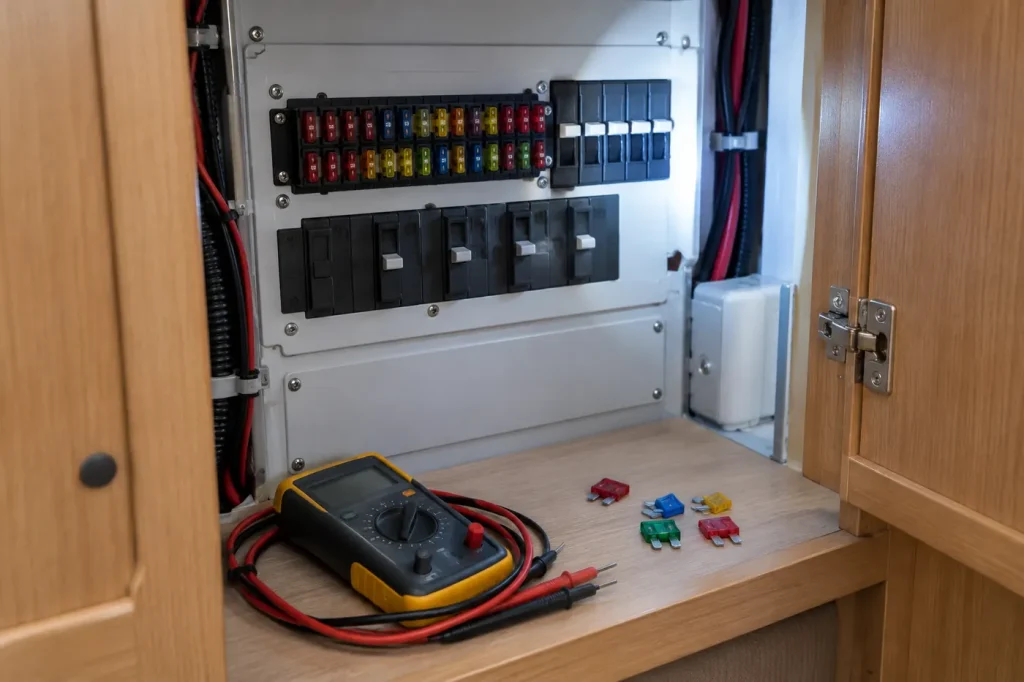
Quick answer
Most converters that seem dead have no 120V coming in, blown reverse battery fuses, or have shut themselves down for heat, overload or high input voltage. Reset the converter's breaker, check its fuses, then unhook the battery cables and read them: about 13.6 volts means the converter works.
- Difficulty
- Moderate
- Time
- 20-90 min
- Parts cost
- Often $0Fuses are cheap, a converter varies by amp rating and model
What you'll need
Tool links go to Amazon. As an Amazon Associate we earn from qualifying purchases, at no extra cost to you.
Common symptoms
- The 12V lights, water pump and furnace fan quit on shore power, while the 120V outlets still work.
- The house battery runs down even though you are plugged in.
- Lights are dim or flicker when the pump or fan starts.
- The converter’s fan, a whirring sound near the power center, has gone quiet.
- A fuse on the converter or power center blows as soon as you replace it.
Quick checks before anything else
- The 120V outlets work, so shore power reaches the RV.
- The 120V breaker that feeds the converter is on. Push it fully off, then on.
- If your converter plugs into an outlet, the plug is pushed all the way in.
- The reverse battery fuses on the converter’s front panel are not blown.
- The vents and fan opening on the converter are not blocked by stored gear.
- The battery disconnect switch is on.
How do you know the converter is bad?
- No AC in A tripped breaker or dead outlet looks just like a dead converter. Rule it out first.
- Blown reverse battery fuses No DC output after someone hooked the battery up backwards, even for a moment.
- Protective shutdown The converter turns itself off for overload, a short, overheating, or input voltage over 132 volts.
- Wiring fault A loose ground, a broken wire or an open inline fuse between the converter and the battery.
- Bad battery A shorted cell drags the output down and makes a good converter look weak.
- Failed converter Zero volts out with good AC in and good fuses. This is the only case where the converter itself is bad.
- Shore power onAC in must be 105 to 132 volts
- Unhook battery cablesAt the battery, so the battery is out of the test
- Meter on the cablesRed probe on positive, black on negative, DC volts
- About 13.6 volts (plus or minus 0.2)?
Yes: the converter works. Look at the battery, the disconnect switch and the 12V fuses instead.
No: check the reverse battery fuses, the inline battery fuse, the wiring and the ground. If all are good and it still reads zero, the converter has failed.
Step-by-step: test and reset an RV converter
The converter is the box that turns 120V shore or generator power into 12V DC for the lights and the battery. When an RV converter is not working, most of the fixes are outside it: power in, fuses and wires out. Work in this order. WFCO says its converters have no serviceable parts inside, so the goal is to prove whether the box itself has failed.
- Find the converter and its label It may be built into the power center with the breakers and fuses, or be a separate box under a bed or in a cabinet. Write down the brand and model from the label for fuse types and any replacement.
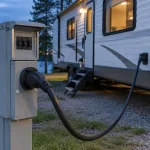
- Confirm 120V power reaches it Make sure the RV outlets work. Find the breaker that feeds the converter and push it fully off, then on. Some converters, like the Progressive Dynamics PD9100 and PD9200 series, plug into a 120V outlet, so check that outlet with a lamp or tester. If nothing on the 120V side works, go to RV has no power when plugged in first.
- Do a power reset Most RV converters have no reset button. WFCO says its units shut down by themselves during an overload or short and return to normal once the problem is gone. Progressive Dynamics says its units can also shut down from overheating or from input over 132 volts. To restart by hand, turn off the converter’s 120V breaker or unplug it, turn off big 12V loads, let a hot unit cool, then power it back up.
- Clear the vents Progressive Dynamics says poor airflow makes its converters cut their output or shut down, and WFCO warns never to cover the vents or mount the unit with zero clearance. Move stored gear away and vacuum dust off the vents with the power off.
-
Check the reverse battery fuses On a WFCO WF-8900 these sit on the front panel of the power center. Both makers say only a battery connected backwards blows them. Check the battery is wired positive to positive, then replace each fuse with the same type and rating shown on the unit. WFCO calls for an ATC Littelfuse Type 257 automotive-style fuse.
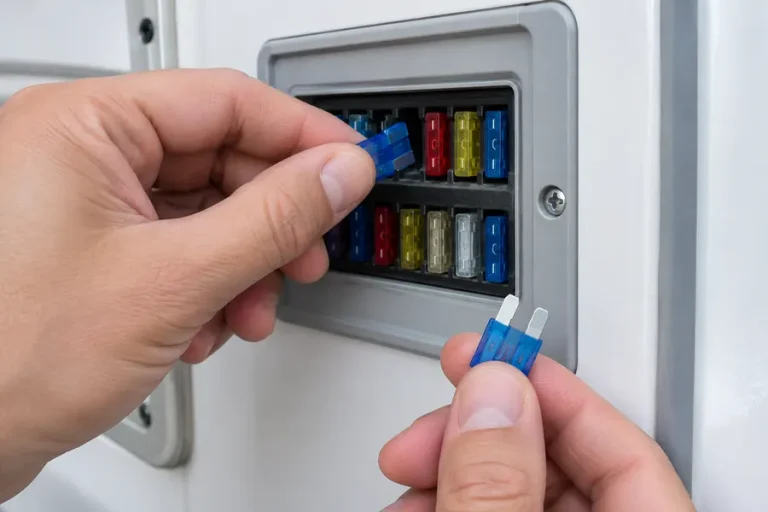
Replace with the same type and rating -
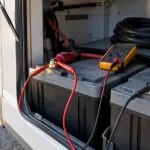
Test the output with the battery unhooked With shore power on, take the cables off the battery and read across them with your meter on DC volts. WFCO says about 13.6 volts, plus or minus 0.2, with no load means the converter works. Taking the battery out of the circuit matters, because a good battery holds the voltage up even when the converter is dead. Put the cables back when you are done.
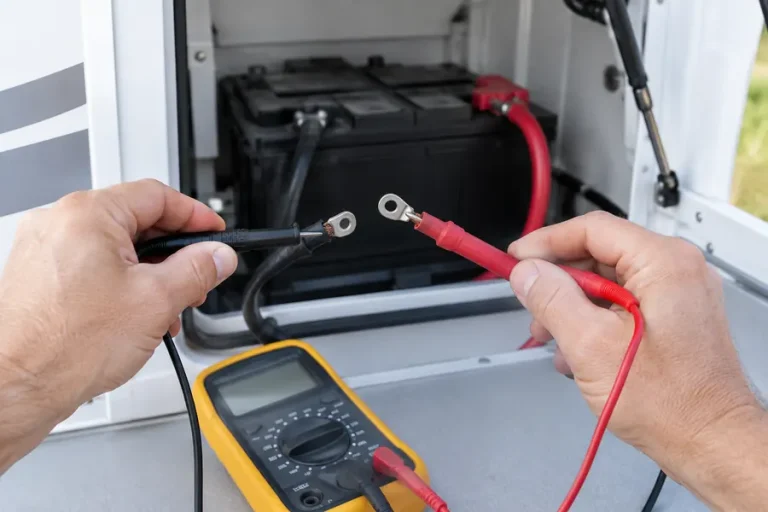
Read the cables with the battery out of the circuit - Chase a zero reading If you get about zero, WFCO says to check for an open inline fuse in the battery wire (if the RV maker installed one), an open wire between the converter and the battery, a loose ground, and connections that are not tight. If the fuses and AC power are good and it still reads zero, WFCO says the converter is not working.
- Check 12V branch fuses If the converter tests fine but one 12V item is dead, look at that circuit’s fuse. The WF-8900 has eleven 12V circuits, fused at 20 amps or less, except circuits 10 and 11, which can take up to 30 amps. Replace a blown fuse with the same rating. If it blows again, Progressive Dynamics says to trace that circuit for a short.
- Look at the battery Progressive Dynamics lists bad battery cells as a cause of low converter output, and WFCO says a converter that keeps cycling between its normal and fast-charge modes may point to a shorted cell. If the converter passes step 6 but the system still sags, see RV battery not charging when plugged in.
- Try shore power if it fails on the generator If the converter works on shore power but drops out on the generator, Progressive Dynamics says some generators send voltage spikes that trip its over-voltage shutdown. Adding another 120V load may smooth them out. If it keeps happening, have the generator checked, and see RV generator running but no power.
Stop. Converters run on 120 volts, and WFCO says installation and service belong to an experienced technician. Turn off shore power, the generator and any inverter before you open a power center panel, and never open the converter case.
How to replace an RV converter
WFCO says its converters have no serviceable parts, so a failed one is replaced. In a WFCO WF-8900 power center the converter is its own section, which WFCO labels the main board assembly. Progressive Dynamics publishes a crossover guide that matches its models to converters from WFCO, Parallax, Iota and Powermax, including some “converter section only” swaps. Match the amp rating and your battery type, lead-acid or lithium.
The Progressive Dynamics PD9100 and PD9200 guide gives this order for a stand-alone unit:
- Mount it where the fan and vents have open air, never in a compartment with batteries or LP gas.
- Run a separate chassis ground wire from the converter’s ground lug to the frame.
- Disconnect both battery cables, then connect the battery negative to the converter’s NEG lug.
- Plug the converter in and confirm its output with a DC voltmeter, then unplug it.
- Connect the battery positive to the POS lug. A small spark is normal. Tighten the DC lugs to 30 to 50 inch-pounds.
- Reconnect any pendant, then plug the converter back in.
If yours is built into the power center with 120V breakers, have a tech do it.
WFCO vs Progressive Dynamics converters
WFCO WF-8900 series. These are three-stage converters built into a power center. They pick a mode on their own: 13.6 volts for normal use, 14.4 volts for up to four hours to charge fast, and 13.2 volts to float in storage. The cooling fan is variable speed and controlled by current, so it runs faster as the load goes up. WFCO gives a two-year limited warranty to the original owner.
Progressive Dynamics. The PD9100 and PD9200 run on 105 to 130 volts AC and may not give full output below 105 volts. The PD9200 has the Charge Wizard built in, with Boost at 14.4, Normal at 13.6 and Storage at 13.2 volts. On the PD9100 it was an add-on, no longer sold since June 2023. A light and button, on a pendant for the PD9200, let you see and pick the mode. Models run from 30 to 80 amps, and two-stage “AL” versions are made for lithium (LiFePO4) batteries. For how the converter fits the whole 12V and 120V system, see our RV electrical problems guide.
When to call an RV tech
- The converter reads zero at the unhooked cables with good fuses and good AC in.
- The converter’s 120V breaker trips again right after you reset it.
- New reverse battery fuses blow even though the battery is wired correctly.
- You smell burning, see scorch marks, or hear loud buzzing from the power center.
- The converter is built into the power center and needs replacing.
Common questions
How can you tell if your RV converter is bad?
Unhook the battery cables, keep shore power on, and read across the cables. WFCO says about 13.6 volts means the converter works. If you read zero with good AC in and good fuses, the converter has failed. A battery that drains on shore power and dim 12V lights are the usual warning signs.
Can I run my RV without a converter?
Yes, for a while. The house battery runs the 12V side, but nothing recharges it from shore power, so the lights, water pump and the fan in our RV furnace guide stop once it runs down. The 120V outlets keep working on shore power.
Does an RV converter have a fuse?
Yes. Most have reverse battery fuses that blow only if the battery was hooked up backwards. The power center also has fuses for each 12V circuit. Replace any fuse with the same type and rating.
Why does my RV converter keep blowing fuses?
If the reverse battery fuses keep blowing, the battery cables are likely crossed somewhere. Both WFCO and Progressive Dynamics say that is the only thing that blows them. If a 12V branch fuse keeps blowing, that circuit has a short or too much load on it, so trace that circuit before you fit a bigger fuse.
Why is my RV converter fan running all the time?
On a WFCO the fan speed follows the current, so it runs more while the converter charges a low battery or carries a big 12V load. That is normal. A fan that never runs while the converter is hot, or a converter that keeps shutting off, points to an airflow or converter problem.
How much does it cost to replace an RV converter?
It depends on the amp rating, and on swapping a stand-alone unit versus a section inside the power center, so we won’t quote a number. Shops bill labor by the hour. Doing the output test yourself first, and bringing the model number, keeps the bill down.