You turn on a hot faucet and get cold water, the heater works on propane but not on electric, or the relief valve keeps dripping. Most RV water heater repair starts with a few simple checks: a full tank, the bypass valves, propane, 12V power and the reset button. This page explains how tank and tankless heaters work, which parts fail, the makers’ specs, and where DIY should stop.
How does an RV water heater work?
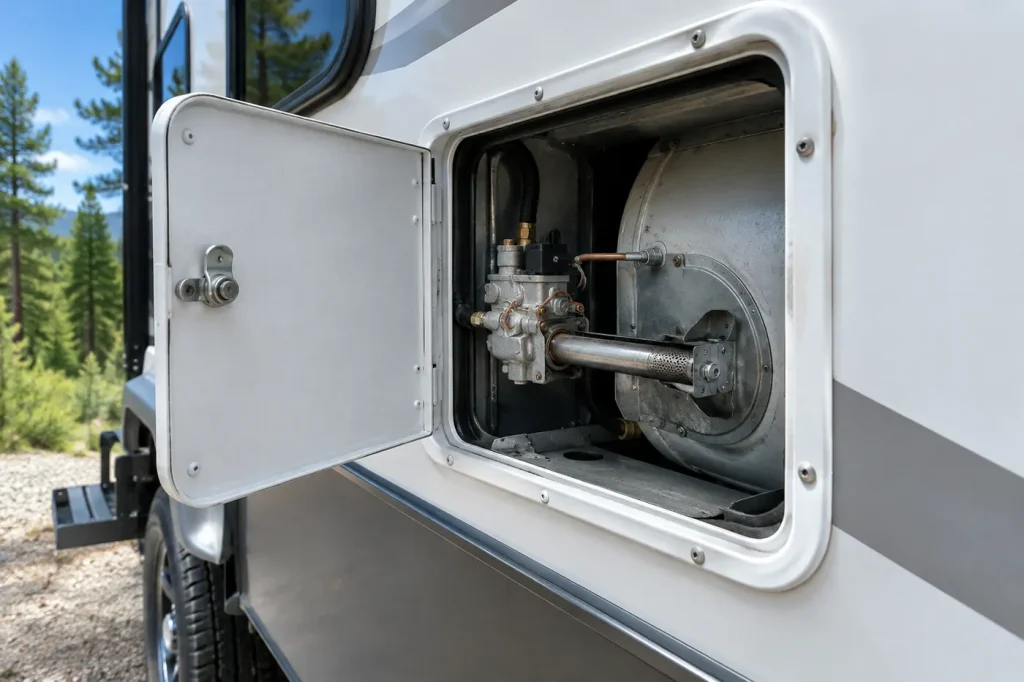
Most RVs have a small tank heater with its controls behind a door on the outside wall. Many heat with propane, 120V electric, or both. Newer RVs often have a tankless heater that burns propane only while hot water flows. Every type needs 12V DC for its controls.
- Water fills the heater. The pump or city hookup fills it. A tank must be full before you turn on any heat.
- You switch it on. The gas side and the electric side each have their own switch.
- The burner lights. On a DSI (direct spark ignition) model, a control board opens the gas valve and sparks an electrode. Suburban purges for 15 seconds before each spark and tries 3 times before it locks out.
- The electric element heats. On models with one, a 120V element inside the tank warms the water.
- The thermostat holds the temperature. Suburban’s SW6D thermostat holds 130°F and is not adjustable.
- Safety limits stand guard. The ECO (energy cut-off) is a high-limit switch that cuts the heat if the water gets too hot. The P&T (pressure and temperature) relief valve lets water out if heat or pressure climbs too high.
- Tankless units fire on flow. A flow sensor starts the burner only when enough hot water moves. Truma’s AquaGo needs about 0.4 gallons per minute (gpm).
Which RV water heater parts fail, and what are the signs?
| Part | What it does | Sign it is failing |
|---|---|---|
| Anode rod (Suburban) | Corrodes so the steel tank does not | Rotten-egg smell, or a rod mostly eaten away |
| Bypass valves | Route water around the heater for winterizing | No hot water at all after storage |
| DSI board, fuse and electrode | Make the spark and watch for flame | No clicking, or clicking with no flame, then a lockout |
| Gas valve | Lets propane reach the burner | Spark but no flame while the stove lights fine |
| Electric element | Heats the water on 120V | Works on gas but never on electric |
| Thermostat and ECO | Hold the temperature and cut heat if it runs too hot | A reset button or lockout that keeps tripping |
| P&T relief valve | Lets out water if pressure or heat gets too high | Constant dripping even after you restore the air pocket |
What should I check first when my RV water heater stops working?
- Full tank. Open a hot faucet. Steady water with no spitting air means the heater is full.
- Bypass valves. If you winterized, set them back so water flows through the heater.
- Propane. Check the tank level and valve, then light a stove burner.
- Power. Check the 12V fuse and the 120V breaker. Dometic boards also have their own 2 amp fuse.
- ECO reset. On a Suburban, push the reset button once the water is below 110°F.
- Burner tube and vent. With the heater off and cool, look for insect nests. Dometic warns they cause poor or delayed lighting.
- Flow on tankless units. Open the hot tap all the way and clean a clogged faucet screen.
Safety first. Never switch on the electric element with an empty tank: Suburban says even a short dry run burns it out. Water at 130°F can scald, so let the heater cool before you pull the relief valve handle. Never plug or remove the relief valve. If you smell propane, close the tank valve, do not touch switches, and get everyone out. Turn off the 120V breaker before touching any wiring.
RV water heater specs to know
These numbers come from the makers’ manuals. Your exact model may differ, so check the rating plate and manual on your heater.
| Spec | Suburban SW6D | Dometic (Atwood) XT | Girard GSWH-2 and Furrion F2GWH | Truma AquaGo |
|---|---|---|---|---|
| Type | Tank with anode rod | 6 or 10 gallon aluminum tank, no anode | Tankless, 42,000 BTU/h | Tankless, 20,000 to 60,000 BTU/h |
| Power | 12V DC; 120V element on E models | 12V DC; 2 amp board fuse, never over 3 amps | 12V DC, under 3 amps | 12V DC; shuts off below 10 or above 16.4 volts |
| Propane pressure | See your model’s manual | 11 in. water column, three appliances running | 11 to 14 in. water column | 10.5 to 14 in. water column |
| Hot water temperature | 130°F, fixed | About 130°F (mixing valve) | 95 to 124°F, factory 115°F | 120°F standard |
| Overheat cutoff | Above 180°F; reset below 110°F | ECO lockout; switch off 30 seconds | 140°F (code E3) | 185°F (code 4) |
| Water pressure limit | P&T opens at 210°F or 150 psi | P&T no higher than 150 psi | 125 psi max | 65 psi max inlet; 100 psi relief valve |
| Tries and reset | 3 tries; switch off 5 seconds, then on | 3 tries, red lamp; switch off, then on | 2 tries; hot faucet off, then on | 3 tries; off 5 seconds, then on |
| Flow needed to fire | None | None | 0.8 gpm per hot faucet | About 0.4 gpm |
Suburban, Atwood and tankless: how are RV water heaters different?
Suburban heaters use a steel tank with an anode rod, a metal rod that corrodes in place of the tank. It is also the drain plug. Suburban recommends a new rod every year, sooner with water high in iron or sulfate. An E in the model, such as SW6DE, means it has an electric element. These tanks show no codes.
Atwood heaters, now Dometic, use an aluminum tank. Dometic says an anode rod in place of the drain plug damages the fitting and voids the warranty, so never buy one for an Atwood. A red lamp tells you the gas side has locked out.
Tankless units from Girard, Furrion and Truma show error codes. Look yours up on our Girard and Furrion code page or the Truma AquaGo blink codes. Parts do not swap between brands, so note the model and serial number from the rating plate before you order.
When should you call an RV tech for water heater repair?
- Gas valve problems. Suburban tells owners not to try to repair the gas valve.
- Board or sensor diagnosis. If propane and 12V are good and it still locks out, testing takes a meter and the wiring diagram.
- Soot or a yellow flame. Suburban says soot means the heater is running unsafely.
- A gas safety code that repeats, such as a false flame signal, after one reset.
- Water leaking from the tank body, which usually means the tank has failed.
Shops bill by the hour, so doing the cheap checks first means less time on the clock.
Common questions
What are the most common RV water heater problems?
The causes we check first are simple: bypass valves left in winter mode, propane off or air in the gas line, a tripped ECO, a blown fuse, and an element burned out by a dry tank. After those come a dripping relief valve, a worn anode rod and insect nests in the burner tube.
How do I reset my RV water heater?
Most reset by cycling the switch. On a Suburban, turn the switch off, wait 5 seconds and turn it on; its red ECO button resets once the water is below 110°F. On a Dometic (Atwood), turn the switch off for at least 30 seconds after an overheat. On a Girard, turn the hot faucet off and on; on a Truma, switch off, wait 5 seconds and switch on.
Why does my RV water heater work on gas but not on electric?
Check shore power, the 120V breaker, the electric switch and the ECO reset. If all of that is good, the element has likely burned out, which most often happens when it was switched on with an empty tank.
Why is my RV water heater igniter not clicking?
The board is not getting 12V power or is not being told to run. Check the switch, the 12V fuse, the battery and the ECO reset. On a Dometic, also check the 2 amp board fuse, make sure voltage is not above 14 volts, and check the thermal cutoff.
Why does my RV water heater keep shutting off?
On a tank heater, the ECO tripped from overheating or the flame went out. On a tankless unit, low flow is the usual cause, so open the tap wider. A Truma also stops below 10 or above 16.4 volts, and a Girard shuts off after 20 minutes of running and shows En.
Can I still use water if the water heater is leaking?
A dripping relief valve is normal, because heated water expands in a closed system. Restore the air pocket: heater off, water supply off, open a hot faucet, pull the relief valve handle until water stops, then let it snap shut. If the tank itself leaks, shut off its gas and power and set the bypass valves; cold water still works.
How long should an RV water heater last?
The makers do not publish a lifespan. Suburban warrants its heaters for two years and the inner tank into the third year, but that is a warranty, not a life rating. The manuals ask you to replace a Suburban anode yearly, drain an Atwood at least once a year, descale a Truma when its panel asks, and drain any heater before freezing weather.