Why your RV water heater relief valve is leaking (and when it’s normal)
Water keeps dripping from the valve on the front of your RV water heater. Some dripping is normal, and the makers say so. Here is how to restore the air pocket, what else causes it, and when the valve needs replacing.
 By Complete RV Guide team
Updated Oct 25, 2026
8 min read
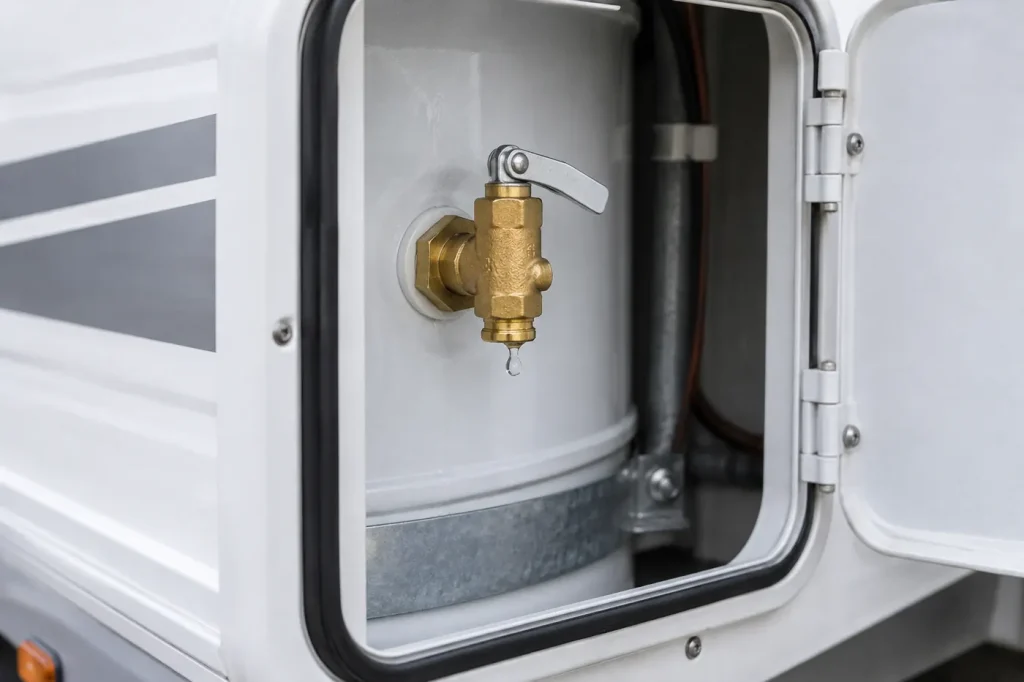
Quick answer
A little dripping while the heater runs is normal: heated water expands in the RV's closed system until the valve opens at 150 psi. On a tank heater, restore the air pocket at the top of the tank: heater off and cool, water off, open a hot faucet, and pull the valve lever until the water stops. If it still drips, check water pressure and debris on the valve seat.
- Difficulty
- Easy
- Time
- 15-45 min
- Parts cost
- Usually $0A new relief valve varies by heater model
What you'll need
- Towel
- Flashlight
- Water pressure gauge
- Bucket
- Gloves
Tool links go to Amazon. As an Amazon Associate we earn from qualifying purchases, at no extra cost to you.
Common symptoms
- Water drips from the brass valve with a lever on the front of the water heater, behind the outside door.
- A puddle or a wet streak forms under the water heater door on the outside wall.
- The valve drips even when the heater is off and the water is cold.
- Your water pump kicks on by itself every so often with no faucet open.
Quick checks before anything else
- The water comes from the relief valve itself, not from a fitting or the tank body.
- Note if it drips only while heating, or all the time.
- If you are on city water, find out what pressure the campground supplies.
- If you have a pressure regulator at the hose, make sure it is in place.
- Think back: has the air pocket been refreshed this season, or since the tank was last drained?
Stop. Never plug, cap or remove the relief valve to stop a leak. Suburban and Dometic both say never to plug it, and Dometic warns of an explosion risk if the outlet is blocked. Let the water cool before you pull the lever, because the discharge is scalding hot.
Why is my RV water heater relief valve dripping?
Some dripping is normal. The P&T (pressure and temperature) relief valve is a safety valve that opens if the water gets too hot or the pressure gets too high. Suburban says its valve opens at 210°F or 150 psi (pounds per square inch). Water expands as it heats, and an RV water system is closed, so the pressure has nowhere to go. Suburban says that during heating it will reach 150 psi, the valve will drip until the pressure falls below that, and this “does not indicate a defective relief valve.” Dometic says the same about its tanks.
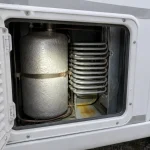
- Air pocket used up Tank heaters keep a pocket of air at the top to absorb expansion. Everyday use slowly dissolves it, and dripping starts.
- Check valve at the heater inlet A one-way valve right at the cold inlet stops expanding water from pushing back. Suburban says it increases weeping.
- Water pressure too high Strong city water, or a pump set high, leaves little room before the valve opens.
- Dirt or scale on the valve seat Debris keeps the valve from sealing, so it drips even when the water is cold.
- Worn valve An old valve that no longer snaps shut needs replacing.
- Overheating Rare, but the valve also opens on temperature. Lots of very hot water means a heat control problem.
- Water heatsIt expands as it warms
- Closed systemClosed faucets and a check valve leave nowhere to go
- Air pocket absorbs itA cushion at the top of the tank, by design
- Pressure reaches 150 psiOnce the air pocket is gone
- Valve opens and dripsUntil pressure falls below 150 psi
- Still dripping after you restore the air pocket?
Yes: check water pressure, a check valve at the inlet, and dirt on the valve seat (steps 4 to 6).
No: repeat the air pocket refresh whenever the dripping comes back.
Step-by-step: stopping a dripping relief valve
We start with the free fix that works most of the time on a tank heater, then look at pressure and the valve itself. Tankless heaters have no air pocket, so skip to step 4 if you have one.
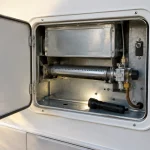
- Find where the water comes from Open the outside door and dry everything with a towel. Watch the relief valve’s outlet, the water fittings and the bottom of the tank. Water from the valve’s outlet is what this guide covers. A leaking tank body is covered in the questions at the end.
- Note when it drips If it drips only while the heater runs and stops once the water is hot, thermal expansion is the cause, and step 3 usually fixes it. If it drips with the heater off and the water cold, expansion is not to blame. Go to steps 4 and 6.
-
Restore the air pocket This is Suburban’s procedure, and Dometic’s matches it. Turn the water heater off and let the water cool. Turn off the cold water supply (the pump or the city water hookup). Open a hot faucet in the RV; Dometic says the one nearest the heater. Pull the relief valve lever straight out and let water flow until it stops. Let the lever snap shut, close the faucet, and turn the water back on. As the tank refills, the air pocket forms again. Repeat this whenever the dripping returns.
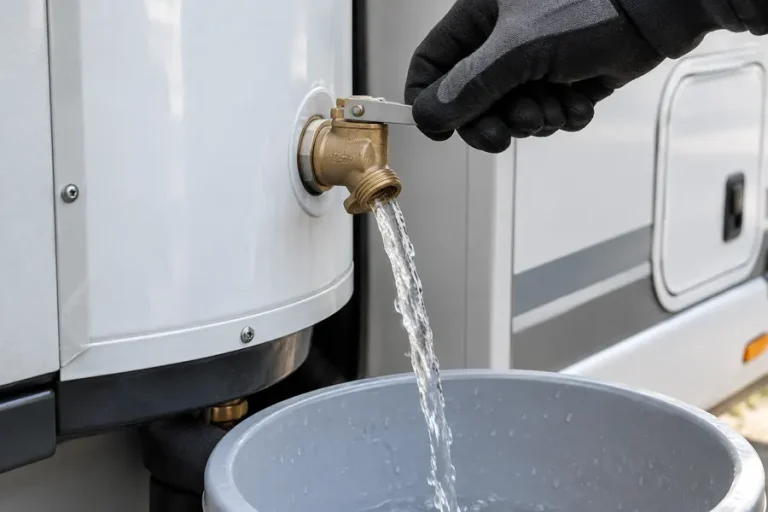
Pull the lever until the water stops, then let it snap shut -
Check your water pressure On city water, a pressure gauge at the spigot tells you what the park supplies. Truma says the water pressure into its AquaGo must be limited to 65 psi and recommends a pressure regulator above that. Girard rates its GSWH-2 for 125 psi at most. If the pump runs on its own with no faucet open, a dripping valve may be the leak; our guide to an RV water pump that keeps running or cycling covers the rest.
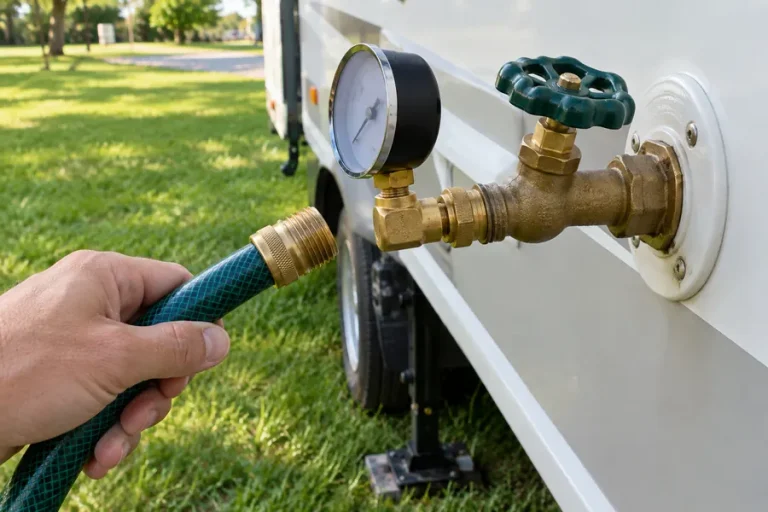
Know your city water pressure before you hook up - Look for a check valve at the heater inlet A check valve is a one-way valve that keeps hot water from flowing back into the cold line. Suburban recommends not installing one directly at the heater’s cold inlet, because it traps expansion and increases weeping. If yours has one there, ask a dealer about moving it or adding expansion control (step 7).
- Flush the valve seat If the valve drips when the water is cold, debris may be holding it open. Truma’s fix: let the heater cool, then slowly raise the test lever to flush dirt off the valve seat. Dometic says hard water with high mineral content shortens the life of the relief valve, which is one more reason to drain and flush the tank as its manual asks.
- Add expansion control for good If it keeps weeping after you restore the air pocket, Suburban suggests an expansion or accumulator tank in the cold line between the heater and the check valve. Dometic gives two permanent fixes: a relief valve in the cold inlet line set to relieve at 100 to 125 psi with a drain line to the outside, or a diaphragm expansion tank sized for about 15 ounces of expansion and pre-charged to your water supply pressure. A dealer or plumber can fit either.
- Rule out overheating The valve also opens on temperature: 210°F on a Suburban. Suburban’s thermostat holds 130°F and its ECO (energy cut-off) trips above 180°F, so very hot water pouring out means the heat controls are failing. Turn the heater off at gas and electric and call a tech. Furrion says a valve that discharges periodically means a problem: turn the heater off and call for service. Girard says the same when the unit overheats often and the valve discharges.
- Replace the valve when it fails Replace it if it drips with cold water at normal pressure after flushing, will not snap shut, or is crusted with corrosion. Dometic says the valve is not serviceable and must be replaced, with a combination temperature and pressure relief valve certified to ANSI Z21.22 and set no higher than 150 psi. Suburban lists part 161157 for its SW6D family. On a Truma, only a Truma 100 psi valve fitted by a Truma certified technician will do.
Relief valve ratings by heater
| Heater | Valve opens at | Owner fix for dripping |
|---|---|---|
| Suburban SW6D family (tank) | 210°F or 150 psi | Restore the air pocket |
| Dometic (Atwood) XT (tank) | Set no higher than 150 psi | Restore the air gap |
| Suburban ST-42 / ST-60 (tankless) | 150 psi | Ask about thermal expansion |
| Truma AquaGo (tankless) | 100 psi valve | Keep inlet at 65 psi or less; flush seat |
| Girard GSWH-2, Furrion F2GWH (tankless) | Not stated in the manual | Call for service if it discharges |
Tank vs tankless heaters
Tank heaters (Suburban, Atwood). These hold 6 to 10 gallons, so expansion is real every time they heat. The air pocket is the built-in cushion. Dometic says to operate the relief valve by hand at least once a year.
Tankless heaters. There is no air pocket to restore. Suburban’s ST manual says periodic discharge may come from thermal expansion in a closed system. Girard says to look at the relief valve monthly for water residue. Truma’s list of causes is the most complete: pressure over 65 psi, water with no room to expand, or lime under the seat. Parts and how they work are in our RV water heater repair guide.
Tools and parts for this fix
Only what this guide uses. For parts, match the part number in your unit's manual before you order.

CARBO 0-200 PSI water pressure gauge
Threads onto the spigot to show the park's water pressure; the red pointer records pressure spikes.
Check price on Amazon
Camco 40058 adjustable pressure regulator
Keeps high campground pressure off the water heater when the gauge reads too high.
Check price on Amazon
As an Amazon Associate we earn from qualifying purchases, at no extra cost to you.
When to call an RV tech
- Very hot water or steam comes from the valve, or it opens every time the heater runs at normal pressure.
- The valve drips when cold after you flush it, and you do not want to replace it yourself.
- You want a check valve moved or an expansion tank added.
- A Girard, Furrion or Truma valve discharges. Truma wants its own technician to replace the valve.
- Water leaks from the tank body or a fitting, not the valve.
Hot water stopped too? Start with RV water heater not working on gas or electric. Not sure where the water under your RV is coming from? Try the RV problem finder.
Common questions
Is it normal for an RV water heater relief valve to drip?
Yes, a little dripping while the heater runs is normal. Suburban says the valve drips until pressure drops below 150 psi and that this does not mean the valve is bad.
How do I stop my RV water heater pressure relief valve from leaking?
Restore the air pocket first: heater off and cool, water supply off, open a hot faucet, pull the lever until the water stops, let it snap shut, then refill. If that does not hold, check water pressure, look for a check valve at the heater inlet, flush the seat, and add an expansion tank. Never plug it.
What causes water to come out of the pressure relief valve?
Heated water expands in a closed system and pushes the pressure up to the valve’s setting. A lost air pocket, high city water pressure, a check valve at the inlet, dirt on the seat, or a worn valve make it worse. Less often, the water is overheating.
Can I still use water if the water heater is leaking?
If only the relief valve drips, yes, and you can keep using the heater while you fix it. If the tank body leaks, turn off its gas and power, set the bypass valves to route water around it, and your cold water still works. A leaking tank usually means the tank has failed.
How often should you test an RV water heater relief valve?
Dometic and Furrion both say to operate the valve by hand at least once a year, and Girard says to check it monthly for signs of leaking. Do it with the water cool. If it will not snap shut afterward, replace it.
How much does it cost to replace an RV water heater relief valve?
The valve itself is a small part, but prices vary by maker and rating, so match the part number for your heater. A shop bills labor by the hour. Try the free air pocket fix first.
Sources
- Suburban SW6D, SW6DE, SW6DM, SW6DEM Installation and Operation Manual (Oliver Travel Trailers copy)
- Suburban ST-42 / ST-60 On Demand Water Heater Operation Manual (Forest River copy)
- Dometic (Atwood) XT 6 and 10 Gallon Water Heater Operation Manual (Forest River copy)
- Girard GSWH-2 Tankless Water Heater Owner's Manual (Forest River copy)
- Furrion F2GWH Tankless Water Heater User Manual (Forest River copy)
- Truma AquaGo Operating and Installation Instructions (Forest River copy)