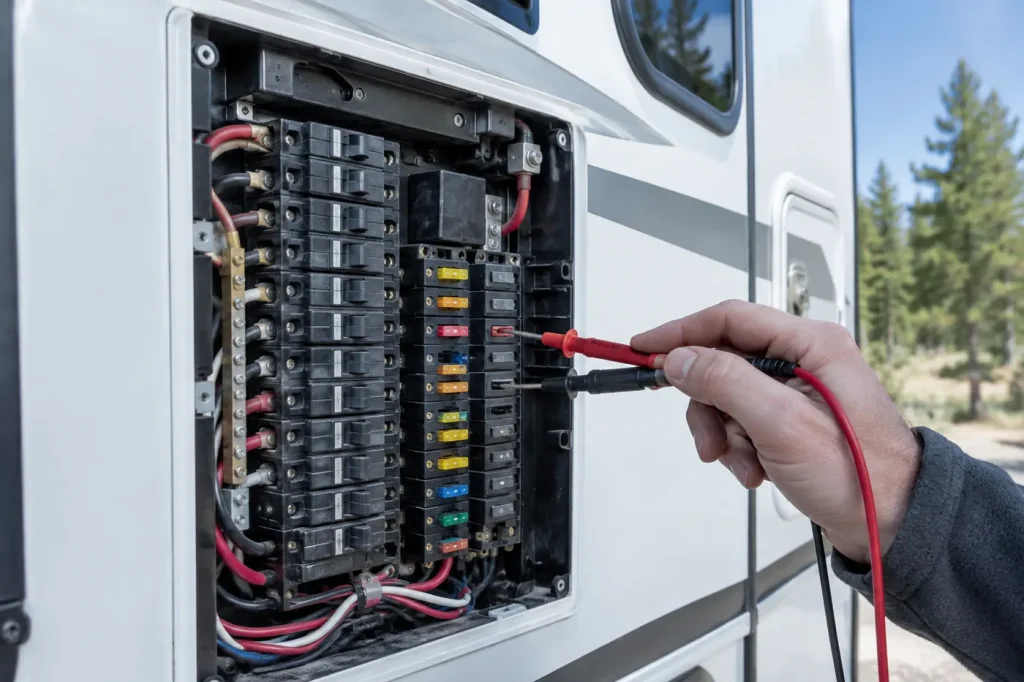
Lights that won’t come on, dead outlets, or a battery that drains while you’re plugged in are the most common RV electrical problems. Many trace back to a tripped breaker, a blown fuse, a surge protector holding power off, or a switch someone forgot. This page explains how your RV’s two power systems work, which parts fail, the key specs, and where DIY should stop.
How does an RV electrical system work?
Your RV has two separate systems. The 120 volt AC side works like house power and runs the outlets, air conditioner and microwave. The 12 volt DC side runs off the house batteries and powers lights, the water pump and the furnace fan. When one side fails and the other works, that tells you where to look; our RV problem finder helps narrow it.
- Power comes in. You plug into shore power (the campground pedestal) or start the generator. A 30 amp RV gets one 120 volt line. A 50 amp RV gets two 120 volt lines, with 240 volts between them.
- The surge protector checks it. An EMS (electrical management system) holds power off when voltage is too high or low, or the wiring is faulty.
- The transfer switch picks a source. It chooses shore or generator power and sends it to the breaker panel.
- The breaker panel splits it up. Breakers feed each 120 volt circuit. Outlets near water have GFCI (ground fault circuit interrupter) protection, which cuts power when current leaks to ground.
- The converter feeds the 12 volt side. It turns 120 volts AC into about 13.6 volts DC, runs your 12 volt items and charges the batteries while you’re plugged in.
- The batteries take over off-grid. Unplugged, the batteries run the 12 volt side alone. An inverter, if you have one, turns battery power back into 120 volts for some outlets.
Which RV electrical parts fail, and what are the signs?
| Part | What it does | Sign it is failing |
|---|---|---|
| Shore cord and plug | Carries 120 volts from the pedestal | Burnt or loose prongs; power cuts out when the cord moves |
| Surge protector or EMS | Blocks bad power and absorbs spikes | RV stays dark with an error code or red light |
| Transfer switch | Chooses shore or generator power | Works on one source but not the other |
| GFCI outlet | Cuts power when current leaks to ground | Outlets in several rooms dead at once; trips again after reset |
| Converter | Makes 12 volts and charges batteries | Battery runs down while plugged in; dim lights |
| House batteries | Store 12 volt power | Lights fade overnight; swollen case or corroded terminals |
| 12 volt fuses | Protect each 12 volt circuit | One 12 volt item dead while the rest work |
What should I check first when my RV has no power?
- Pedestal and surge protector. Reset the pedestal breaker, then read your surge protector’s lights or code. Many wait before passing power (128 seconds on a Surge Guard, 15 or 136 seconds on a Progressive EMS), so a short dark spell is normal.
- GFCI outlets. Reset every GFCI. One tripped GFCI can kill outlets in other rooms.
- Breakers. A tripped breaker sits in the middle. Push it fully off, then on.
- 12 volt fuses. Look at the metal strip in the fuse for a dead circuit. If it is broken, replace it with the same amp rating.
- Battery disconnect switch. On some RVs it shuts off the 12 volt lights even on shore power.
- Converter output. With shore power on, a charging converter holds the battery near 13.2 to 14.4 volts. If the meter shows the same as when unplugged, it isn’t charging.
Safety first. 120 volt power can kill. Unplug shore power and shut off the generator and inverter before you open the panel or touch 120 volt wiring. Batteries give off hydrogen gas while charging, so wear eye protection, keep sparks away, and take off rings before working on terminals.
RV electrical specs to know
These numbers come from the makers’ manuals. Your exact model may differ, so check the label and manual on your unit.
| Converter spec | WFCO WF-8900 series | Progressive Dynamics with Charge Wizard |
|---|---|---|
| Normal mode | 13.6 V (absorption) | 13.6 V (Normal) |
| Fast charge | 14.4 V (bulk), 4 hours at most | 14.4 V (Boost) |
| Storage charge | 13.2 V (float) | 13.2 V (Storage) |
| Equalize | See your model’s manual | 14.4 V for 15 minutes every 21 hours |
| Output test | 13.6 V, plus or minus 0.2, at the unhooked battery cables, 105 to 132 V AC in | See your model’s manual |
| Surge protector spec | Progressive Industries EMS-HW30C / HW50C | Southwire Surge Guard 35530 / 35550 |
|---|---|---|
| Low voltage cutoff | Below 104 V | Below 102 V for 8 to 14 seconds |
| High voltage cutoff | Above 132 V | Above 132 V for 8 to 14 seconds |
| Delay before power returns | 136 or 15 seconds (factory set to 15) | 128 seconds |
| Surge rating | 1,790 J (30 amp), 3,580 J (50 amp) | 2,450 J (30 amp), 3,850 J (50 amp) |
| Fault display | E 1 reverse polarity, E 2 open ground, E 3 / E 5 high volts, E 4 / E 6 low volts | Red line light for bad voltage, flashing caution light for wiring faults |
Which brands are in RV electrical systems, and how do they differ?
Converters. WFCO converters and Progressive Dynamics converters with the Charge Wizard pick their charge stage on their own and use the same three voltages. WFCO gives a simple output test and says its units have no serviceable parts. Progressive Dynamics adds a light and button that show the mode and let you pick it by hand, and sells 2-stage models for lithium (LiFePO4) batteries.
Surge protectors. Progressive Industries and Southwire Surge Guard both cut power at bad voltage and add a delay before it returns, which protects the air conditioner compressor. Progressive shows numbered codes, plus a “PE” code for what last cut the power; Surge Guard uses colored lights. When the surge part is used up, Progressive shows E 10 and Surge Guard lights its SURGE light, and each maker says to replace that part or the unit.
30 amp vs 50 amp. A 30 amp cord carries one 120 volt line. A 50 amp cord carries two, and Southwire says to expect about 115 to 120 volts on each and 240 volts between them. Progressive Industries recommends 10 gauge extension cords for 30 amp and 6 gauge for 50 amp, no longer than 20 to 25 feet, and says never to plug its EMS into an inverter.
When should you call an RV tech for electrical repair?
- Heat damage. A burning smell, scorch marks, or a melted plug. Progressive Industries says not to use a pedestal outlet that shows charring.
- A breaker or GFCI that trips again right away with everything unplugged.
- A tingle from the RV’s metal, or a surge protector reporting open ground or voltage on ground.
- A converter that reads zero with good fuses and AC power. WFCO says that unit is not working.
- Any work inside the converter, transfer switch, inverter or 120 volt panel.
Shops bill by the hour, so doing the cheap checks first means less time on the clock.
Common questions
Can I run my RV without a converter?
Yes, for a while. The 12 volt side runs from the house batteries, but nothing recharges them from shore power, so lights, water pump and furnace fan stop once the batteries run down. The 120 volt outlets still work on shore power.
How do I tell if my RV converter is bad?
Signs are a battery that drains while plugged in, dim lights, or a dead 12 volt side on shore power. To test a WFCO, unhook the battery cables, keep shore power on, and read the cables with a meter. About 13.6 volts means it works; zero means check its fuses, wiring and ground. WFCO adds that a converter cycling between modes may point to a shorted battery cell.
Does an RV converter have a fuse?
Yes. WFCO WF-8900 power centers have reverse battery protection fuses on the front panel. They blow if the battery was ever hooked up backwards, even for a second. Fix the connection, then replace them with the same type and rating.
How do I reset my RV converter?
Most converters have no reset button. WFCO units shut down by themselves during an overload or short and come back once it clears. To restart one by hand, turn off its 120 volt breaker, wait a minute, turn it back on, then check its fuses.
How much does it cost to replace an RV converter?
It varies by brand, amp rating and whether it is built into the power center, so we won’t quote a number. WFCO says its units have no serviceable parts, so a failed one is replaced. Labor is hourly, so note the model number before you ask for a quote.
What kills RV batteries, and how long do they last?
Battery makers don’t give one lifespan, because care changes it so much. Trojan names the main killers: sitting partly charged, which builds sulfate on the plates; letting water drop below the plates in flooded batteries; and constant overcharging. A 13.2 volt storage mode lets you stay plugged in without overcharging.
How do I reset my RV inverter?
Turn it off with its switch or remote panel, fix what made it shut down, and turn it back on. Inverters usually shut off to protect themselves from low battery voltage, overload or heat, so charge the batteries and cut the load first. Fault code steps differ by brand, so check your manual.