RV battery not charging when plugged in to shore power
You have been on shore power all day and the house battery is still low. Here is how to find the break between the pedestal and the battery, from the disconnect switch to the converter test.
 By Complete RV Guide team
Updated Oct 25, 2026
8 min read
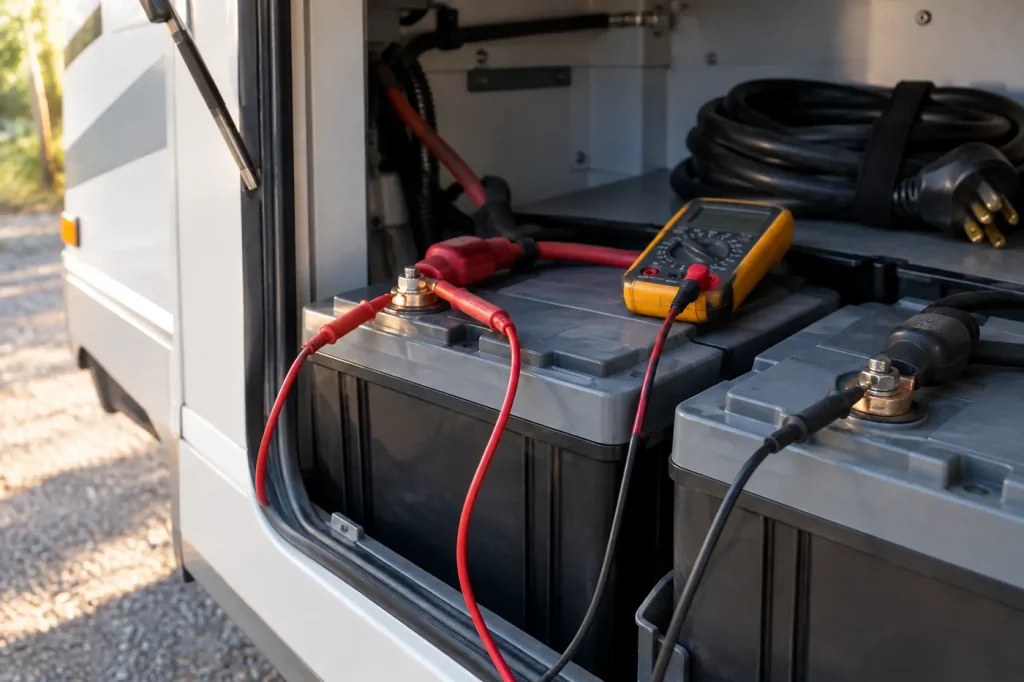
Quick answer
Most often the battery disconnect switch is off, the converter's 120V breaker has tripped, or a fuse or loose cable sits between the converter and the battery. Read the battery voltage unplugged and plugged in: if it does not rise, unhook the battery cables and check for about 13.6 volts from the converter.
- Difficulty
- Easy
- Time
- 15-60 min
- Parts cost
- Usually $0Fuses are cheap, a converter or battery varies by model
What you'll need
- Multimeter
- Terminal brush
- Wrench set
- Spare fuses
- Distilled water
- Hydrometer
Tool links go to Amazon. As an Amazon Associate we earn from qualifying purchases, at no extra cost to you.
Common symptoms
- The RV has been on shore power all night, and the house battery still reads the same as when it was unplugged.
- Lights are bright while you are plugged in, then fade fast as soon as you unplug.
- The battery monitor panel shows the battery low even though the pedestal is on.
- You put in new lithium batteries and they never seem to reach full.
Quick checks before anything else
- The battery disconnect switch is on.
- 120V outlets in the RV work, so shore power is really reaching the coach.
- The 120V breaker that feeds the converter is on. Push it fully off, then on.
- Battery cables are tight and free of white or green corrosion.
- Battery voltage, read before and after plugging in, goes up when you plug in.
- Flooded batteries have water above the plates.
What causes it?
- Battery disconnect switch off On many RVs the switch sits between the battery and the converter, so the converter runs the lights but cannot reach the battery.
- No 120V to the converter A tripped breaker, a dead outlet the converter plugs into, or a surge protector still holding power off.
- Blown fuse or loose wire on the battery side Reverse battery fuses on the converter, an inline fuse in the battery wire, a loose ground, or a corroded terminal.
- Failed converter It puts out zero volts with good AC in and good fuses.
- Worn out battery A shorted cell or a sulfated battery will not take or hold a charge, even from a healthy converter.
- Charger and battery mismatch A lead-acid converter on lithium batteries charges slowly or not fully.
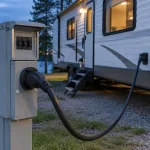
- Pedestal and cordPedestal breaker on, cord seated
- Surge protector or EMSWaits 15 or 136 s (Progressive) or 128 s (Surge Guard)
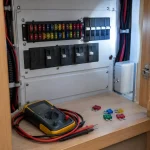
- Breaker panelA 120V breaker feeds the converter
- ConverterNeeds about 105 to 132 V AC in; puts out 13.2, 13.6 or 14.4 V DC
- Fuses, disconnect, cablesReverse battery fuses, inline fuse, battery switch
- Battery voltage rises when you plug in?
Yes: the converter is charging. If the battery still runs down fast, test the battery itself.
No: work back up the chain. Test the converter output with the battery cables off (step 6).
Step-by-step: find why the battery won’t charge on shore power
When your RV battery is not charging when plugged in, the fault sits between the pedestal and the battery posts. We start with switches and quick readings, then test the converter, then the battery. You need a multimeter set to DC volts.
-
Take a resting battery reading Unplug, turn off 12V loads, and put the meter on the battery posts. Trojan Battery says to let a battery rest at least one hour after charging for an accurate reading. A fully charged 12V lead-acid battery at rest reads about 12.6 volts or a little more. Write the number down. You will compare against it.
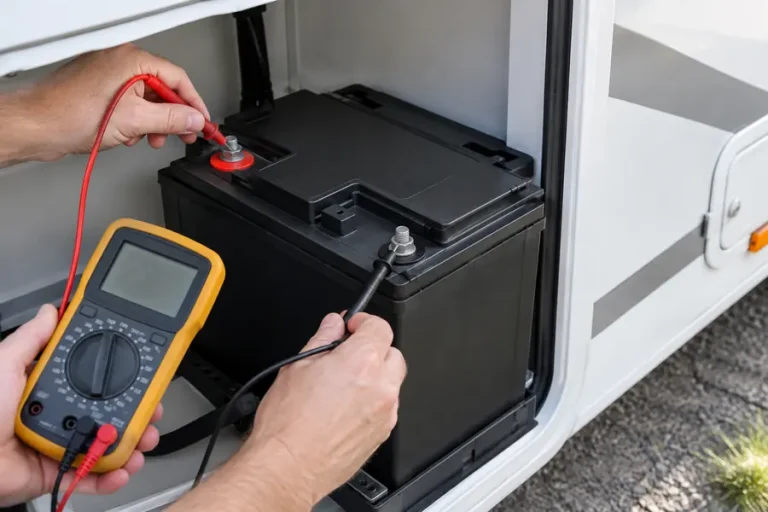
Read the battery at rest, then again plugged in - Plug in and read again Plug in, wait for the surge protector delay to end, and read again. A charging battery reads higher than the resting number. A full battery on a WFCO or Progressive Dynamics converter sits near one of the converter’s mode voltages: 13.2, 13.6 or 14.4 volts. If the reading does not move at all, the charge is not reaching the battery, so go on to step 3.
- Turn on the battery disconnect Find the battery disconnect switch. It may be a rocker switch by the door, a knob near the battery or a switch in a storage bay. On many RVs it cuts the battery off from the converter, so the lights work on shore power but the battery gets nothing. Wiring varies, so test it: switch it on, then repeat step 2.
- Prove the converter has 120V Check that the RV outlets work. Then find the converter’s breaker in the 120V panel and push it fully off, then on. Some converters plug into a 120V outlet behind a panel, so check that the plug is seated. If no 120V outlet works anywhere, the problem is upstream: see RV has no power when plugged in.
- Check the reverse battery fuses WFCO WF-8900 power centers have reverse battery protection fuses on the front panel. Progressive Dynamics converters have them too. Both makers say a battery hooked up backwards, even for a second, is what blows them. Look for a broken strip or use a continuity tester. Make sure the battery is wired positive to positive, then replace each fuse with the same type and rating.
- Test the converter output This is WFCO’s own test, and it works on most converters. With shore power on, disconnect the cables at the battery. Put the red probe on the red (positive) cable and the black probe on the black (negative) cable. WFCO says a reading of 13.6 volts, plus or minus 0.2, with no load means the converter works, as long as the AC going in is 105 to 132 volts. Reconnect the cables when you are done.
- If the test reads zero, check the wiring WFCO lists four things to check when the output at the battery reads about 0.0 volts: an open inline fuse in the battery wire (if the RV maker put one in), a broken wire between the converter and the battery, a loose ground, and connections that are not tight enough. If the fuses and AC power are good and the converter still reads zero, WFCO says the converter is not working. Our guide to an RV converter not working covers testing and replacing it.
-
Clean and tighten the battery terminals Corrosion and loose terminals block charging even when the converter is fine. Turn off shore power, take the negative cable off first, clean the posts and cable ends, then refit the negative cable last and tighten both.
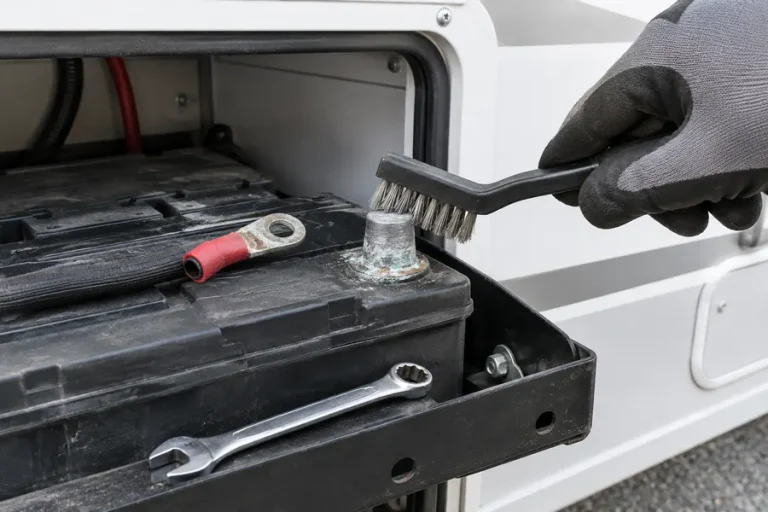
Clean posts and cable ends, then tighten - Check water in flooded batteries WFCO says to check the fluid level in any battery on the RV charging system every month. Trojan says plates left above the fluid can be damaged for good, and to add only distilled water, best done after charging.
- Test the battery itself If the converter passes step 6 and the cables are good, the battery is next. WFCO notes that a converter that keeps cycling between its normal and fast-charge modes can point to a shorted battery cell. With a hydrometer, Trojan says a reading of 1.277 or more means full charge for most of its batteries. A battery that will not reach full, or drops fast once unplugged, needs a load test at a battery or RV shop.
Stop. Batteries give off hydrogen gas while they charge. Wear eye protection, take off rings and watches, keep sparks and flames away, and turn off shore power before you take cables off. Do not charge a battery that is swollen or hot to the touch. Have it replaced.
WFCO vs Progressive Dynamics: what changes
Both brands use the same three charge voltages. They differ in how much you can see and control.
WFCO WF-8900 series. The converter picks its mode by itself from the RV system voltage. Absorption, its normal mode, is about 13.6 volts. Bulk, its fast-charge mode, is about 14.4 volts for no more than four hours. Float, its storage trickle, is 13.2 volts, and turning on a light sends it back to normal mode. There is no light that shows the mode, and WFCO says the unit has no serviceable parts.
Progressive Dynamics with the Charge Wizard. The Charge Wizard is PD’s four-stage control. It uses Boost at 14.4 volts to bring the battery to about 90%, Normal at 13.6 volts, Storage at 13.2 volts, and Equalize at 14.4 volts for 15 minutes every 21 hours. A light and button, on the converter’s fuse board or on a plug-in pendant depending on the model, show the mode and let you force Boost by hand. In PD’s own test, a 55 amp converter brought a drained 125 amp-hour battery to 90% in about 3 hours at 14.4 volts, but needed 40 hours at 13.6 volts. So a battery sitting at 13.6 volts is charging, just slowly. PD9100 series units without the optional Wizard hold a steady 13.6 volts.
Lithium batteries. The voltages above are for lead-acid and AGM batteries. Progressive Dynamics sells separate two-stage models for lithium (LiFePO4) batteries and warns not to use those on lead-acid. If you switched to lithium, match the converter to what the battery maker asks for. For both 12V and 120V power, see our RV electrical problems guide.
Tools and parts for this fix
Only what this guide uses. For parts, match the part number in your unit's manual before you order.

Reads battery voltage unplugged and plugged in, then checks for about 13.6 volts from the converter.
Check price on Amazon
Steelman battery post terminal cleaner
Scrubs white or green corrosion off the battery posts and cable clamps before you retighten them.
Check price on Amazon
EZRED SP101 battery hydrometer
Checks each flooded cell's specific gravity when you test the battery itself for a weak cell.
Check price on Amazon
As an Amazon Associate we earn from qualifying purchases, at no extra cost to you.
When to call an RV tech
- The converter reads zero at the unhooked cables with good fuses and good AC in.
- New reverse battery fuses blow again right away with the battery hooked up correctly.
- The converter’s 120V breaker trips again as soon as you reset it.
- Wires, fuses or terminals show heat damage, melting or a burnt smell.
- You would need to open the converter or power center, or work inside the 120V panel.
- A battery is swollen or hot, or keeps boiling off water on shore power.
Common questions
Does an RV battery charge when the RV is plugged in?
Yes, on almost every RV with a built-in converter. The converter turns 120V shore power into about 13.2 to 14.4 volts DC, runs the 12V items and charges the house battery at the same time. On many RVs the battery disconnect switch has to be on for that charge to reach the battery.
Why are my RV house batteries not charging when I plug them in?
The usual causes are a battery disconnect switch left off, a tripped converter breaker, blown reverse battery fuses, or loose and corroded cables. If those are fine, test the converter output with the battery cables off. About 13.6 volts there points to the battery.
How do I know if my RV converter is charging my battery?
Read the battery with a meter unplugged, then plugged in. If the reading goes up when you plug in, the converter is charging. If it stays the same, the charge is not reaching the battery, and WFCO’s unhooked-cable test (step 6) tells you whether the converter or the wiring is at fault.
Does the RV battery charge when the disconnect switch is off?
On many RVs it does not, because the switch cuts the battery off from the converter. Wiring varies, so plug in with the switch off and watch the battery voltage. If it does not rise, turn the switch on to charge.
Why isn’t my RV battery charging when I run the generator?
The generator only makes 120V power, and the same converter charges the battery, so the checks above apply, plus the generator’s breaker and the transfer switch. Progressive Dynamics adds that voltage spikes from some generators make its converters shut down, and that adding another load can help. Our guide to an RV generator running but no power covers that side.
How long will an RV battery last without being plugged in?
It depends on the battery’s size and what is drawing power, so no maker gives one number. Lights, the water pump and the furnace fan all pull from it. Trojan warns that storing a battery discharged builds sulfate on the plates, so recharge it soon, or keep it on a 13.2 volt storage mode while parked.
Sources
- WFCO WF-8900 Series Operator Manual (OEM-hosted copy, Gulf Stream Coach)
- Progressive Dynamics Charge Wizard
- Progressive Dynamics PD9100 / PD9200 Series Installation and Operation Guide
- Progressive Dynamics Wizard or Pendant Operation
- Progressive Industries EMS-HW30C / HW50C Instruction Manual (dealer-hosted copy)
- Southwire Surge Guard 35530 / 35550 Installation and Operating Instructions (OEM-hosted copy, Newmar)
- Trojan Battery FAQs