RV has no power when plugged in
You plugged in at the campground and the RV stayed dark, or only the lights or only the outlets work. Here is how to find the break, from the pedestal and surge protector codes to the GFCI and the 12V side.
 By Complete RV Guide team
Updated Oct 26, 2026
8 min read
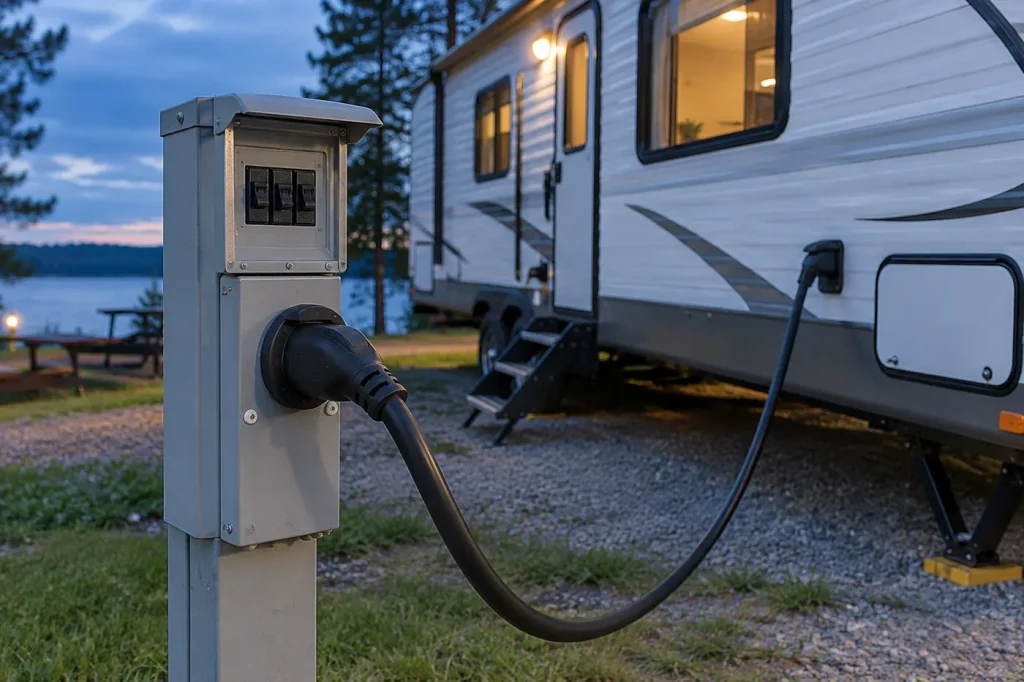
Quick answer
Most often the pedestal breaker is off, the surge protector is still in its start-up delay (up to 136 seconds) or has blocked bad power, or a breaker or GFCI has tripped. If the lights work but outlets don't, the 120V side is out; if outlets work but lights don't, check the battery, disconnect switch and converter.
- Difficulty
- Easy
- Time
- 10-45 min
- Parts cost
- Usually $0A surge protector part or transfer switch varies by model
What you'll need
Tool links go to Amazon. As an Amazon Associate we earn from qualifying purchases, at no extra cost to you.
Common symptoms
- You plug in at the campground and nothing in the RV comes on.
- The lights work, but none of the 120V outlets, the microwave or the air conditioner do.
- The outlets work, but the lights, water pump and furnace fan are dead.
- Outlets in the kitchen, bathroom and outside are dead while the rest of the RV has power.
- Your surge protector shows an error code or a red or flashing light.
Quick checks before anything else
- The pedestal breaker is on. Push it fully off, then on.
- The cord is pushed all the way into the pedestal and the RV inlet, with no loose adapters.
- Your surge protector has finished its start-up delay (up to 136 seconds).
- No error code or red light shows on the surge protector or EMS.
- The generator is off, so the transfer switch can pick shore power.
- The main breaker in the RV panel is on, and no GFCI outlet is tripped.
What causes it?
- Pedestal or cord problem A tripped pedestal breaker, a dead outlet, a loose adapter or a damaged plug. Nothing works anywhere.
- Surge protector holding power off It is still counting down, or it found low or high voltage or bad wiring at the pedestal.
- Transfer switch The generator is running, or the switch has dirty contacts or has failed, so shore power never reaches the panel.
- Tripped breaker or GFCI Some outlets or appliances dead, the rest fine.
- 12V side down Outlets work but lights do not: the battery, the disconnect switch, the converter or a fuse.
- PedestalAbout 120 V from each hot to neutral, 0 V from neutral to ground
- Surge protector or EMSWaits 128 s (Surge Guard) or 15 or 136 s (Progressive EMS)
- Transfer switchPasses shore power when the generator is off
- Main and branch breakersFeed each 120V circuit
- GFCI outletsOne GFCI can protect outlets in several rooms
- Only some outlets dead?
Yes: look for a tripped GFCI or branch breaker first.
No, everything is dead: work from the pedestal down, one box at a time.
Step-by-step: get power back when your RV is plugged in
When your RV has no power when plugged in, first sort out which side is dead. The 120V side runs the outlets, microwave and air conditioner. The 12V side runs off the house battery and powers the lights, water pump and furnace fan. Then work from the pedestal inward.
- Decide which side is out Try a 120V outlet and a ceiling light. Lights on but outlets dead means a 120V problem, so carry on with step 2. Outlets on but lights dead means a 12V problem, so skip to step 10. Everything dead means a 120V problem plus a low battery, so start at step 2.
- Reset the pedestal breaker Turn the breaker off, unplug, look at the plug and outlet, then plug in and turn it on. Progressive Industries says never to use a pedestal outlet with charring, because a weak connection there can melt your plug. If you use an adapter, such as 50 amp to 30 amp, make sure it is seated at both ends.
- Wait out the surge protector delay A surge protector or EMS (electrical management system) holds power off at first to protect the AC compressor. A Southwire Surge Guard flashes its caution light for 128 seconds. A Progressive Industries EMS flashes its delay light for 15 seconds as shipped, or 136 seconds if set that way. A dark RV during that wait is normal.
- Read the code or lights If the delay ends and power still does not come on, the surge protector found a problem. On a Progressive EMS, read the E code on the display. On a Surge Guard, look at the line lights and the caution light. The table below lists what each one means. Southwire recommends not bypassing its unit, because it may be saving your appliances from bad power.
- Measure the pedestal If you have a meter that reads AC volts up to 250 and know how to use it safely, check the pedestal outlet. Southwire says each hot to neutral should read between 102 and 132 volts, and neutral to ground should read 0 volts. It adds that 2 to 3 volts from neutral to ground is not unusual, but more than that makes its caution light flash. Bad readings mean the park’s power is at fault, so try another pedestal and tell the office.
- Turn off the generator The transfer switch picks shore or generator power. In the Progressive Dynamics transfer switch guides, the generator always wins, and shore power does not come through while generator power is present. Shut the generator off, then check whether shore power comes on. For the opposite problem, see RV generator running but no power.
-
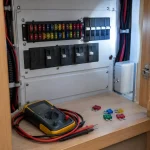
Reset the main breaker A tripped breaker in the RV panel sits in the middle, between on and off. Push the main breaker and each branch breaker fully off, then on. If the main trips again right away with loads off, stop and call a tech.
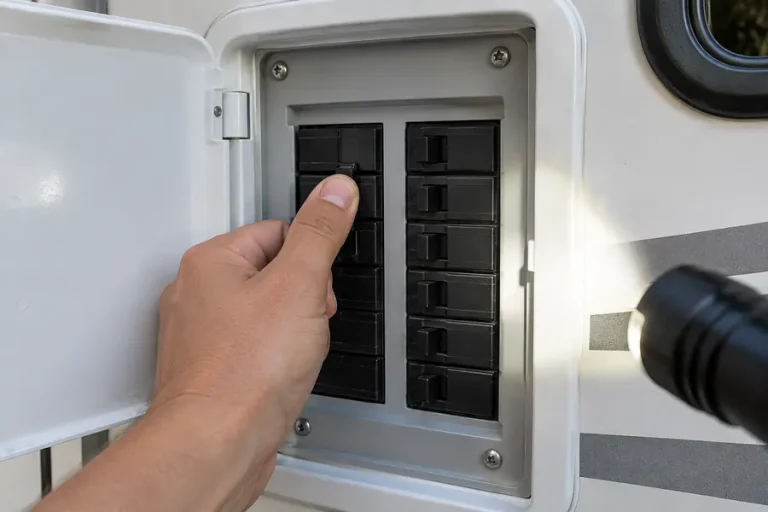
Push a tripped breaker fully off, then on -
Reset every GFCI outlet A GFCI (ground fault circuit interrupter) outlet has Test and Reset buttons and cuts power when current leaks to ground. One tripped GFCI can kill outlets in other rooms, often the bathroom, kitchen and outside outlets. Press Reset on every GFCI you can find. Check this first when some outlets are dead but no breaker is tripped.
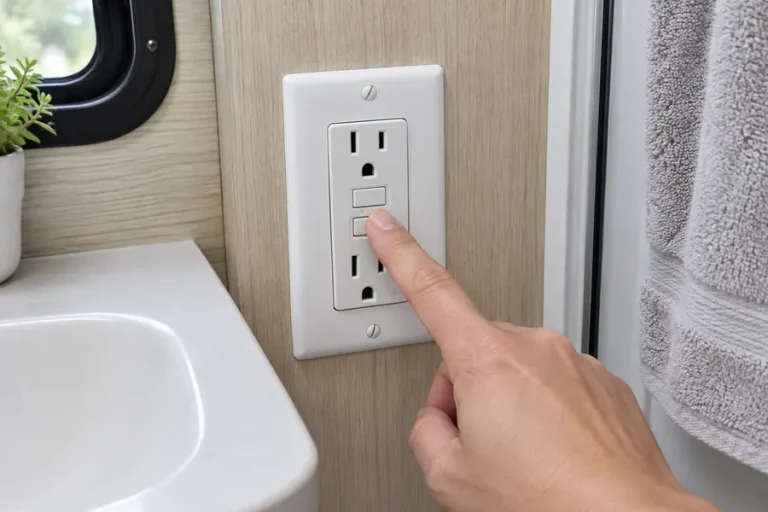
One tripped GFCI can kill outlets in other rooms - Cut big loads and add them back If power comes on and then drops, too much may be running. Southwire says that if the coach powers up after 128 seconds and goes off again 8 to 10 seconds later, you likely have low voltage, and to turn off as many loads as you can. Start the air conditioner last, by itself. If one appliance trips a breaker every time, see RV AC keeps tripping the breaker.
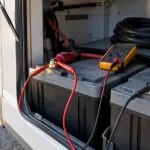
- If only the 12V side is out Lights and fans run on the battery and converter, even on shore power. Check that the battery disconnect switch is on, that the converter’s 120V breaker is on, and that the battery reads about 12.6 volts or more. If the battery is low and does not climb while plugged in, go to RV battery not charging when plugged in. If the converter seems dead, our RV converter guide shows the output test.
Stop. If you feel a tingle from the RV’s metal, smell burning, or see a scorched plug or pedestal, unplug and do not use that power. Do not open the breaker panel, transfer switch or surge protector with power connected. Progressive Industries says never to bypass its EMS for a 240 volt fault (code E 3).
| What you see | What it means | What to do |
|---|---|---|
| EMS E 1, or Surge Guard caution flashing after the delay | Reverse polarity: hot and neutral swapped | Move to another pedestal and tell the park |
| EMS E 2 | Open ground | Move to another pedestal |
| EMS E 3 / E 5, or Surge Guard line light red | Voltage above 132 V (E 3 can mean 240 V on the plug) | Unplug; do not bypass |
| EMS E 4 / E 6, or Surge Guard line light red | Voltage below 104 V (EMS) or 102 V (Surge Guard) | Turn off loads or wait for park power to recover |
| EMS E 7 / E 8 | Frequency too high or too low | Move to other power |
| EMS display dark | Possible open neutral | Unplug; try another pedestal |
| EMS E 10, or Surge Guard SURGE light on | The surge part is used up | Power still flows; replace the module (Progressive) or the unit (Surge Guard) |
Progressive Industries vs Surge Guard: reading the signs
Progressive Industries EMS (HW30C and HW50C). The display scrolls voltage, amps, frequency and the error code. E 9 right after you plug in is normal, and E 0 means all is well. A PE (previous error) code tells you why it last cut power, such as PE 4 for low voltage, and clears when you unplug. The remote display has a bypass switch for a failed unit only. Progressive says that if the display reads E 0 and the delay light has stopped but the coach has no power, call its tech support. It also says never to plug the EMS into an inverter.
Southwire Surge Guard (35530 and 35550). There are no numbers, only lights. Green line lights mean the voltage is in range. A red line light means low or high voltage. A flashing caution light means the 128-second delay, or a wiring fault like reverse polarity or an open ground if it keeps flashing. The 50 amp model has a light for each leg. Southwire notes that with a 15, 20 or 30 amp adapter on a 50 amp cord, you will read 0 volts between the two hot legs instead of 240. That is expected.
Both cut power on bad voltage and wiring, and both delay power coming back. For the full picture of RV power, see our RV electrical problems guide.
When to call an RV tech
- The main breaker or a GFCI trips again right away with everything unplugged.
- The pedestal reads good, the surge protector shows no fault, and the RV still has no power.
- Power works on the generator but not on shore power, or the other way round. That points to the transfer switch.
- You feel a tingle from the RV body or the surge protector reports voltage on ground.
Common questions
Why is my RV not getting power when I plug it in?
Most often the pedestal breaker is off, the surge protector is still in its delay or has found bad power, or the RV’s main breaker has tripped. Check the pedestal, wait out the delay, read any code, then reset the main breaker. If the generator is running, the transfer switch keeps shore power out.
Why do my camper lights work but not the outlets?
Your lights run on 12V battery power, so they keep working with no shore power at all. Dead outlets mean the 120V side is out: the pedestal, the surge protector, the transfer switch, a breaker or a GFCI. Fix that soon, because the battery will run down without the converter charging it.
Why is there no power to the outlets but the breaker isn’t tripped?
A tripped GFCI is the first thing to check. One GFCI outlet can feed outlets in other rooms, so press Reset on every GFCI in the RV, including outside ones. If that does not help and other 120V items work, a loose connection on that circuit needs a tech.
How do I reset the power on my RV?
Turn the pedestal breaker off and back on, and wait out the surge protector delay. Then push the RV main and branch breakers fully off and on, and press Reset on each GFCI. For the 12V side, check the battery disconnect switch and the converter breaker.
Why did the power in my RV suddenly go out?
Usually the surge protector cut it for low or high voltage, a breaker tripped from too much load, or the park’s power failed. Look at the surge protector first: a Progressive EMS shows a PE code with the reason.
Sources
- Progressive Industries EMS-HW30C / HW50C Instruction Manual (dealer-hosted copy)
- Southwire Surge Guard 35530 / 35550 Installation and Operating Instructions (OEM-hosted copy, Newmar)
- Progressive Dynamics PD5100 Automatic Transfer Switch Installation and Operation Guide
- Progressive Dynamics PD52 / PD53 Automatic Transfer Switch Installation and Operation Guide