RV AC keeps tripping the breaker
Your RV AC trips the breaker every time the compressor kicks on, or knocks out the pedestal or the generator. Find out which breaker is tripping and why, from total load to a hard-starting compressor.
 By Complete RV Guide team
Updated Oct 25, 2026
8 min read
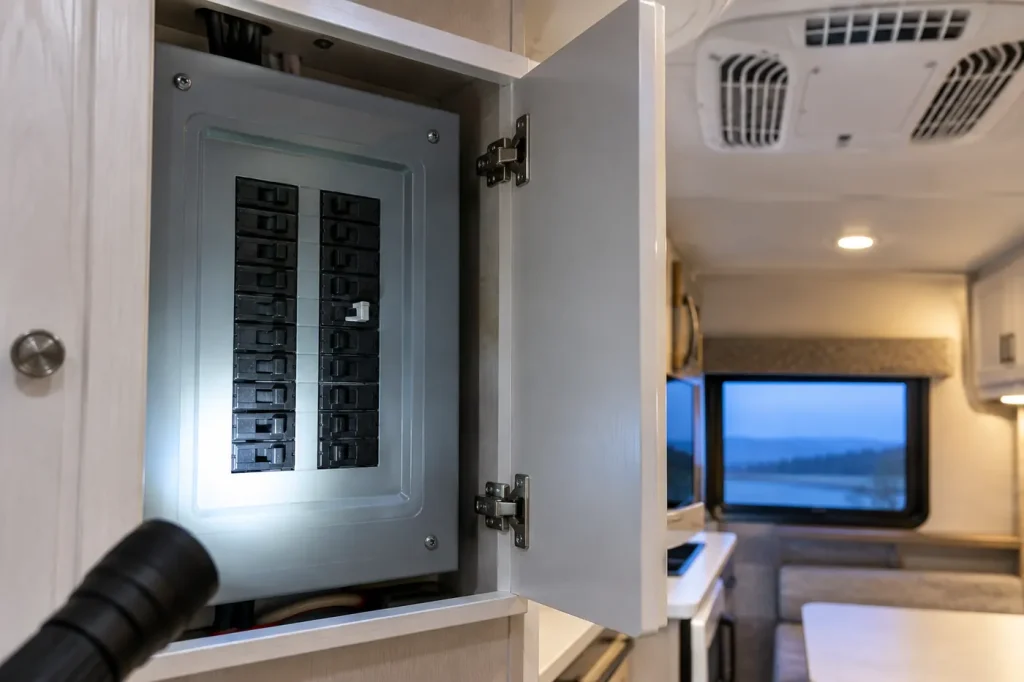
Quick answer
Rule out the two free causes first: too much load at once, or restarting the compressor before its pressure equalizes. Turn off the microwave, water heater and other big loads, wait 2 to 3 minutes after any shutoff, then start the AC alone. If its own breaker still trips with nothing else on, have the starting and running amps checked.
- Difficulty
- Easy
- Time
- 15-45 min
- Parts cost
- Usually $0A breaker, capacitor or compressor varies by model
What you'll need
Tool links go to Amazon. As an Amazon Associate we earn from qualifying purchases, at no extra cost to you.
Common symptoms
- The AC breaker in the RV panel trips the moment the compressor kicks on.
- Everything goes dark when the AC starts while the microwave or water heater is running.
- The campground pedestal breaker trips, not the one inside the RV.
- The AC trips the generator breaker or shuts the generator down.
- It trips when you turn the AC off and right back on.
- It hums for a few seconds before the breaker goes.
Quick checks before anything else
- Find which breaker tripped: the AC breaker, the main breaker, the pedestal, or the generator.
- Turn off the microwave, electric water heater, space heaters and other big loads.
- After any shutoff, wait 2 to 3 minutes before you restart the AC.
- Use a cord and adapter rated for the load, as short as you can, with tight, clean plugs.
- With two air conditioners, start them one at a time.
- Clean the return air filters and look for ice on the coil.
Stop. If a breaker trips again right after a reset with the AC as the only load, or you smell burning or see scorch marks at a plug, stop resetting it. The AC runs on 120 volts, and its capacitors can hold a charge after the power is off. Don’t open the ceiling unit or the roof shroud to test parts yourself.
Why does my RV AC keep tripping the breaker?
- Too much load at once The AC plus a microwave or water heater can top a 30 amp service. The main breaker or the pedestal trips.
- Restarting too soon The compressor can’t start against high pressure in the first 2 to 3 minutes after it stops, and the effort can kick the breaker.
- Low voltage A long, thin extension cord or a weak pedestal starves the compressor at start-up.
- Undersized generator The AC needs a burst of power to start, and a small or heavily loaded generator can’t supply it.
- Hard-starting compressor A worn capacitor or failing compressor hums, stalls and pulls heavy current.
- A tired breaker or bad wiring The breaker trips even though the AC draws normal amps.
Step-by-step: stopping the RV AC from tripping breakers
Work from the cheapest checks to the ones that need a meter or a tech. When your RV AC keeps tripping the breaker, the step where the problem shows up tells you if the fault is in the power supply or in the AC.
- Name the breaker that tripped There are up to four. The AC’s own breaker in the RV panel protects the AC circuit. The main breaker in the panel, and the breaker on the pedestal, protect everything on the shore cord. The generator has its own breaker too. If the main or pedestal trips, think total load (step 2). If only the AC breaker trips, think start-up and the AC itself (steps 4 to 7).
- Add up what is running Your RV’s 30 amp service gives you about 3,600 watts at 120 volts. A Dometic Brisk II rooftop unit is rated at 12.4 amps for the compressor alone on the 13,500 BTU model and 13.3 amps on the 15,000 BTU model, plus 2 to 2.5 amps for its fan. Cummins’ typical appliance table puts a microwave at 8 to 11.25 amps and an electric water heater at 8 to 12.5 amps. AC, microwave and water heater together can pass 30 amps. Turn off the extras, start the AC, then add loads one at a time.
- Wait before you restart Coleman-Mach explains that after the compressor stops, its refrigerant needs two to three minutes for high pressure to equalize, and the compressor can’t start against it. Restarting sooner can kick the breaker or the overload. Dometic says to wait at least 2 minutes before restarting the compressor after you switch it off. That is why switching the AC off and right back on, or a short power blink, can trip it.
- Check the circuit size Both Dometic and Coleman-Mach call for each AC to sit on its own 20 amp time delay fuse or breaker. A time delay breaker lets the short start-up surge pass without tripping. Dometic specs 12 gauge (AWG) copper wire up to 24 feet, and Coleman-Mach 12 AWG up to 25 feet, with bigger wire for longer runs. If the AC breaker is smaller than 20 amps or is not a time delay type, it does not match the makers’ spec, and an electrician should correct it.
- Fix low voltage at the cord When a Coleman-Mach compressor won’t start, the maker says to check the wire size, the breakers, and that the extension cord is sized for the distance from the outlet to the RV. Dometic’s checklist asks you to make sure a shore line is sized to run the unit’s load. Skip long or thin cords and stacked adapters. Plug straight into a 30 amp pedestal outlet when you can, and look at the plug ends for heat marks.
- Give the generator enough headroom Cummins says an air conditioner can draw 3 to 4 times its normal 1,400 to 2,400 running watts for a moment as it starts, and that the generator’s breaker can trip even when the steady loads add up to less than its rating. Dometic’s general guide is a 3.5 kW generator for one rooftop unit and 5.0 kW for two. Generators also lose power at high altitude and in heat. Turn off the battery charger and other loads, then start one AC at a time. If the generator shuts down rather than tripping, see Onan generator keeps shutting off.
- Listen for a hum at start-up Stand under the AC when it calls for cooling. A compressor that hums for a few seconds and then trips the breaker is struggling to start. A stalled motor keeps pulling close to its locked rotor current, which Dometic lists at 68 amps for the 13,500 BTU Brisk II, more than five times its running current. A weak capacitor, the part that gives the motor its kick to start, can cause this. Testing it means discharging it safely and metering it, so leave that to a tech.
-
Clean the filters and coils Dirty filters, iced coils and leaves in the roof grilles make the AC work harder. On Coleman-Mach R410A units, a dirty condenser coil, dirty filters or a failed fan trip a high pressure switch that locks out the compressor. That stops cooling but is not a breaker trip; you reset it by turning the 115 volt power off and back on. Dometic says to wash the filters at least every 2 weeks of use.

Wash the filters at least every 2 weeks of use - Test the breaker itself If the AC still trips its breaker with nothing else running, Coleman-Mach says to have an electrician measure the starting and running amps. If they are normal, the breaker is faulty and needs replacing. If they are high, the AC needs service.
| When it trips | Likely cause | Step |
|---|---|---|
| Main or pedestal, with other loads on | Total load over 30 amps | 2 |
| Right after you switch the AC off and on | Restart before pressure equalizes | 3 |
| AC breaker, at every compressor start | Breaker type, low voltage or hard start | 4, 5, 7 |
| Generator breaker, or generator quits | Start-up surge too big for the generator | 6 |
| AC breaker, AC alone, amps normal | Worn breaker | 9 |
Dometic vs Coleman-Mach vs Furrion: amp draw and protection
Dometic. The Brisk II (B57915, 13,500 BTU and B59516, 15,000 BTU) is rated at 12.4 and 13.3 compressor amps, with locked rotor amps of 68 and 70. Dometic requires a 20 amp time delay fuse or breaker and 12 AWG copper up to 24 feet. Its generator guide is 3.5 kW for one unit and 5.0 kW for two, and it notes generators lose power at high altitude and from lack of maintenance.
Coleman-Mach (Airxcel). The 48000 series manual calls for a 20 amp time delay fuse or breaker on each unit and 12 AWG wire up to 25 feet. It does not print amp draw in the owner’s manual, so read the rating plate on your unit. Its R410A units add the high pressure lockout described in step 8.
Furrion Chill. Furrion lists 13.1 amps cooling for the 13,500 BTU FACR13SA, 14.6 for the FACR14SA, and 15.4 for the 15,500 BTU FACR15SA. It calls for a time delay fuse or breaker sized from the rooftop unit’s nameplate and at least 12 AWG cord.
Our RV AC repair guide compares the three brands in more detail. If a Dometic CCC 2 thermostat shows E7 after a trip, that code means no 120 volt power at the AC; see Dometic thermostat error codes.
When to call an RV tech
- The AC breaker trips with the AC as the only load, after you waited 3 minutes.
- The compressor hums and stalls, or you suspect the capacitor.
- A plug, outlet or breaker shows scorch marks or feels hot.
- The breaker or AC wiring needs replacing. Coleman-Mach says electrical work should be done by qualified service people.
- The high pressure switch keeps locking out the compressor.
- The pedestal or the RV has no power at all. Start with RV has no power when plugged in, or generator running but no power if you are on the generator.
Common questions
What causes an AC breaker to trip immediately?
A breaker that trips the instant the compressor starts usually points to a hard start. The compressor may be restarting before its pressure has equalized, getting low voltage, or stalling on a weak capacitor. If it trips even with the AC off and nothing else on, suspect a short in the wiring and call a tech.
Can you run an RV air conditioner on a 20 amp breaker?
Yes. Dometic and Coleman-Mach both call for the AC’s own circuit to have a 20 amp time delay breaker or fuse. Running the whole RV from a 20 amp outlet is different: a 15,000 BTU Dometic Brisk II already uses about 15 amps for its compressor and fan, so little is left for anything else.
Why does my AC keep tripping the breaker after only 5 minutes?
If it runs a few minutes and then trips, look at what else came on in that time. A water heater element, microwave or battery charger cycling on can push the total over the limit. A cord or adapter that heats up as current flows is another suspect, so feel the plug ends after a trip.
Why does my RV air conditioner turn on and off repeatedly?
Some cycling is normal: the compressor turns off when the room reaches the set point while the fan keeps running. Furrion says a unit that keeps switching itself off may have its freeze sensor tripping because it is cold outside or all the air vents are closed. On Coleman-Mach R410A units, a high pressure lockout shuts the compressor off until you cycle the power.
How do I reset my RV air conditioner after a trip?
Turn the AC off at the thermostat. Push the tripped breaker fully to OFF, then back to ON. Wait two to three minutes before you turn the AC back on so the pressure can equalize. On Coleman-Mach R410A units, cycling the 115 volt power also clears a high pressure lockout.
Sources
- Dometic rooftop air conditioner Installation and Operating Instructions (B57915, B59516, 640315; Form 3315079.016)
- Coleman-Mach (Airxcel) 48000 Series Roof Top Air Conditioner Operation and Maintenance Instructions
- Furrion Chill Rooftop Air Conditioner Instruction Manual (FACR13SA, FACR14SA, FACR15SA)
- Cummins Onan Operator Manual, RV QG 5500 / 7000 (HGJAA, HGJAB), A035D009