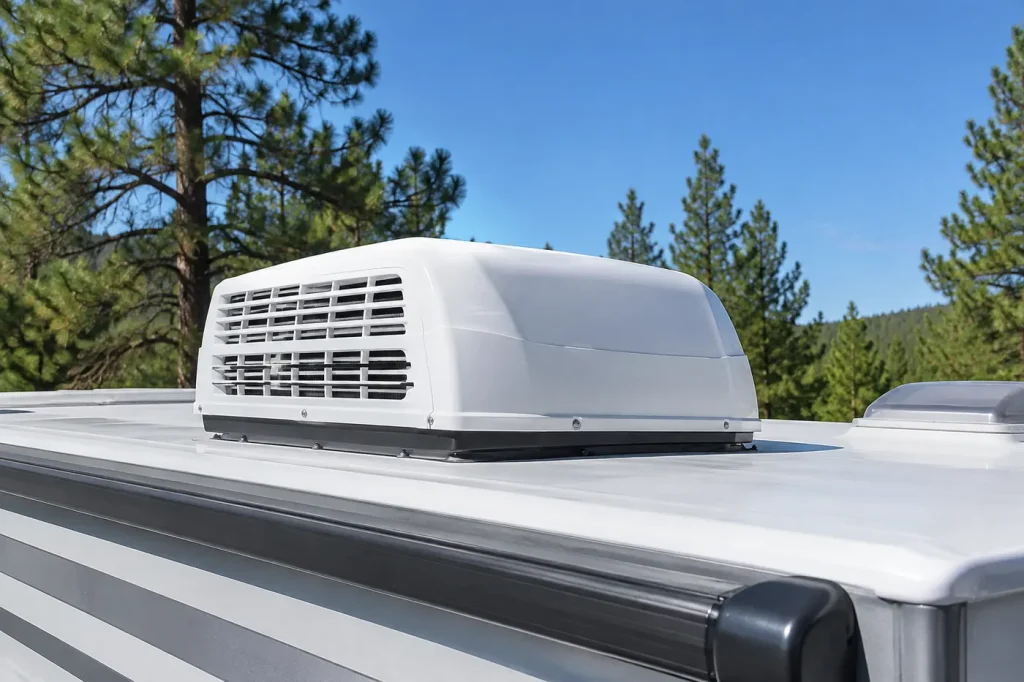
Your rooftop air conditioner hums but blows warm air, trips the breaker, or drips water on the floor. A lot of RV AC repair comes down to power, dirty filters, an iced coil or a worn capacitor, and you can check most of those yourself. This page explains how the unit works, which parts fail, the specs from the Dometic, Coleman-Mach and Furrion manuals, and when to call a tech.
How does an RV air conditioner work?
Most RVs use a rooftop air conditioner running on 120 volt AC from shore power or a generator. The cooling parts sit on the roof. A ceiling assembly inside, called the air distribution box, holds the vents, filters and often the controls. BTU measures how much heat the unit can move out in an hour.
- Thermostat calls for cool. The room is warmer than the set point.
- Compressor delay. Many controls wait a few minutes first. Coleman-Mach explains why: after the compressor stops, the refrigerant needs two to three minutes for its high pressure to even out.
- Fans start. One fan pulls room air through the filter and across the cold coil. Another pushes outside air across the hot coil on the roof.
- Capacitor kicks the compressor. A capacitor stores electricity and releases it in a burst so the motors can start.
- Heat leaves on the roof. The compressor squeezes the refrigerant and sends it to the roof coil, where it gives up heat and turns into a liquid.
- Cold coil cools your air. The liquid expands in the inside coil and gets cold. Room air blown across it cools down, and the water it pulls from the air drains out on the roof.
Which RV AC parts fail, and what are the signs?
| Part | What it does | Sign it is failing |
|---|---|---|
| Capacitor | Gives the compressor and fan motor a burst of power to start | Hums but the compressor will not start, slow fan, bulged or leaking case |
| Compressor | Pumps refrigerant around the system | Fan runs but air never gets cold, or the breaker trips at each start |
| Fan motor | Moves air across both coils | No airflow, squealing or grinding, a burning smell |
| Thermostat and control board | Decide when to cool and switch the parts on | Blank display, an E code, the unit ignores settings |
| Safety switches | A freeze sensor or high pressure switch stops the compressor to protect it | Unit keeps shutting off, or the compressor stays off while the fan runs |
| Filters and coils | Clean the air and move heat in and out | Weak airflow, ice on the inside coil, bent or dirty fins |
| Roof gasket and drain openings | Seal the unit to the roof and let water run off | Water dripping from the ceiling assembly |
Why did my RV AC stop working, and what should I check first?
- Breakers. Check the AC breaker in the RV panel and the breaker on the campground pedestal.
- Power source. Make sure the generator is running and putting out power; Dometic’s general guide is 3.5 kW for one unit. On shore power, turn off big loads like the microwave.
- Filters. Pull and wash the filters behind the return air grille.
- Thermostat. Set it to cool and a few degrees below room temperature, then wait three minutes for the compressor delay.
- Ice. Take the filter out and look at the coil. If it is iced, run the fan only until it clears.
- Roof grilles. Clear leaves and dirt from the roof unit’s air intake grilles.
- Code. Look up any code on the thermostat, for example in our Dometic CCC 2 code list.
Safety first. The AC runs on 120 volts, which can kill. Before you remove the ceiling cover or the roof shroud, unplug shore power, shut off the generator and turn off the inverter. Capacitors can hold a charge after the power is off, so do not touch their terminals. Never slide the roof unit, which can tear its gasket.
RV AC specs to know
These numbers come from the makers’ manuals. Your exact model may differ, so check the label on the roof unit’s base pan, seen with the return air grille removed.
| Spec | Dometic (Brisk II, Penguin II) | Coleman-Mach (Airxcel) | Furrion Chill |
|---|---|---|---|
| Power | 120V AC, 60 Hz | 115V AC, 60 Hz | 115V AC, 60 Hz |
| Cooling capacity | Brisk II: 13,500 or 15,000 BTU (B57915, B59516). Penguin II: 11,000 to 15,000 BTU | See your model’s manual | 13,500, 14,500 or 15,500 BTU (FACR13SA, FACR14SA, FACR15SA) |
| Current draw | Compressor rated load 12.4 amps (13,500 BTU) or 13.3 amps (15,000 BTU) | See your model’s manual | 13.1 amps (13,500 BTU) to 15.4 amps (15,500 BTU) when cooling |
| Circuit protection | 20 amp time delay fuse or breaker; 12 AWG copper up to 24 feet | 20 amp time delay fuse or breaker; 12 AWG up to 25 feet | See the unit’s nameplate; 12 AWG minimum |
| Wait before restarting | At least 2 minutes; the CCC 2 thermostat adds about 2 minutes | 2 to 3 minutes; the 9420 thermostat waits 3 minutes | See your model’s manual |
| Filter care | Wash at least every 2 weeks of use | Clean at least every 2 weeks of use | Clean every 4 weeks or sooner; replace at least every 12 months |
| Thermostat range | About 65 to 90°F at the return air (ceiling knob models) | See your model’s manual | 61 to 86°F (knob models) |
| Fault display | E codes on digital thermostats, E1 to E9 on the CCC 2 | No numbered codes on the 9420 thermostat, only words such as LO and HI | E1, E2, E3 and “lo” on Chill wall thermostats |
Dometic vs Coleman-Mach vs Furrion: how are RV air conditioners different?
Dometic sells the Brisk II, a standard-height unit, and the Penguin II, a low-profile unit. Coleman-Mach units come from Airxcel and Furrion Chill units from Lippert. All three cool the same way, and the Dometic and Furrion manuals both call for a 14-1/4 inch square roof opening.
What changes when you troubleshoot is the control side. Some Dometic E codes lock out only cooling while the fan and furnace keep working. Coleman-Mach R410A units have a high pressure switch that locks out the compressor until you cycle the power. Furrion Chill wall thermostats shut the whole system down for each code. Match parts to the roof unit’s model number, since ceiling assemblies, boards and thermostats generally do not swap between brands.
When should you call an RV tech for AC repair?
- Breaker keeps tripping. Coleman-Mach says to have an electrician check the starting and running amps.
- Repeated lockouts. Coleman-Mach says repeated high pressure trips need a qualified technician.
- Refrigerant problems. Furrion says refrigerant faults go to a certified technician, and refrigerant must never be released into the air.
- Ice that keeps coming back. Dometic says to call service if frost returns after you clean the filter.
- Damaged roof seals. Replacing the gasket means lifting the unit.
Shops bill by the hour, so doing the cheap checks first means less time on the clock.
Common questions
How do I reset my RV air conditioner?
Most rooftop units have no reset button. Turn the AC off at the thermostat, wait two to three minutes and turn it back on. On Coleman-Mach R410A units, a tripped high pressure switch resets only when you switch the 115V power off and on at the breaker.
How do I reset a Dometic thermostat?
On the CCC 2, put the thermostat in OFF mode and hold the MODE and ZONE buttons together until the screen shows “IniT”. Let go, then press ON/OFF to exit. This restores factory settings, so set your temperatures again. On Single Zone LCD and CT thermostats, the similar step is an installer setup, so use it only if a tech tells you to.
Why is my RV air conditioner blowing cool air but not cold air?
An RV AC cools the air passing through it by only about 15 to 20 degrees, Coleman-Mach says, so air coming in at 80°F should leave at about 60 to 65°F. If you see that difference, the unit is at full capacity: park in shade, close the blinds and start the AC early. If the difference is smaller, check the filters, coils and power.
How do I know if my RV AC capacitor is bad?
The usual sign is a hum when the compressor or fan should start, but nothing spins. A swollen or leaking case is another clue. Testing one means safely discharging it and measuring it with a meter, so we leave that to a tech.
How do I stop my RV AC from freezing up?
Keep the filters clean and do not run the coldest setting on cool nights. Coleman-Mach suggests a middle setting when it drops below 75°F outside, and Furrion says to keep at least two duct vents open. If the coil has iced, run the fan on high until the airflow comes back; Furrion suggests about half an hour.
Why is my RV AC leaking water inside?
The unit makes water as it cools, and it should drain out on the roof. Furrion lists clogged drain openings and damaged seals as causes, and a melting iced coil can also drip. Clean the filters and clear the drain openings; if water still comes in, call a tech about the gasket.
What is the average lifespan of an RV air conditioner?
Dometic, Coleman-Mach and Furrion do not publish a lifespan. Their manuals ask for clean filters, and Coleman-Mach adds checking the roof bolts and the shroud for cracks. A unit that gets that care and proper voltage avoids the most common failures.