RV furnace keeps shutting off or won’t stay lit
Your RV furnace lights, runs a little, then quits, over and over. How long it runs before it stops tells you which safety switch is tripping and what to fix.
 By Complete RV Guide team
Updated Oct 25, 2026
8 min read
Quick answer
Most shutoffs are airflow or voltage. If the burner runs a few minutes and goes out while the fan keeps blowing, the limit switch is opening: clear the return-air grille, open every register and check the ducts. If the fan runs about 30 seconds and stops, check battery voltage while the fan runs.
- Difficulty
- Moderate
- Time
- 20-90 min
- Parts cost
- Usually $0Switches, sensors and boards vary by furnace model
What you'll need
- Multimeter
- Flashlight
- Phone timer
- Vacuum with brush nozzle
- Screwdriver
Tool links go to Amazon. As an Amazon Associate we earn from qualifying purchases, at no extra cost to you.
Common symptoms
- The fan starts, runs about 30 seconds, then stops with no ticking.
- The burner lights with a soft whoosh and goes out a few seconds later.
- The burner runs a few minutes, goes out while the fan keeps blowing, then lights again later.
- The furnace turns on and off all night and the RV never gets warm.
- It stays lit on shore power but quits on battery.
- After a few rounds it stops trying and won’t restart until you reset it.
Quick checks before anything else
- The return-air grille is clear: no bins, bedding or shoes against it.
- All floor and wall registers are open and uncovered.
- The battery reads about 12.6 volts at rest, and stays above 10.5 volts while the fan runs.
- The propane tank valve is fully open and a stove burner lights.
- The outside furnace vent is free of nests, snow and covers.
- The thermostat is not in sunlight or in the path of a heat register.
Why does an RV furnace keep shutting off?
The control board watches three things the whole time the furnace runs: airflow (the sail switch), heat (the limit switch) and flame (the flame sensor). If any of them drops out, the board shuts off the gas. How long the furnace runs before it quits tells you which one tripped.
- Limit switch cycling The burner runs a few minutes, goes out while the fan keeps blowing, then relights. The furnace is overheating, almost always from poor airflow.
- Sail switch dropping out The fan runs about 30 seconds with no ticking, then stops. The fan is not moving enough air to hold the sail switch closed.
- Low voltage under load A weak battery or a long, thin wire drops the voltage when the motor starts. The blower slows and the sail switch opens.
- Flame sense loss The burner lights and dies within seconds. The board cannot see the flame, so it closes the gas valve.
- Gas pressure dips It locks out now and then, often at the moment it calls for heat. A tired regulator, a kinked line or moisture in the gas can cause it.
- Thermostat short cycling Each cycle is normal but very short, because the thermostat warms up too fast.
- Blower startsSail switch must close within 30 seconds
- PurgeAbout 15 seconds of fan only
- Spark and flame senseAbout 7 seconds per try, 3 tries
- HeatingBoard watches flame, sail switch and limit switch
- Limit opensLockout if it stays open 5 minutes
- Did it quit before any ticking?
Yes: airflow was never proved. Look at voltage, lint, the return air and the gas switch (steps 2 to 5).
No: it lit first. Quick dropout points to flame sensing (step 7); minutes of heat then cold air points to the limit switch (steps 2, 3 and 9).
Step-by-step: finding why it shuts off
We start with airflow and voltage, because they are free to check and they cause most shutoffs. Gas and flame checks come last.
- Time when it quits Start the furnace and watch a clock. Note how long the fan ran, if you heard ticking, if the burner lit, and if the fan kept going after the flame went out. The table below matches each result to a cause.
-
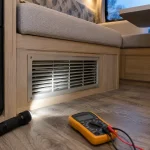
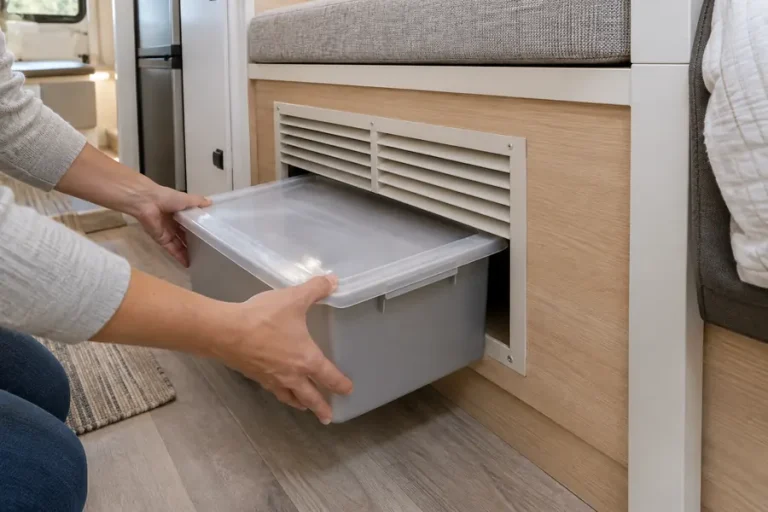
Clear the return air and registers The return-air grille is where room air flows back into the furnace, usually in a cabinet face under a counter, bed or sofa. Suburban says too little return air makes the furnace overheat and cycle on its limit switch, and can also make it seem to run nonstop without warming the RV. Atwood says not to block registers or return-air grilles and not to use the furnace cabinet for storage. Open every register, even in rooms you are not using.
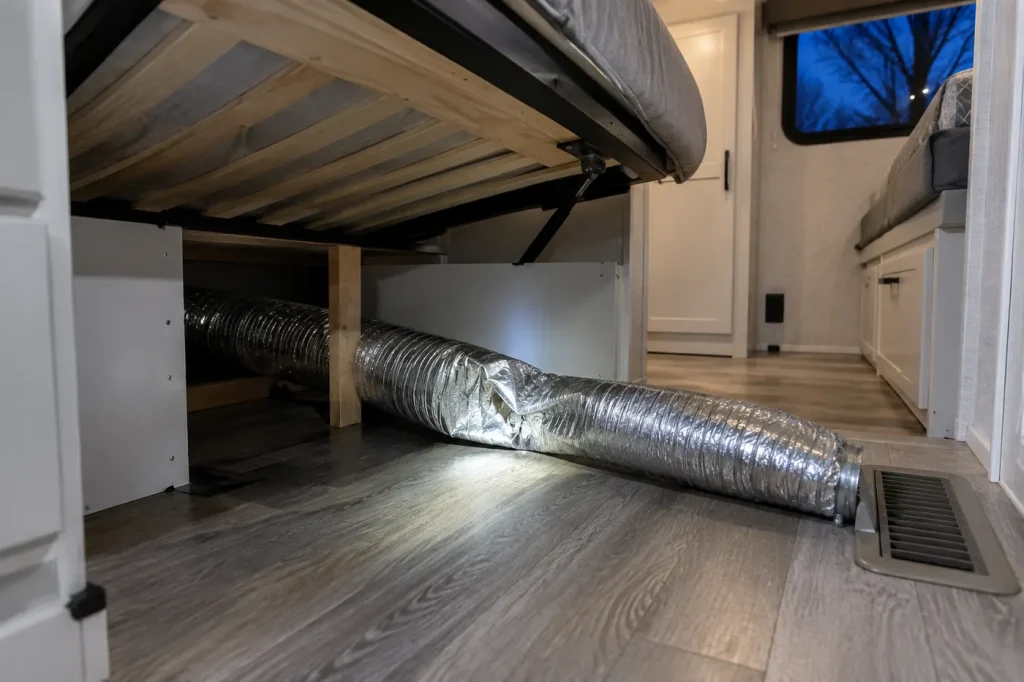
Blocked return air makes the furnace cycle on its limit switch - Check the ducts you can see Look under cabinets and beds for flex duct that is crushed, kinked or pulled off the furnace. Suburban says sharp turns raise the pressure inside the furnace and can make it cycle on the limit, and loose duct connections can overheat furnace parts. Atwood says undersized ducting causes high temperature limiting. Both makers say not to add air boosters (inline duct fans), which cause limit cycling and erratic sail switch operation.
-
Measure voltage while the fan runs Put a meter on the battery, then start the furnace. Suburban rates its furnaces for 10.5 to 13.5 volts, and its fan control boards go into standby below 9.5 volts. Its sail switch closes at about 75% of normal fan speed, so a sagging battery can open it mid-run. Plug into shore power or run the generator and try again. If the furnace stays lit now, fix the battery or charging side first; our converter guide shows how to test it.
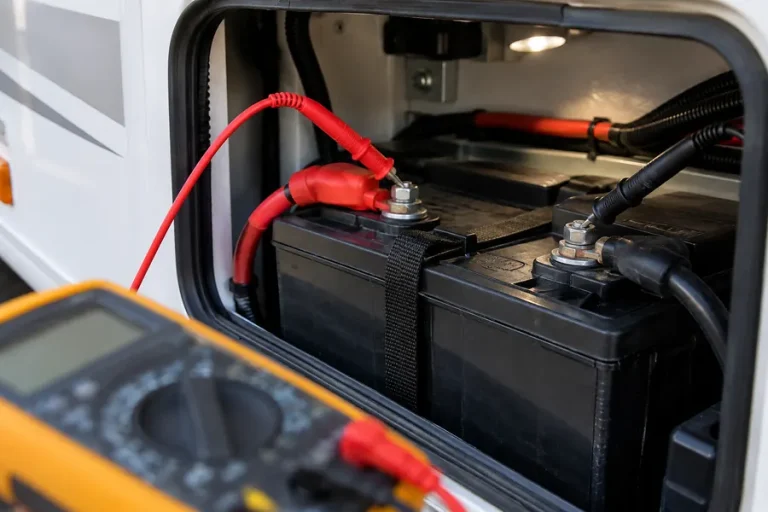
Check voltage at rest and again with the furnace fan running - Check the gas switch and tank valve Many furnaces have a switch that cuts power to the gas valve. Suburban’s SF VHQ manual says that if you start the furnace with this switch off, the motor runs 30 seconds, then shuts off and locks out. Atwood says to open the tank valve fully and never run with it partly closed.
- Look at the thermostat If every cycle is normal but short, the thermostat may be warming up too fast. Atwood says to mount it 48 to 54 inches above the floor on an inside wall, away from sunlight, appliances and heat registers. On older thermostats with an adjustable heat anticipator (a small dial that sets how early the heat shuts off), Suburban says to set it at 0.7 amps, and to raise the setting for longer cycles.
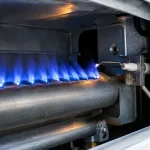
- Burner dies in seconds: check flame sensing If the flame lights and goes out within a few seconds, the board is not seeing it. An Atwood board flashes two flashes for this. Suburban says the sensor must sit in the inner blue part of the flame, about 1/4 to 5/16 inch above the burner, with no carbon on it and tight wires at both ends. A tech can also measure flame current: Suburban wants at least 7 microamps within 7 seconds of lighting.
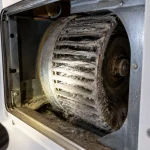
- Clean lint from the blower and sail switch Suburban says lint on the room-air blower wheel makes the motor drag and move too little air, and dust on the sail switch stops its arm from moving freely. Atwood says running the furnace with anything blocking the blower damages the wheel and causes overheating and cycling. Vacuum what you can reach with the power off. A full cleaning usually means pulling the furnace, which is tech work. Our blower guide covers noise and slow fans.
- Still cycling with good airflow: test the limit switch If the return air, ducts and voltage are good and the burner still goes out after a few minutes, have a tech test the limit switch. Never jump or bypass it, because it is what stops the furnace from overheating.
- Random lockouts: check gas pressure Suburban blames occasional lockouts on gas pressure that dips when the furnace calls for heat, from a bad tank regulator, a kink in the line, or moisture. It specifies 11 to 14 inches of water column at the furnace, with no more than a 1/2 inch drop when the furnace starts. A tech checks this with a manometer (a low-pressure gas gauge).
Some stopping is normal. The furnace turns on and off as the thermostat is satisfied. When the burner shuts off, Suburban’s fan control boards keep the fan running 90 seconds to cool the furnace.
| When it quits | Likely cause | Steps |
|---|---|---|
| Fan runs about 30 seconds, no ticking | Sail switch, low voltage, gas switch off | 4, 5, 8 |
| Seconds after the burner lights | Flame sensing | 7 |
| A few minutes of heat, then cold air | Limit switch and airflow | 2, 3, 9 |
| Short but normal cycles | Thermostat | 6 |
| Now and then, at start-up | Gas pressure | 10 |
Suburban vs Atwood (Dometic) furnaces
Suburban. On fan control boards, a sail switch that stays open 30 seconds causes a lockout with the blower off. A limit switch that stays open 5 minutes causes a lockout that you clear at the thermostat. Some other Suburban boards close the gas valve and keep the blower running while the limit is open. Older boards give no blink codes, so you work from timing.
Atwood and Dometic. The board LED tells you which switch tripped. One flash with a 3-second pause is a limit switch or airflow problem, a soft lockout. Two flashes are a flame sense fault, a hard lockout that needs a thermostat or power switch reset. Dometic’s current DF manual adds four flashes for high voltage (16 to 17 volts) and five for low voltage (8 to 9 volts). For “furnace shuts off before it reaches the desired temperature,” Dometic’s first fix is to open all vents and clear the air intake. How each part works is in our RV furnace repair guide.
Tools and parts for this fix
Only what this guide uses. For parts, match the part number in your unit's manual before you order.
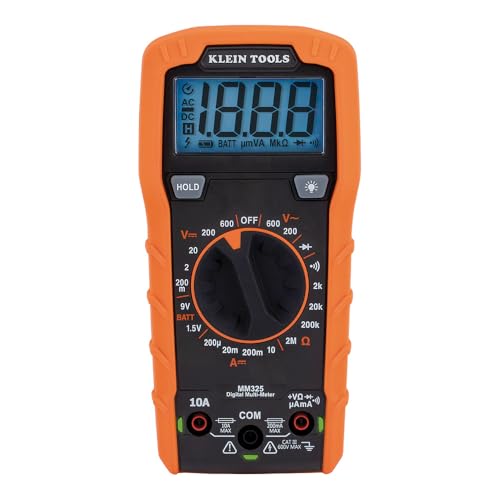
Checks that battery voltage stays above 10.5 volts while the furnace fan runs.
Check price on Amazon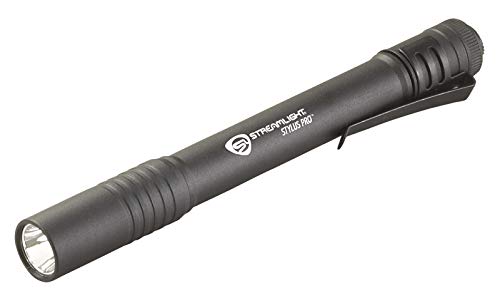
Streamlight Stylus Pro penlight
Helps you look behind the return-air grille and into ducts for lint or blockages.
Check price on Amazon
As an Amazon Associate we earn from qualifying purchases, at no extra cost to you.
When to call an RV tech
- It cycles on the limit switch with clear return air, open registers and good voltage.
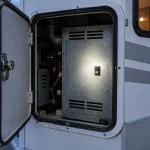
- The blower wheel or sail switch needs cleaning and the furnace has to come out.
- The flame sensor needs adjusting or a flame current test.
- Gas pressure needs checking with a manometer.
- Both Atwood and Suburban say to shut the furnace down and call for service if it cycles erratically or is slow to light.
- You smell gas, see soot at the vent, or a CO alarm sounds.
Common questions
Why does my RV furnace run for 30 seconds and then shut off?
The fan is not proving airflow. On Suburban fan control boards, if the sail switch stays open 30 seconds after the blower starts, the board locks out. Low battery voltage, lint on the blower or sail switch, or blocked return air are the usual causes. On Suburban SF VHQ models, the gas switch being off does the same thing.
Why does my RV furnace turn on and off repeatedly?
If the burner goes out after a few minutes while the fan keeps blowing, the limit switch is opening because the furnace is overheating, usually from poor airflow. If each cycle is complete but short, look at the thermostat’s location and anticipator setting. Normal cycling with the thermostat is not a fault.
Why does my furnace keep igniting and then shut off?
When it lights and goes out within seconds, the board is not sensing the flame. A dirty or badly placed flame sensor, a loose sensor wire, or a weak yellow flame are common reasons. On an Atwood board this shows as two flashes.
Why won’t my RV furnace stay on when I’m on battery?
The voltage sags when the blower starts, and the fan slows until the sail switch opens. Suburban needs at least 10.5 volts. If it runs fine on shore power, fix the battery before you buy furnace parts.
How do I reset my RV furnace after it shuts off?
Turn the thermostat off, wait for the blower to stop, then turn it back to Heat. On Atwood furnaces you can also turn the furnace power switch off and on. Our page on the RV furnace reset button explains why most furnaces don’t have one. A reset won’t stop the shutoffs until you fix the cause.
Sources
- Suburban RV Furnace Service Manual (Airxcel/Suburban, dealer-hosted copy)
- Suburban SF-VHQ/SF-VHFQ Installation, Operation and Maintenance Instructions, PN 206010 (Forest River copy)
- Suburban Gas Furnaces User's Information Manual, SF-Q/SFV/SH series, PN 205881 (Forest River copy)
- Atwood (Dometic) Hydroflame AFM/AFMD Technical Installation Manual, Lit. 32471 (Forest River copy)
- Atwood (Dometic) Hydroflame AFL Series (AFLD35/40) Technical Installation Manual, Lit. 32472 (NHTSA copy)
- Atwood Hydroflame AFS/AFM/AFL User's Information Manual, Lit. 31973 (Gulf Stream Coach copy)
- Dometic DFSA/DFSD/DFMD/DFLD/DFLA Furnace Operating Manual (Dometic)