RV furnace clicking but not igniting: causes and fixes
The fan runs and the furnace ticks, but the burner never lights or dies in seconds. Here is how to find which part of the ignition sequence is failing.
 By Complete RV Guide team
Updated Oct 25, 2026
8 min read
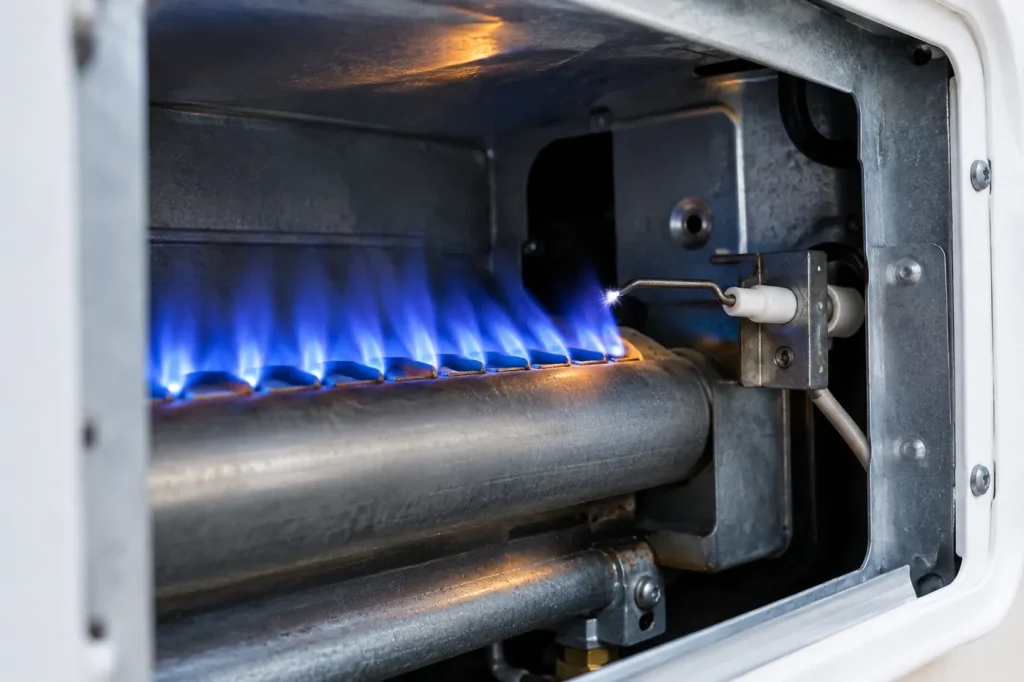
Quick answer
Clicking means the board is sparking, so the problem is usually gas reaching the burner: air in the line after a refill, a partly closed tank valve, or low pressure. Run a stove burner until its flame is steady, check battery voltage during the try, then reset the furnace once.
- Difficulty
- Moderate
- Time
- 15-90 min
- Parts cost
- Usually $0An electrode, gas valve or board varies by furnace model
What you'll need
- Multimeter
- Flashlight
- 1/8 in gap gauge
- Nut driver
- Screwdriver
Tool links go to Amazon. As an Amazon Associate we earn from qualifying purchases, at no extra cost to you.
Common symptoms
- The fan runs and you hear fast ticking for several seconds, but no flame.
- Ticking, a quiet gap, more ticking, three rounds in all, then it gives up.
- The burner lights with a soft whoosh, then goes out a few seconds later.
- The fan runs, but you never hear any ticking.
- It lights on some tries and fails on others.
- The stove lights fine, but the furnace will not.
Quick checks before anything else
- A stove burner lights and holds a steady blue flame.
- The tank valve is fully open and the tank is not near empty.
- If you just refilled or swapped tanks, run a stove burner for a minute before you try the furnace.
- Battery voltage stays above 10.5 volts while the furnace fan runs.
- The air intake on the outside furnace vent is free of nests and snow.
- You reset the furnace once and listened to one full try.
Stop. If you smell propane at any point, do not reset the furnace again. Close the tank valve, get everyone out and air the RV out. Atwood also warns never to try to light the burner by hand, and Suburban says never to run the furnace with the electrode wire disconnected.
Step-by-step: finding where ignition fails
When an RV furnace is not igniting or not lighting, the fan and the thermostat are already doing their job. The fault sits somewhere between “airflow proved” and “flame proved.” These steps find which part of that short window is failing.
- Time one full try Reset the furnace and time one try. On a Suburban, the blower starts, the sail switch closes, and about 15 seconds of purge follow. Then the board opens the gas valve and sparks for about 7 seconds while it looks for flame. With no flame, it purges again and tries again. After three failed tries, it closes the gas valve and locks out. Atwood says to allow 30 seconds after the blower starts for the burner to light. Write down what you got: no ticking, ticking with no flame, or flame that dies.
- Purge air from the gas line After a refill, a tank swap or long storage, the line can hold air. The furnace only sparks for a few seconds per try, so it can lock out before propane reaches the burner. Light a stove burner and let it run until the flame is steady, then reset the furnace. If it still will not light, do not keep cycling it: Atwood says that after three attempts with no ignition you should shut it down and call a service tech.
- Check voltage while it tries to light The spark, the gas valve and the blower all run on 12V DC. Measure at the battery during a try. Suburban lists 10.5 volts as the minimum, and its fan control boards go into standby below 9.5 volts. Low voltage also slows the blower, and Suburban’s sail switch needs about 75% of normal blower speed to close. Then plug into shore power or run the generator and try again. If it lights now, the battery is the problem. See our RV battery and converter guide. Never run the furnace from a battery charger alone: Suburban warns some chargers put out more than 14.5 volts, which can damage the board.
- No ticking at all: check the go-ahead circuit If the igniter is not clicking at all, the board has not been cleared to spark. It will not spark until the sail switch (the airflow paddle switch) and the limit switch (the overheat switch) both report OK. Suburban’s first check for “electrode not sparking” is voltage at the board after the blower reaches full speed, then continuity through those two switches. If the fan runs about 30 seconds and stops, that points to the sail switch, which we cover in RV furnace not working: 12 checks.
- No ticking, switches OK: the electrode and its wire The electrode is a metal rod in a ceramic insulator that sits over the burner and makes the spark. With power and gas off, Suburban’s order is: check the wire connections at both ends, check the wire for continuity and replace it if open, then check the gap. The spark gap between the electrode and its ground should be 1/8 inch. Next, look for cracks in the electrode or carbon on its tip. If all of that checks out, Suburban says to replace the board, which is not field repairable.
- Ticking but no gas: the gas valve If you hear the spark but the burner never lights, check whether the board sends 12V to the gas valve during the try. Suburban’s rule is simple. Voltage at the valve but no gas means a bad valve. No voltage means checking the wires and plug between board and valve, and if those are good, the board. Replacing a gas valve ends with a leak test, so we leave that to a tech.
- Ticking, gas flowing, still no flame: pressure and burner Gas pressure is read with a manometer, a gauge that measures low gas pressure in inches of water column (WC). Suburban specifies 11 to 14 inches WC at the furnace and says the pressure should drop no more than 1/2 inch when the furnace starts. A bigger drop points to a bad regulator, a restricted or pinched line, or moisture. Atwood’s manuals call for 10 to 13 inches WC with all appliances running, read at a 1/8-inch test port. If pressure is good, Suburban says to look for a blocked burner orifice or burner and to check that the electrode sits about 1/4 inch above the burner slots.
- Lights, then goes out in seconds: flame sensing Once the burner lights, the board must see the flame or it shuts the gas off. On many Suburban models it senses flame through the spark electrode, and others use a separate flame sensor. Suburban’s checks: the sensor sits in the inner blue cone of the flame, about 1/4 to 5/16 inch above the burner, with no carbon on it and tight wires at both ends. The flame itself should be hard blue. A tech can measure flame current with a microamp meter (a microamp is a millionth of an amp). Suburban wants at least 7 microamps within 7 seconds of lighting, and if that is good but it still drops out, the board is at fault.
- Lights some tries, fails others Suburban blames occasional lockouts on gas pressure that dips when the furnace calls for heat (a weak tank regulator, a kinked line, or moisture), airflow that does not close the sail switch every time, or a dirty electrode and burner. To test the gas side, a tech can run the furnace from a separate upright tank and regulator, as Suburban’s manual describes. If it works that way, the RV’s gas system is at fault. Atwood’s owner manual says to shut the furnace down and call for service if it cycles erratically or is slow to light.
| What you hear or see | Likely cause | Step |
|---|---|---|
| Fan runs, no ticking | Sail switch, limit switch, electrode wire or board | 4, 5 |
| Ticking, no flame | Air in line, gas valve, low pressure | 2, 6, 7 |
| Flame, then out in seconds | Flame sensing | 8 |
| Lights on shore power, not on battery | Low voltage | 3 |
| Random lockouts | Pressure dips, airflow, dirty burner | 9 |
Suburban vs Atwood (Dometic) furnaces
Suburban. The service manual spells out electrode setup. The spark gap is 1/8 inch. On NT models the electrode sits 3/16 inch over the burner ports. Where there is a separate flame sensor, its gap to ground should be about twice the spark gap, 1/4 inch on park models. Sparking to the sensor damages the board. After the third failed try, fan control boards run the blower 3 more minutes and then stop.
Atwood (Dometic Hydroflame). Allow 30 seconds for the burner to light, and stop after three failed attempts. The board LED gives two codes that matter here. Two flashes with a 3-second pause is a flame sense fault, a “hard” lockout that waits for you to reset the thermostat or the furnace power switch. Three flashes is an ignition lockout, a “soft” lockout that the board retries on its own after one hour. The Atwood manuals we read do not list electrode gaps, so check your model’s service information or have a tech set it.
How the parts fit together is in our RV furnace repair guide.
Tools and parts for this fix
Only what this guide uses. For parts, match the part number in your unit's manual before you order.

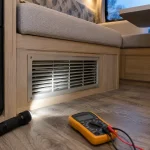
Reads battery voltage during an ignition try and checks the electrode wire for continuity.
Check price on Amazon
Yellow Jacket 78060 gas pressure kit
A manometer that reads propane pressure in inches of water column, as the pressure step describes.
Check price on Amazon
As an Amazon Associate we earn from qualifying purchases, at no extra cost to you.
When to call an RV tech
- The gas valve needs testing or replacing. Any gas fitting you open needs a leak test afterward.
- Gas pressure needs checking and you do not own a manometer.
- The electrode needs regapping and you cannot reach it without pulling the furnace.
- The board is the last suspect. Suburban boards are not field repairable.
- Flame current needs measuring.
- The burner is slow to light (delayed ignition), or you smell gas.
Common questions
What would cause an RV furnace not to ignite?
When an RV furnace won’t ignite, we check the gas side first because it is cheapest: air in the line after a refill, a low tank, a partly closed valve, or low pressure from the regulator. Next come spark problems, such as a wrong electrode gap, a cracked electrode or a loose wire. Low battery voltage can cause either kind of failure, so test it on shore power before buying parts.
Why is my furnace running but not igniting?
The fan starts before any spark or gas, so a running fan only proves the motor and thermostat work. When the furnace is clicking but not turning on the heat, the burner still needs the sail switch to close, a spark, and gas at the right pressure. Listen for ticking: none means a switch or spark problem, ticking means a gas problem.
Do all RV furnaces have a reset button?
No. The Suburban and Atwood manuals we checked describe no reset button. You clear a lockout with the thermostat, and on an Atwood also with the furnace power switch. A reset only buys three more tries, so it will not fix the cause.
Will an RV furnace work without electricity?
No. A standard RV furnace burns propane but needs 12V DC to run its blower, spark and gas valve, and Suburban’s minimum is 10.5 volts. When you are plugged in, the converter usually supplies it. Off grid, it all comes from the battery. Park model furnaces are different and run on 120 volts AC.
My Suburban RV furnace won’t stay lit. What could be causing this?
Watch how long the flame lasts. If it dies within a few seconds, the board is not seeing the flame: check the sensor position, carbon on the tip and the sensor wiring (step 8). If it runs a few minutes and goes out while the fan keeps blowing, the limit switch is opening because of poor airflow, which our no-heat checklist covers.
Why does my RV furnace keep clicking?
The clicking is the spark, and it means the board is trying to light the burner. Three bursts of clicking with quiet gaps between them is the normal retry pattern before a lockout. If the clicking keeps going after the burner lights, the board is not sensing the flame, which is step 8.
Sources
- Suburban RV Furnace Service Manual (Airxcel/Suburban, dealer-hosted copy)
- Atwood (Dometic) Hydroflame AFM/AFMD Technical Installation Manual, Lit. 32471 (Forest River copy)
- Atwood (Dometic) Hydroflame AFL Series (AFLD35/40) Technical Installation Manual, Lit. 32472 (NHTSA copy)
- Atwood Hydroflame AFS/AFM/AFL User's Information Manual, Lit. 31973 (Gulf Stream Coach copy)