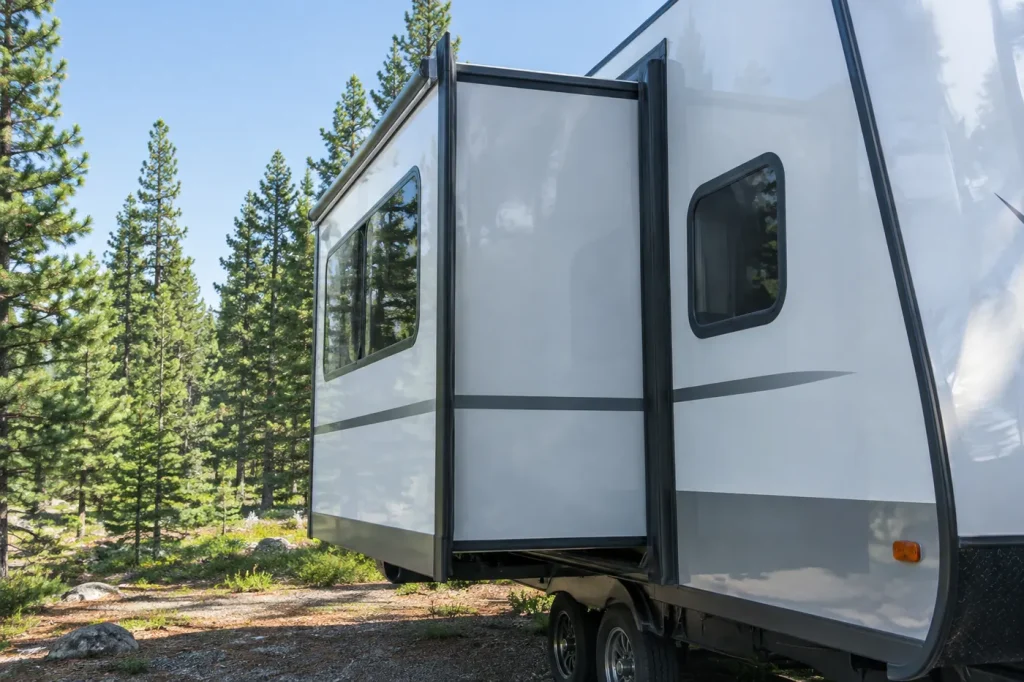
A slide-out that won’t move, stops halfway, comes out crooked or lets rain in can stop a trip cold. Most RV slide out repair starts with battery, fuse and alignment checks you can do yourself before anyone takes the room apart. This page covers how the main systems work, which parts fail, Lippert’s specs, and where DIY should stop.
How does an RV slide-out work?
A slide-out is a section of wall and floor that moves out to make the inside bigger. Lippert (LCI) makes many of today’s slide systems.
- You press the switch. The wall switch or touchpad signals a controller, a small circuit board that runs the motors.
- The battery powers the motors. Slide motors run on 12 volt DC from the house battery. A weak battery means a slow room, a stall or a fault code.
- The drive moves the room. Depending on the system, that is a motor in each side wall, gears and racks under the floor, or hydraulic cylinders.
- The controller keeps both sides even. On Lippert’s in-wall (Schwintek) system, each motor counts its turns so the controller can keep the room square.
- The system stops at the end of travel. The controller senses when the room is fully in or out and shuts the motors off.
- Seals close the gap. Rubber bulb seals press against the RV wall, and wiper seals sweep the room’s roof and sides as it moves.
Which RV slide-out parts fail, and what are the signs?
| Part | What it does | Sign it is failing |
|---|---|---|
| House battery | Powers the slide motors | Slow movement, stalls, or a low-voltage fault |
| Fuse or breaker | Protects the slide circuit | Nothing happens and no lights on the controller |
| Wall switch and wiring | Sends the in or out signal | Works in one direction only, or only if you jiggle it |
| Controller | Runs the motors and keeps them in step | Room goes out crooked; blinking fault lights; stops partway |
| Motor | Turns the drive | One side moves and the other doesn’t; motor fault code |
| Gear racks and drive | Move the room | Grinding, popping or squeaking; the room binds |
| Seals and wipers | Keep water and drafts out | Leaks at corners or top; daylight around the room; torn rubber |
What should I check first when my RV slide-out won’t move?
- Battery voltage. Lippert says to charge the battery if it reads under 11 volts at the in-wall controller. For SlimRack slides, Lippert says to run the engine or generator or plug into shore power before you move the room.
- Fuse. Check the slide fuse in the 12V fuse panel. Lippert says that if a new fuse blows right away, the wiring needs a tech.
- Obstructions. Check outside for posts, folded-over seals and debris on the room’s roof, and inside for furniture, open cabinets and rugs.
- Locks and brake. Remove any transit bars (travel locks). Many systems also need the parking brake set, or a motorhome in park.
- Fault lights. Find the controller and count the blinks. On Lippert boards, the green light shows which motor and the red light shows the fault. Look up the code in our Lippert slide error codes.
- Switch. If the controller lights don’t come on in both directions, Lippert says to unplug and replug the switch wires at the board. If that fails, the switch or its wiring is bad.
Safety first. A slide room is very heavy and its motors can crush a hand. Keep people and pets out of the room’s path, inside and out, and stay clear of the gear racks while it moves. Never jump or charge the battery from the controller’s power terminals; Lippert says to do it at the battery. When you move a room by hand, both sides must move together or the room can be damaged. Never work under the RV while it rests on leveling jacks; use jack stands.
RV slide-out specs to know
These numbers come from the makers’ manuals. Your exact system may differ, so check the label on your controller and its manual.
| Spec | Lippert in-wall (Schwintek) | Lippert SlimRack |
|---|---|---|
| Power | 12V system; can run on as little as 8 volts, but draws more current at low voltage | 12V DC gear motor in each side |
| When to charge | Below 11 volts at the controller | Low-voltage fault below 12 volts; the room will not move at 10.5 volts or less |
| Low-voltage codes | Code 3: below 8 volts at start. Code 2: fell below 6 volts while running | Low-voltage light, or 1 green and 2 red flashes |
| High-voltage fault | Above 18 volts (code 4) | 17 volts or more (6 red flashes) |
| Fault lights | Green blinks 1 or 2 times for the motor; red blinks 2 to 9 times for the code | Red flashes for the fault, green flashes for the motor |
| Keeping sides even | Re-time: run fully out, bring in 8 to 10 inches, repeat at least 3 times. Hold the switch 3 to 5 seconds at each end | Touchpad controller: stops set at install, reset by a dealer. Rocker-switch controllers set the stops each time you use the room |
| Electrical override | Press the mode button 6 times fast, hold the 7th press about 5 seconds, then hold IN | Touchpad: hold SET STOPS/CLEAR FAULTS 5 seconds, then motor buttons 1 and 2 and IN. Rocker-switch controllers go into Emergency Jog on their own |
| Upkeep | See your model’s manual | Inspect the gear racks; use a dry lubricant if it squeaks |
Which slide-out systems are common, and how are they different?
Lippert in-wall (Schwintek). A motor sits in each side wall and drives a gear along a rack on the room’s side. Lippert says the controller loses its zero point (its starting count) when the room is not run fully in or out, and the room goes out crooked. Re-timing fixes that.
Lippert SlimRack. A rack-and-pinion system with a 12V gear motor in a channel in each side wall, so the floor stays flush. Its controller and override steps differ from Schwintek’s.
Through-frame. A motor under the floor turns gears (pinions) that drive toothed bars (racks) under the room. A crooked room usually needs a mechanical adjustment, not a reset.
Hydraulic. A 12V pump pushes fluid to cylinders that move the room, often on motorhomes and large fifth wheels. Slow or weak movement points to low fluid or a leak.
Leveling on the same rig. Lippert’s Ground Control 3.0 (electric) and Level-Up (hydraulic) leveling systems share the house battery. Ground Control 3.0 shows Low Voltage below 10.8 volts, and Level-Up below 9.5 volts. Fix the cause, then press ENTER to clear the message. See the Ground Control 3.0 codes.
When should you call an RV tech for slide-out repair?
- A room stuck out. The override won’t bring it in, or only one side moves.
- Repeat motor or wiring codes. Lippert says code 8 usually means pinched or broken wiring or a faulty motor.
- After an override. Lippert says a SlimRack touchpad controller must be reprogrammed by a dealer after an override.
- Grinding, a bent rack or a dropped room. Stop using the slide.
- A hydraulic leak. Fluid under the coach needs a tech.
Shops bill by the hour, so doing the cheap checks first means less time on the clock.
Common questions
How do I reset my RV slide-out?
On a Lippert in-wall (Schwintek) slide, re-time it: hold OUT until the room is fully out, bring it in 8 to 10 inches, and repeat at least three times until both sides move together. Then hold the switch 3 to 5 seconds at each end every time. Other systems reset differently.
How do I manually retract an RV slide-out?
Try the electrical override first. On a Lippert in-wall controller, press the mode button six times fast, hold the seventh press about five seconds until the lights flash, then hold IN. On SlimRack, if the power is out or the override fails, Lippert’s steps are to remove both motors, push the room in evenly, then reinstall the motors and fit a transit bar.
How can I tell if a slide-out motor is bad?
Check the battery first, since low voltage looks like a motor problem. Then read the fault lights. A Schwintek code 6 means a motor or its wiring shorted, and code 8 means no signal from the motor’s sensor, usually wiring. On SlimRack, 4 red flashes mean a motor fault, from a bad connection or a bad motor.
Why does my slide-out go out unevenly?
On an in-wall system, the two motors are out of step, usually because the room wasn’t run all the way in or out. Re-timing fixes most cases. On through-frame and other rack systems, a rack or gear needs adjustment.
Why does my slide-out leak?
Most leaks come from seals that are dried out, torn or folded over, or from a room that isn’t fully in or out. Clean the seals and treat the rubber with a conditioner made for RV seals.
Are all RV slide-out seals the same?
No. Bulb seals and wiper seals come in different shapes and sizes, and they vary by RV maker and model. Take a piece of the old seal or the RV maker’s part number when you buy, and match the shape as well as the length.
How much does it cost to repair an RV slide-out?
Many fixes cost nothing: charging the battery, re-timing an in-wall slide or clearing an obstruction. Parts like a controller, motor or seal vary by system and model, and labor is billed by the hour. Have the controller label and RV model ready when you ask for a quote.