RV slide-out not working: troubleshooting by slide type
Your slide-out won't go in, won't open, or only one side moves. Start with battery voltage, then follow the checks for your system: Lippert in-wall (Schwintek), SlimRack, through-frame or hydraulic.
 By Complete RV Guide team
Updated Oct 25, 2026
9 min read
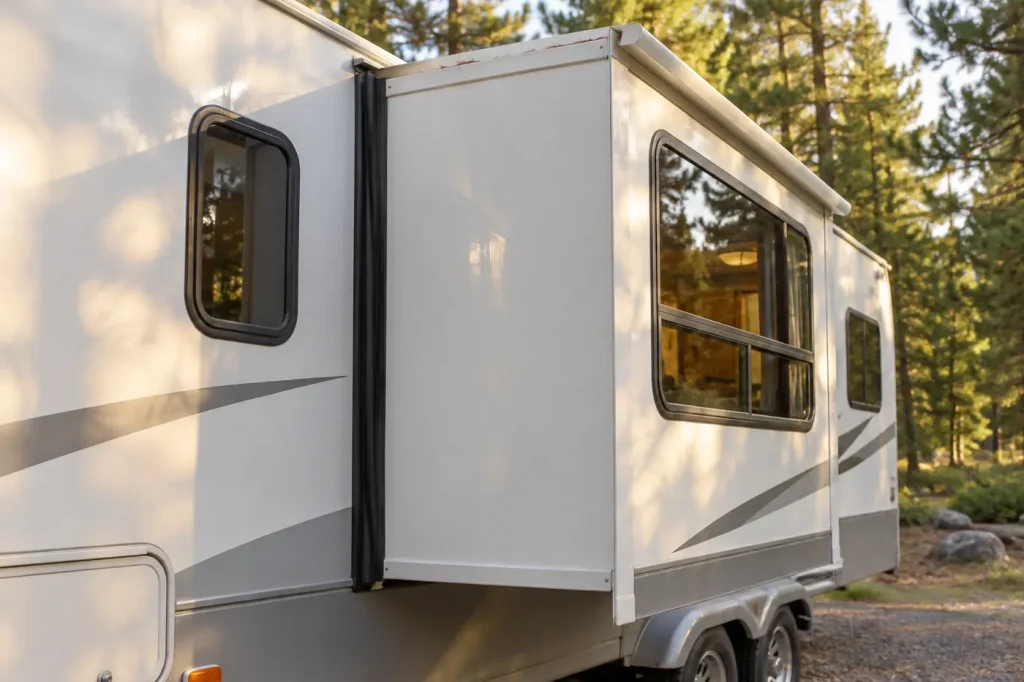
Quick answer
Low battery voltage is the first thing to rule out: Lippert says to charge if an in-wall controller sees under 11 volts, and a SlimRack room won't move at 10.5 volts or less. Then check the slide fuse or breaker, clear the room's path, and count the blinking lights on the controller. An in-wall room that comes out crooked usually needs re-timing.
- Difficulty
- Moderate
- Time
- 15-90 min
- Parts cost
- Usually $0Fuses are cheap, motors and controllers vary by slide system
What you'll need
- Multimeter
- Flashlight
- Spare fuses
- Wire brush
- 3/4 in socket and ratchet
- Cordless drill with hex bit
Tool links go to Amazon. As an Amazon Associate we earn from qualifying purchases, at no extra cost to you.
Common symptoms
- You press the switch and nothing happens: no motor sound, no lights on the controller.
- The room moves slowly, stops partway, or only moves in one direction.
- One side moves a few inches and stops.
- The room goes out or comes in crooked.
- Red and green lights blink on the slide controller or the wall touchpad.
Quick checks before anything else
- The house battery is charged, and the engine or generator is running or the RV is plugged in.
- Lights and other 12V loads you don’t need are turned off.
- Transit bars (the metal bars that lock the room for travel) are removed.
- Nothing blocks the room inside (furniture, rugs, open cabinets) or outside (posts, trees, a folded-over seal).
- Leaves, water and branches are off the top of the room.
- The RV is level, and on a motorhome the parking brake is set.
- The slide fuse or breaker on the 12V panel is good.
What causes it?
- Low battery voltage The most common cause. The room crawls, stalls, or the controller shows a low-voltage code.
- Blown fuse or tripped breaker Nothing happens at all, and the controller lights stay dark.
- Bad ground or loose connection The room works some days and not others.
- Something in the way The room stops at the same spot every time, or a motor current fault appears.
- Motors out of step On in-wall slides, the room comes out crooked after it was stopped partway.
- Failed motor, wiring or actuator One side won’t move, or the motor runs and the room doesn’t.
- You press and hold the switchStatus lights should come on in both directions
- Controller checks voltageBelow 8 volts at start, it stops with code 3
- Both motors runEach motor counts its turns to keep the room square
- Room reaches the endKeep holding a few seconds until the motors shut off
- Did it stop with an error?
Yes: count the red blinks for the code and the green blinks for the motor. Press the switch again to reset the board.
No, but it is crooked: the motors lost their zero point. Re-time the room (step 8).
Step-by-step: RV slide-out troubleshooting, low voltage first
When your RV slide-out is not working, start with power, because low voltage can look like a dead motor or a bad controller. Do these steps in order, then read the section for your slide type.
- Find out which slide system you have Check the owner’s manual packet and the controller label. In-wall (Schwintek) and SlimRack slides have a motor in each side wall. Through-frame slides have tubes and a motor or actuator under the RV. Hydraulic slides have a 12V pump with a fluid tank.
-
Measure the battery voltage Put a meter on the posts. A charged 12V lead-acid battery reads about 12.6 volts at rest. Lippert says to charge if an in-wall controller sees less than 11 volts. A SlimRack controller flags low voltage below 12 volts and will not move the room at 10.5 volts or less. Keystone notes that being plugged in may not be enough, so charge a weak battery first. If it won’t hold a charge, see our guide to an RV battery not charging when plugged in.
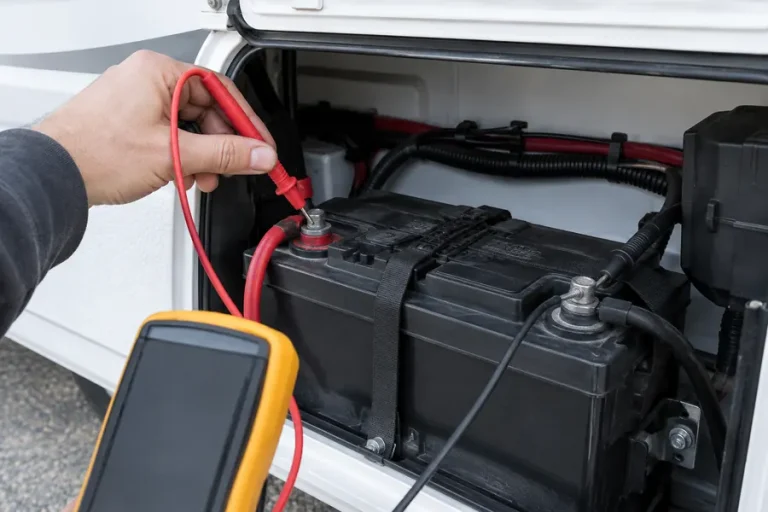
Charge the battery before you blame the motor - Help the battery while the room moves Lippert says to have the engine or generator running, or the RV on shore power, before you move a SlimRack room. Keystone also says to turn off lights and other 12V items you don’t need. Never jump or charge the battery from the controller’s power posts. Lippert says to do it at the battery.
- Check the fuse or breaker Find the slide fuse or breaker on the 12V panel. Lippert says an in-wall slide needs at least a 30-amp breaker, and the RV maker’s papers show where it is. If a new fuse blows right away, there is a wiring fault, and that is a job for a tech.
-
Clean and tighten the power and ground Check the battery terminals, the ground wire to the frame and the plugs at the controller. Lippert’s through-frame and above-floor manuals say over 90% of unit electrical problems come from bad ground connections. With the battery disconnected, clean off corrosion and tighten anything loose.
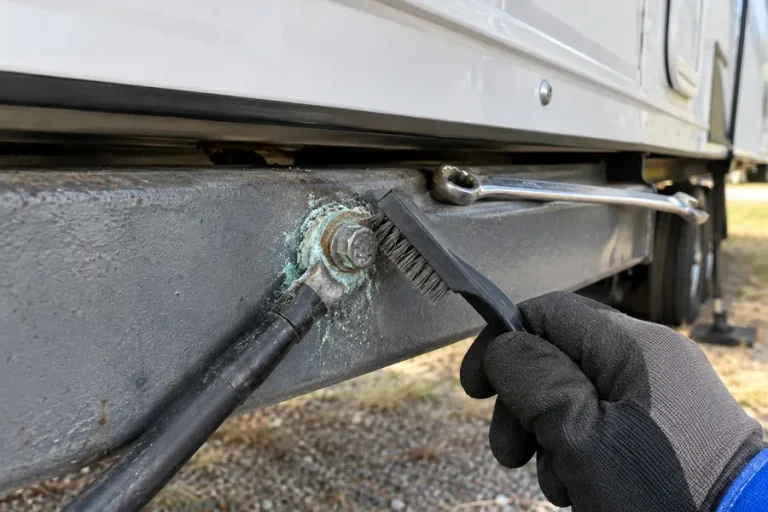
Bad grounds cause many slide electrical problems - Clear the path and meet the safety locks Remove transit bars and anything in the room’s path. Some systems also have interlocks (safety checks that block movement). Lippert’s in-wall manual says a motorhome’s ignition must be off. SlimRack wants the parking brake set and the transmission in park or neutral. Other Lippert systems need the ignition on, so check your manual.
- Read the fault lights Find the controller and press the switch. On Lippert in-wall and SlimRack systems, the green light blinks to show which motor and the red light blinks the fault code. Write the code down before you clear it, then look it up in our Lippert slide-out error codes. If no lights come on in one or both directions, Lippert says to unplug and replug the switch wires at the board. If that fails, the switch or its wiring is bad.
- Re-time an in-wall room that runs crooked Lippert says the controller loses its zero point (its starting count) when the room is not run fully in or out. Hold OUT until the room is fully out, bring it in 8 to 10 inches, and repeat at least three times until both sides move together. From then on, hold the switch 3 to 5 seconds at each end.
Stop. Keep people, pets and hands out of the room’s path and away from gear racks while it moves. Lippert warns that moving parts can pinch, crush or cut. Before you work on or under a slide, Keystone says to disconnect the batteries.
Differences by slide type
After the checks above, the fix depends on the drive system.
Lippert in-wall (Schwintek)
Each side has its own motor. If only one side moves 2 to 4 inches and stops, Lippert says to press the switch while a helper pushes the stuck side. Lippert calls code 8 the most common code. It usually means pinched or broken wiring, or a bad or unplugged motor. Code 5 means too much motor current, often from an obstruction, debris in the gear rack, or a wiper seal caught on the floor.
To bring the room in with an error showing, use the electrical override: press the mode button on the controller six times fast, hold the seventh press about five seconds until the lights flash, then hold IN. Override does not keep the motors in step, so stop if one side lags. Re-time the room afterward.
Lippert SlimRack
With the touchpad controller, minor faults clear when you press IN or OUT, and major faults clear with the SET STOPS/CLEAR FAULTS button on the back of the touchpad. After a major fault, Lippert says a dealer must reprogram the controller. The rocker-switch (auto-programmable) controllers go into Emergency Jog on a major fault, so you may need to press the switch many times. If the power is out or the override fails, Lippert’s last resort is to remove both motors and push the room in evenly. Both sides must move together. See the SlimRack fault codes for each flash pattern.
Through-frame electric
Lippert’s chart says a motor that runs while the room doesn’t move can mean the actuator has come loose from its front mounting bracket, so check the jam nuts. A slow room points to low voltage, a poor ground or very cold weather. If the room stalls mid-travel, crank it a short way with the manual override, then try the switch again. To crank it by hand, disconnect the battery first. Then use a 3/4 inch socket or a fifth wheel landing gear crank on the override extension. Turn clockwise to retract. Stop at the end of travel, because Lippert warns the gears can strip.
Hydraulic
A 12V pump pushes automatic transmission fluid (ATF) to the cylinders. Keystone says to keep the fluid within 1/2 inch of the top of the tank with the rooms in, and Lippert recommends ATF with Dexron III or Mercon 5. Keystone adds that the pump’s self-resetting breaker usually sits within 18 inches of the battery. When it trips, the slide seems to work only some of the time. To retract a Lippert through-frame hydraulic room by hand, run a drill with a hex bit clockwise in the override coupler. Lippert says a standard 38 inch room takes about 45 seconds.
Tools and parts for this fix
Only what this guide uses. For parts, match the part number in your unit's manual before you order.

Reads battery voltage at the slide controller to rule out the low-voltage stall Lippert describes.
Check price on Amazon
Replaces a blown slide fuse on the 12V panel when the controller lights stay dark.
Check price on Amazon
Steelman battery terminal brush
Cleans corrosion off battery terminals and cable ends, a common cause of bad slide grounds.
Check price on Amazon
As an Amazon Associate we earn from qualifying purchases, at no extra cost to you.
When to call an RV tech
- A new fuse blows right away, or the breaker keeps tripping.
- Codes 6, 8 or 9 come back on an in-wall slide after you check the plugs.
- A SlimRack touchpad needed an override. Lippert requires a dealer to reprogram it.
- The room is stuck out and the override won’t bring it in, or only one side moves.
- You hear grinding, see a bent rack, or the room sags or drops.
- Hydraulic fluid leaks under the RV.
For how each system works and what each part does, see our RV slide-out repair guide.
Common questions
How do I reset my RV slide-out?
It depends on the system. On a Lippert in-wall slide, pressing the switch again resets the board after an error, and re-timing (fully out, in 8 to 10 inches, at least three times) resets the motor count. On a SlimRack touchpad, press IN or OUT for a minor fault or the SET STOPS/CLEAR FAULTS button for a major one. A rocker-switch SlimRack controller returns to normal after five minutes with no use, or when you cycle its power.
Where is the fuse for the slide-out on an RV?
Most slides are fed from the 12V fuse panel or a breaker near the battery. For in-wall slides, Lippert says the RV maker’s documents show where the breaker is. Keystone says a hydraulic pump’s breaker usually sits within 18 inches of the battery. If you have no power to the slides at all, check the house battery and that breaker first.
How do I manually retract an RV slide-out?
Use your system’s electrical override first. If that fails, in-wall motors are pulled up to disengage, SlimRack motors are removed, through-frame slides take a crank, and hydraulic slides take a drill. Both sides must move together, and the room needs service before you use it again.
Why is one side of my slide-out not working?
On an in-wall slide, each side has its own motor, so one side stopping usually means that motor, its wiring, or its plug has failed. The fault lights tell you which motor: one green blink for motor 1, two for motor 2. Check the plug at the controller and look for pinched wires. On through-frame and other single-drive slides, a crooked room is more often a mechanical adjustment.
Why won’t my RV slide go in?
The common reasons are low voltage, something blocking the room, a seal or wiper caught on the floor, or a fault code that must be cleared. Charge the battery, clear the path, and read the controller lights. If it still won’t move, use the override to bring it in and book service before you travel. If water is coming in around the room instead, see our guide to an RV slide-out leaking.
Sources
- Lippert In-Wall (Schwintek) Slide-Out Troubleshooting Quick Sheet, Rev 09.09.20 (Forest River hosted copy)
- Lippert In-Wall Slide-Out Owner's Manual, CCD-0001602 (Forest River hosted copy)
- Lippert: Retiming a Schwintek slide-out
- Lippert SlimRack Slide-Out Owner's Manual, CCD-0001459 (Forest River hosted copy)
- Lippert Electric Through Frame Slide-Out Owner's Manual, CCD-0001613 (Forest River hosted copy)
- Lippert Hydraulic Through Frame Slide-Out Owner's Manual, CCD-0001616 (Forest River hosted copy)
- Lippert Above Floor Slide-Out Owner's Manual, CCD-0001598 (Forest River hosted copy)
- Keystone RV Owner's Manual (2027), chapter 11 Slide-Out Systems