RV AC leaking water inside: causes and fixes
Water is dripping from your RV's ceiling AC unit or a vent. Find out if it is condensation that can't drain, a frozen coil melting, or rain getting past the roof seal, and how to fix each one.
 By Complete RV Guide team
Updated Oct 25, 2026
8 min read
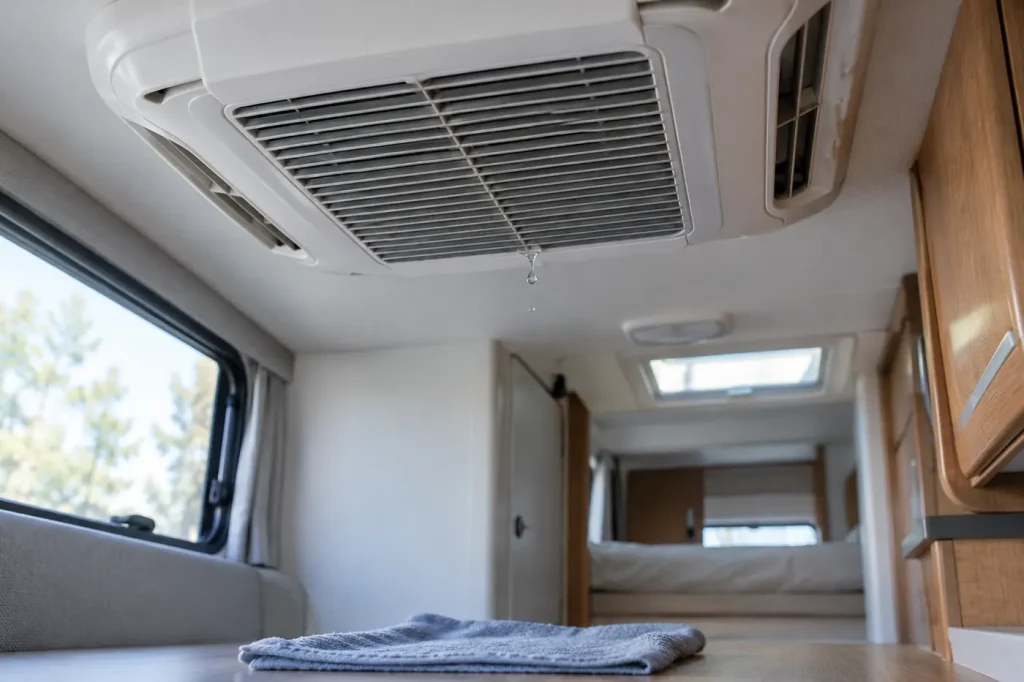
Quick answer
If it drips while cooling, look behind the filter for ice: run high fan until it melts and wash the filters. If there is no ice, clear the drain openings on the roof unit. If it leaks in rain with the AC off, the mounting bolts or gasket are letting water in; Dometic and Furrion call for 40 to 50 inch pounds on the four bolts.
- Difficulty
- Moderate
- Time
- 30-120 min
- Parts cost
- Usually $0A roof gasket kit varies by AC model, plus labor to lift the unit
What you'll need
Tool links go to Amazon. As an Amazon Associate we earn from qualifying purchases, at no extra cost to you.
Common symptoms
- Water drips from the ceiling assembly or the filter grille while the AC cools.
- Water runs out of a ceiling vent or a duct register away from the AC.
- A puddle shows up after you turn the AC off.
- The ceiling around the AC is stained, soft or wet after rain, even with the AC off.
- The air feels very cold but barely moves, and then water drips.
- Vent covers, windows or the ceiling sweat on humid days.
Quick checks before anything else
- Note when it drips: while cooling, after the AC shuts off, or only when it rains.
- Pull the return air filter and look at the coil behind it for frost or ice.
- Wash the filters if they look dirty.
- Open all the ceiling vents and duct registers.
- Close the doors and windows while the AC runs.
- From a ladder, look for leaves and dirt around the roof unit.
Stop. Water and 120 volt power don’t mix. If water is dripping near the ceiling assembly’s controls or wiring, turn the AC off at the breaker before you touch anything. Before you remove the ceiling cover or the roof shroud, unplug shore power, shut off the generator and turn off the inverter, and stay away from the capacitor terminals.
Why is my RV AC leaking water inside?
A rooftop AC makes water as it cools. Dometic says the unit is designed to pull moisture out of the air, and that water should leave on the roof. It ends up inside when the water can’t drain, when there is too much of it at once, or when the seal between the AC and the roof lets rain in.
- Clogged drain openings Leaves and dirt block the openings that let condensation run off the roof unit, so water backs up inside. Drips while cooling.
- Frozen coil melting Ice builds on the inside coil, then melts and spills when the AC cycles off. Very cold air at very low speed comes first.
- Loose mounting bolts or a damaged gasket The roof seal no longer squeezes tight. Leaks in rain, even with the AC off.
- Sweating ducts or vents Cold ducts that aren’t insulated and sealed collect condensation that drips from a register.
- Humid air coming in Open doors and windows feed the AC extra moisture, and cold surfaces sweat.
- Drips while cooling, weak airflowLikely ice on the coil; see it through the filter opening
- Drips while cooling, good airflowDrain openings on the roof unit may be clogged
- Water at a distant ventCold duct sweating; Furrion calls for R-7 duct insulation
- Does it leak in rain with the AC off?
Yes: rain is getting past the roof gasket or bolts. Check bolt torque (40 to 50 inch pounds) and the gasket.
No: it is condensation. Clean the filters, thaw any ice and clear the drain openings.
Step-by-step: stopping an RV AC leak
When your RV AC is leaking water inside, start with the filters and ice, which cost nothing, and leave the roof work for last.
- Look for ice on the coil Dometic says ice on the inside coil shows up as very cold air coming out at very low speed, and you can see the ice through the air inlet with the filter removed. Furrion warns that as the ice melts it can drip from the ceiling trim onto your floor or furniture. If you see frost or ice, go to step 2 before anything else.
-
Thaw a frozen coil Switch the AC to fan only on high. Furrion says to run it about half an hour, and Coleman-Mach says to keep it on high fan until full airflow returns. Put a towel or a bucket under the ceiling assembly to catch the melt. Then resume cooling. If the frost keeps coming back after you clean the filter, Dometic says to call a service center.
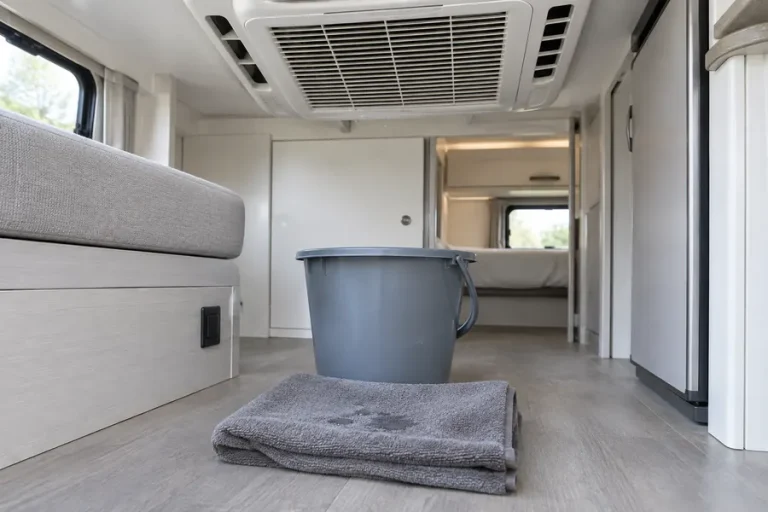
Catch the melt while the fan runs on high -
Wash the filters A clogged filter cuts airflow and can ice up the coil, Coleman-Mach says. Pull the filters from behind the return air grille, wash them in warm soapy water, and let them dry fully before you put them back. Dometic says to do this at least every 2 weeks of use and never to run the unit without its filter, which lets dirt plug the coil.
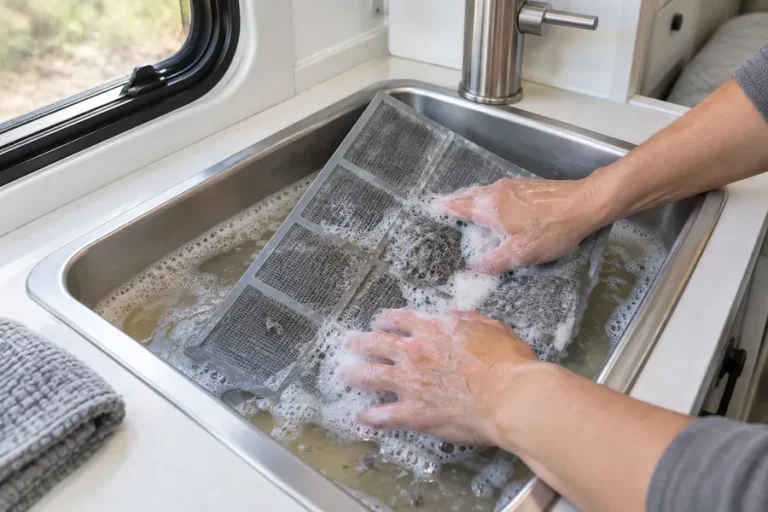
Let the filter dry fully before it goes back in - Keep air moving across the coil Open all the ceiling vents. Furrion says to keep at least two duct vents open in cooling mode, and not to use the coldest setting at night. Coleman-Mach says that when it drops below 75°F outside, set the thermostat to the middle between warmer and cooler. Dometic adds that units frost more easily when it is cool outside, so a warmer setting helps.
- Close up the RV More humid air means more water for the AC to handle. Dometic says keeping doors and windows closed while the AC runs greatly reduces condensation on inside surfaces, and that it is not responsible for damage from condensation on ceilings and windows. Dometic also says the high cool setting gives the most cooling and dehumidifying.
- Clear the drain openings Furrion’s troubleshooting table lists clogged condensation drain openings as a cause of water entering the vehicle, and the fix is to clean them. Leaves and dirt on the roof can block them. With all power off, clear debris from the roof grilles and the drain openings you can reach. Only walk on a roof that is built to be walked on, and if you are not sure, have a tech do it.
- Check vents and ducts that sweat If water drips from a register away from the AC, the duct behind it may be sweating. Furrion’s install manual says to insulate and seal all discharge air ducts to at least R-7 so condensation can’t form on them or nearby surfaces. Furrion also warns that ducts must not bend or collapse, or the roof structure and ceiling can be damaged. Fixing a duct means taking the ceiling assembly off, so it is often a tech job.
- Check the mounting bolt torque The roof unit is held down by 4 long bolts that run up through the ceiling frame from inside. Dometic says to tighten all four evenly to 40 to 50 inch pounds: too little torque gives a poor roof seal and can cause a leak, and too much can damage the base pan or the ceiling template (the frame inside). Furrion gives the same 40 to 50 inch pounds, which compresses the gasket to about 1/2 inch. You need the power off, the ceiling assembly removed, and a torque wrench that reads in inch pounds. Coleman-Mach also says to check periodically that the roof bolts are tight.
- Replace a damaged gasket If the bolts are right and it still leaks in rain, the gasket is likely worn or damaged. Furrion lists damaged seals as a cause of water entering and sends you to a service agent. Dometic and Furrion both warn never to slide the unit across the roof, because that tears the gasket. Replacing it means lifting a unit that Furrion puts at about 100 pounds, so plan on a tech or a hoist.
Dometic vs Coleman-Mach vs Furrion
All three drain condensation onto the roof and seal to it with a gasket on the bottom of the roof unit. The details that matter for leaks:
| Item | Dometic | Coleman-Mach | Furrion Chill |
|---|---|---|---|
| Mounting bolt torque | 40 to 50 in-lb, all four evenly | Not given in the owner’s manual; check bolts are tight | 40 to 50 in-lb, gasket to about 1/2 in |
| Filter care | Wash at least every 2 weeks of use | Clean at least every 2 weeks | Clean every 4 weeks or sooner |
| To thaw ice | Fan only until clear | High fan until full airflow | High fan about 30 minutes |
| Cool-night tip | Warmer setting | Midpoint setting below 75°F outside | No max cool at night, 2 vents open |
On a Dometic CCC 2 or Single Zone thermostat, an E5 code means the freeze sensor is reading wrong and cooling is locked out. Our Dometic thermostat error codes guide explains it. For how the roof unit, ceiling assembly and controls fit together, see our RV AC repair guide.
When to call an RV tech
- Ice keeps coming back after you clean the filters and open the vents.
- Water leaks in rain with the AC off.
- The bolts need checking and you don’t have an inch-pound torque wrench.
- The gasket needs replacing, which means lifting the roof unit.
- The ceiling around the AC is soft, sagging or stained.
- Water is dripping onto the ceiling assembly’s controls or wiring.
If the water shows up along a wall or the floor rather than the ceiling, it may not be the AC at all. Our RV slide-out leaking guide covers one of the other places water gets in, and our RV problem finder sorts the rest by symptom.
Common questions
Is it normal for an RV AC to leak water?
It is normal for an RV AC to make water, but not to drip it inside. Dometic says the unit removes moisture from the air as it cools, and that water should drain off on the roof. Some water running down the outside of the RV on a humid day is fine; drips on your floor are not.
Why is my RV AC leaking water through the vent?
Water at a ceiling vent points to a coil that froze and is melting, or to a duct behind the vent is sweating. Check for ice first through the filter opening. If there is no ice, the duct may need insulation; Furrion calls for R-7.
Why is my RV AC leaking inside when it rains?
If it only leaks in rain, the water is getting past the roof seal, not coming from condensation. Dometic links loose mounting bolts to leaks, and Furrion lists damaged seals. Dometic and Furrion specify 40 to 50 inch pounds on the four bolts, tightened evenly.
Can I still run my AC if it’s leaking water?
Run it on fan only until you find the cause. If the coil is iced, fan only is the fix anyway, and it stops new condensation while you check the filters and drains. Don’t keep cooling if water is dripping near the ceiling assembly’s wiring or soaking the ceiling.
My RV AC drain hole is clogged. How can I fix it?
Turn off all power to the AC, then clear the leaves and dirt from the drain openings and roof grilles on the roof unit. Furrion’s fix for clogged drain openings is simply to clean them. If you would need to take the shroud off to reach them, or you are unsure about walking your roof, have a tech do it.
How do you reseal an RV air conditioner?
First check that the four mounting bolts are tightened evenly to 40 to 50 inch pounds, which squeezes the gasket. If it still leaks, the gasket under the roof unit needs replacing. That means lifting the unit straight up, never sliding it, so we leave it to a tech.
Sources
- Dometic rooftop air conditioner Installation and Operating Instructions (B57915, B59516, 640315; Form 3315079.016)
- Coleman-Mach (Airxcel) 48000 Series Roof Top Air Conditioner Operation and Maintenance Instructions
- Furrion Chill Rooftop Air Conditioner Instruction Manual (FACR13SA, FACR14SA, FACR15SA)
- Dometic Single Zone LCD Thermostat Operating Instructions, Form 3313327.045