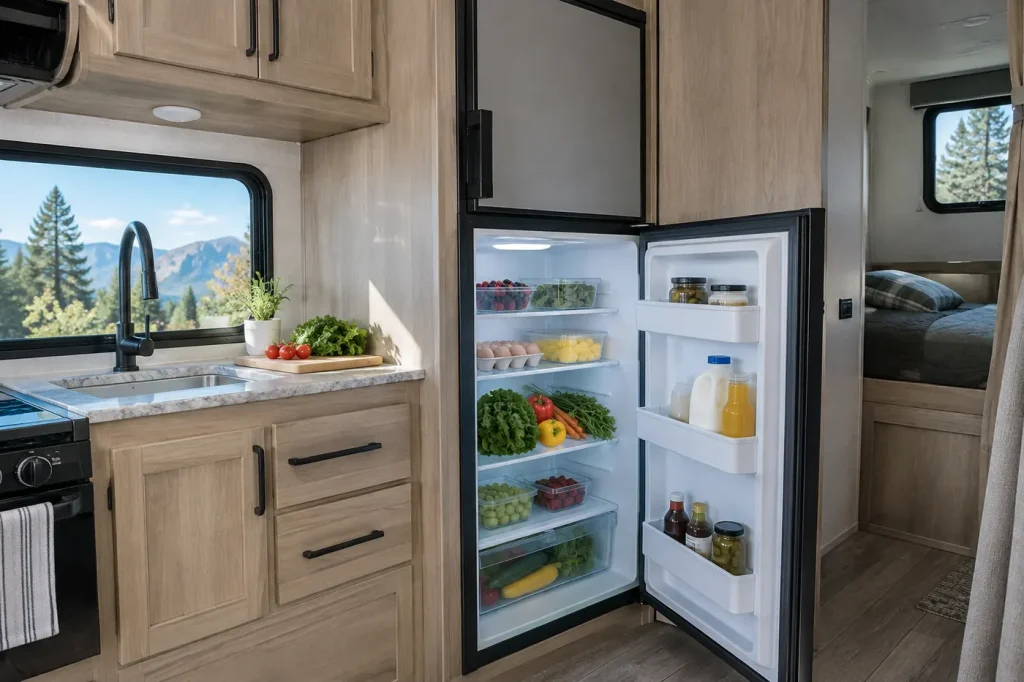
Your RV fridge is warm inside, it works on propane but not on electric, or the display shows a code you do not know. Most RV fridge repair starts with cheap checks you can do yourself: 12 volt power, propane, level and airflow. This page explains how the fridge makes cold, which parts fail, the specs from the Norcold, Dometic and Furrion manuals, and where DIY should stop.
How does an RV fridge work?
Most Norcold and Dometic RV fridges are absorption fridges. They make cold with heat, not a compressor. Sealed tubes on the back, called the cooling unit, hold ammonia, water and hydrogen. A 2-way fridge heats that mix with 120 volt electric or propane. A 3-way model adds a 12 volt heater, which drains the battery fast unless it is being charged.
- Board wakes up. The control board runs on 12 volt DC from your battery or converter, even when the fridge runs on propane or shore power.
- Board picks a heat source. In AUTO mode it uses 120 volt AC when available, otherwise propane.
- Heat reaches the boiler. On electric, a heating element warms the boiler. On propane, the board opens the gas valve and sparks a small burner. If no flame shows up in time, it stops and shows a fault.
- Ammonia boils off and cools. Heat drives ammonia gas out of the water. It rises to the finned coil at the top rear and turns back into a liquid.
- Cold is made inside. The liquid flows by gravity into the evaporator, the tubing in the freezer section, where it evaporates and pulls heat out of the box. Then the cycle repeats.
Because gravity moves the liquid, the fridge must be close to level when parked. A 12V compressor fridge works like a home fridge, with no flame or boiler.
Which RV fridge parts fail, and what are the signs?
| Part | What it does | Sign it is failing |
|---|---|---|
| 12V supply and fuses | Power the control board and protect each circuit | Blank display, a “dc LO” code on Norcold, or one mode dead |
| Control board | Picks the energy source and runs the heat cycle | No response on any mode, or control codes that return after a restart |
| Heating element | Heats the boiler on 120V | Works on propane but not on electric, while the outlet has power |
| Igniter, electrode and burner | Light the propane flame and prove it is lit | Clicking with no flame, “no FL” on Norcold, a flashing CHECK light on Dometic |
| Thermistor | A temperature sensor clipped to the fins inside the fridge box | Fridge too cold or too warm, or a sensor code |
| Cooling unit | The sealed tubes that hold the ammonia mix | No cooling on any mode, an ammonia smell, yellow stains near the boiler |
| Compressor and fans (12V fridges) | Pump refrigerant and move air over the coils | E codes for a compressor start fault or a failed fan |
What should I check first when my RV fridge stops cooling?
- House battery. Charge it and compare the voltage with the specs below. We check this first, because a weak battery stops the fridge on every mode.
- 120V power. Check the outlet behind the outside fridge vent, its breaker and any GFCI outlet.
- Propane. Make sure the tank has gas and every valve is open, including the shutoff valve on the fridge. After a tank swap, turn the fridge off and on a few times to push air out of the line.
- Level. Level the RV whenever you park for more than a few hours.
- Vents. Air must flow from the lower intake vent, through the coils and out the upper vent. Clear nests, leaves and stored items.
- Door seal and load. Look for a torn gasket, heavy frost and an overpacked box.
- Code. Look up any code on the display, for example in our Norcold N64X and N84X code list.
Safety first. If you smell ammonia, turn the fridge off, do not open the doors, open the windows and get everyone out. Then close the fridge gas valve, unplug it and call for service. If you smell propane, do not light anything or touch switches. Turn off 120V and 12V power before you work behind the outside access panel.
RV fridge specs to know
These numbers come from the makers’ manuals. Your exact model may differ, so check the label and manual on your fridge.
| Spec | Norcold absorption (N64X, N84X) | Dometic absorption | 12V compressor (Norcold N15DC, Furrion Arctic) |
|---|---|---|---|
| Power | 120V AC (108 to 132 volts) or propane; 12V DC controls need 10.5 to 15.4 volts | 120V AC or propane; 12V DC controls work down to 9.6 volts | 12V DC only. N15DC starts at 10.9 volts, shuts off at 10.4, restarts at 11.7. Furrion FCR08 and FCR10DCGTA: 9.6 to 17 volts |
| Propane pressure | 11 inches of water column | 11 inches of water column (DMR and DMC 7-series) | No propane |
| Ignition try | 30 seconds per try; repeat 2 or 3 times | About 45 seconds per try; repeat up to 4 times | No burner |
| Level limit when parked | 3° side to side, 6° front to back | No degree limit given; level enough to live in with no noticeable slope | N15DC: 10° in any direction. Furrion: see your model’s manual |
| First cool-down | Cool 8 hours before loading food; call service if not cooling after about 2 hours | A first start can take up to 4 hours before the cooling unit is fully working | N15DC: call service if not cooling after about 2 hours |
| High altitude | Above 5,500 feet, run on AC | Above 5,500 feet, run on electric | No burner to affect |
| How faults show | Two-part codes such as “no FL” | CHECK light on DM and DMA models; LP or E codes on others | N15DC: E codes on the display |
| Reset after a fault | Turn off, then on, to start a new 30 second try | Off for 5 seconds, then on | Furrion hard reset: disconnect all power sources, reconnect, wait 5 to 10 minutes |
Norcold vs Dometic: how are RV fridges different?
Norcold, now part of Thetford, and Dometic make most absorption fridges in US RVs, and both work the same way. The biggest difference when you troubleshoot is the fault display. Larger Norcold models show two-part codes like “no FL”. Many Dometic DM and DMA models only flash a CHECK light, while models like the RM1350 show LP or E codes.
12V compressor fridges, such as the Furrion Arctic from Lippert, have no burner and are less fussy about level; suspect battery voltage and fuses first. Parts do not swap between makers, so note the model and serial number before you order, and check for recalls on the NHTSA recall search.
When should you call an RV tech for fridge repair?
- Cooling unit failure. No cooling on any mode, or an ammonia smell. Dometic says not to keep restarting a fridge that has stopped cooling.
- Gas work. Norcold lists yearly dealer checks: leak testing, gas pressure with a manometer (a low-pressure gas gauge), the burner orifice and a 1/8 to 3/16 inch spark gap.
- Control and sensor codes. Norcold marks codes like “AC rE” and a failed temperature sensor as not owner serviceable.
- 12V compressor faults. Lippert says not to take a Furrion fridge apart yourself.
Shops bill by the hour, so doing the cheap checks first means less time on the clock.
Common questions
How do I reset my RV refrigerator?
Most RV fridges have no reset button; you turn them off and back on. On a Norcold, hold ON/OFF for one second, then press it again to start a new 30 second ignition try. On Dometic DM and DMA models, turn the fridge off for five seconds and back on. A Furrion Arctic hard reset means disconnecting every power source, then waiting 5 to 10 minutes after you reconnect.
Why is my RV refrigerator running but not cooling?
Check level, vents and the heat source first. If it fails on one mode only, that heat source is the problem. If it fails on every mode with good power, gas, level and airflow, suspect the cooling unit.
Why is my RV refrigerator warm but the freezer cold?
The liquid ammonia reaches the freezer first, so a weak system keeps the freezer cold and the fridge warm. Check that the thermistor is clipped to the fins, the vents are clear, the fins are not frosted over and the box is not overpacked. If all of that is fine, have the cooling unit checked.
Why won’t my RV fridge turn on when it has power?
An absorption fridge needs 12 volt DC for its controls, so propane and shore power are not enough. A blank Norcold display means no 12V DC is reaching the panel, so check the house battery, the converter and the fridge fuses. Dometic two-way models use a resettable control fuse that clears when you fix the cause and turn the fridge off and on.
How long does an RV fridge take to get cold?
Norcold says to let its N64X and N84X fridges cool for eight hours before you load food. Dometic says a first start can take up to four hours before the cooling unit is fully working. We start the fridge the day before a trip.
What is the average lifespan of an RV refrigerator?
Norcold and Dometic do not publish a lifespan. Norcold asks for owner checks every three to six months and a yearly dealer safety check. A fridge kept level, vented and serviced avoids the most common failures.