RV fridge not cooling: absorption fridge checks step by step
Your RV fridge is on but the food is warm, or it quits on hot afternoons. Work through these checks from battery and level to vents, burner and the cooling unit.
 By Complete RV Guide team
Updated Oct 25, 2026
9 min read
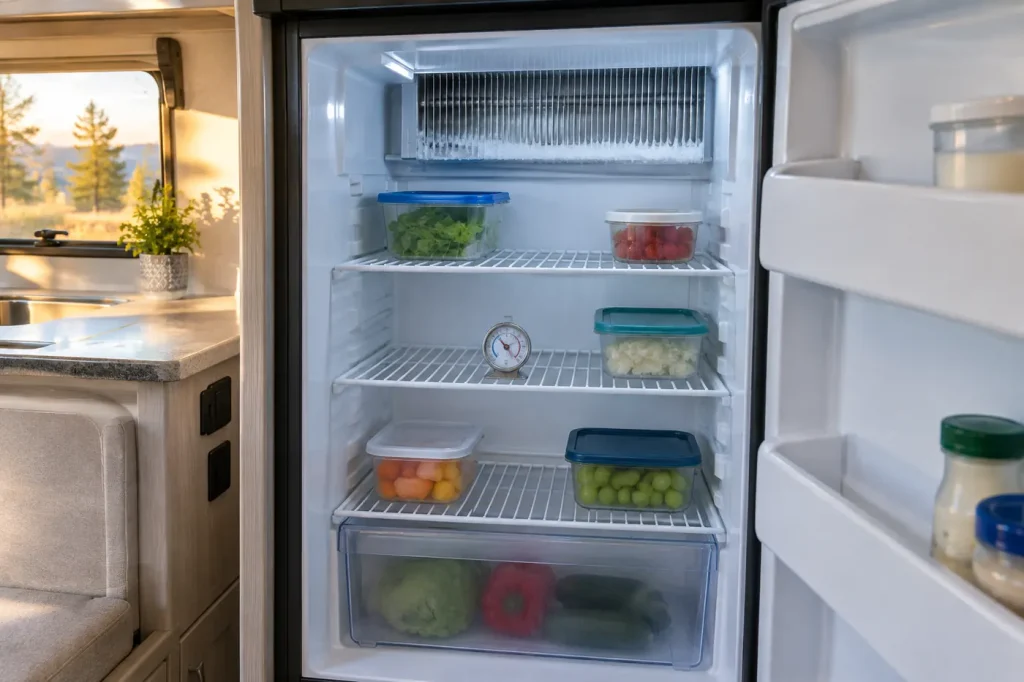
Quick answer
Most RV fridges that stop cooling have low 12V power, an RV that is not level, or blocked vents at the back. Charge the house battery, level the RV, and clear the outside vents, then test electric and propane one at a time to see if one heat source is the problem.
- Difficulty
- Easy
- Time
- 30-90 min
- Parts cost
- Usually $0Sensors, heaters and boards vary by model
What you'll need
- Multimeter
- Bubble level
- Flashlight
- Soft brush
- Fridge thermometer
Tool links go to Amazon. As an Amazon Associate we earn from qualifying purchases, at no extra cost to you.
Common symptoms
- The fridge is on and the light works, but the box feels like room temperature.
- The freezer is cold, but the fridge section is warm.
- It cooled fine at home, then got warm on a hot afternoon.
- It cools on one power source (propane or electric) but not the other.
- The display shows a code or a CHECK light flashes.
Quick checks before anything else
- The house battery is charged. The fridge controls need 12 volts even on propane or shore power.
- The fridge is set to AUTO, not stuck on one manual mode.
- The RV is level, side to side and front to back.
- The outside fridge vents are open and free of nests, leaves and covers.
- The propane tank has gas and its valve is open.
- The door closes tight and the box is not packed full.
- The display shows no code. If it does, write it down first.
What causes an RV fridge to stop cooling?
- Low 12V power The board cannot run the heat source, so nothing works, or Norcold shows “dc LO”.
- Not level Liquid pools in the cooling tubes, so cooling slows or stops after hours parked.
- Blocked or hot airflow Heat cannot leave the coils at the back, so cooling fades on hot days.
- No heat on one source Works on propane but not electric, or the reverse. Points to that source.
- Frost, door seal or overloading The fridge runs, but the cold does not reach the food.
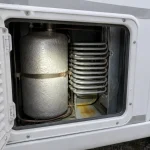
- Failed cooling unit No cooling on any source with good power and gas, sometimes with an ammonia smell.
Step-by-step: RV fridge not cooling, cheapest checks first
Most Norcold and Dometic RV fridges are absorption fridges: they make cold with heat, not a compressor. Work in order, because a weak battery or a slope can look like a dead fridge.
- 12V reaches the boardNorcold controls need 10.5 to 15.4 volts DC
- Board picks a source120V AC first, propane if no AC
- Heat reaches the boilerElectric element, or a 30-second try to light the burner
- Ammonia cools by gravityLiquid flows into the freezer section first, then the fridge fins
- Cooling down after about 2 hours?
Yes: let it run. Norcold says to cool it 8 hours before you load food.
No: work through the steps below. Norcold says to contact a dealer if it has not started to cool after about two hours.
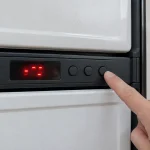
- Read the display first A code tells you where to look. On many Norcold models, “no FL” means the burner did not light, “no AC” means no 120V, and “dc LO” means low 12V. Our Norcold error code guide explains each family. On Dometic DM and DMA models, a flashing CHECK light means the burner did not light.
-
Measure the house battery Put a meter across the battery posts. A charged lead-acid battery at rest reads about 12.6 volts. Norcold gives a control range of 10.5 to 15.4 volts DC, and Dometic says its controls work down to 9.6 volts. If it is low, charge it or plug in, then check that the converter is charging. Our guide to an RV battery not charging when plugged in covers that side.
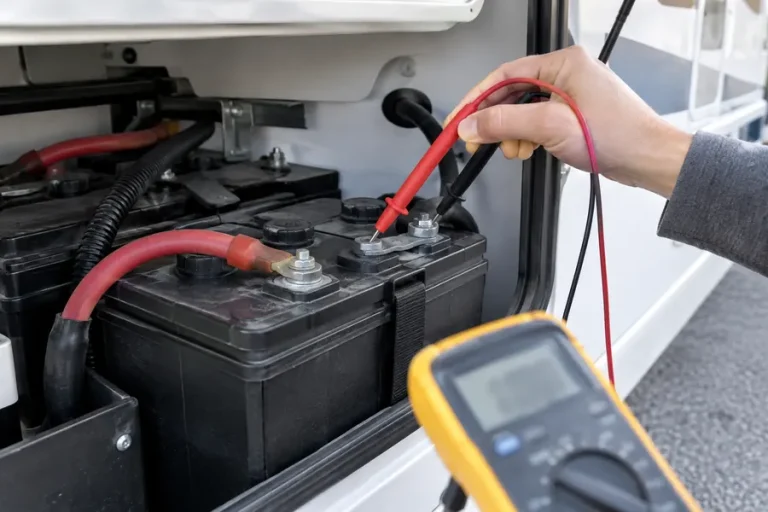
Meter probes on the battery posts - Check the mode In AUTO, a Norcold uses 120V AC when it has it and propane when it does not. On Norcold models with a display, push and release MODE to see the current mode for 10 seconds. A fridge left in manual LP mode will not switch to shore power. If it cools on one source only, use our guide to an RV fridge not working on electric.
-
Level the RV Norcold says its N64X and N84X fridges work within 3° off level side to side and 6° front to back. Dometic gives no degree limit but says to level the RV so it is comfortable to live in, with no slope you notice. Out of level, liquid ammonia collects in the cooling tubes and blocks the flow. Use a bubble level on the freezer floor. Level does not matter while you drive.
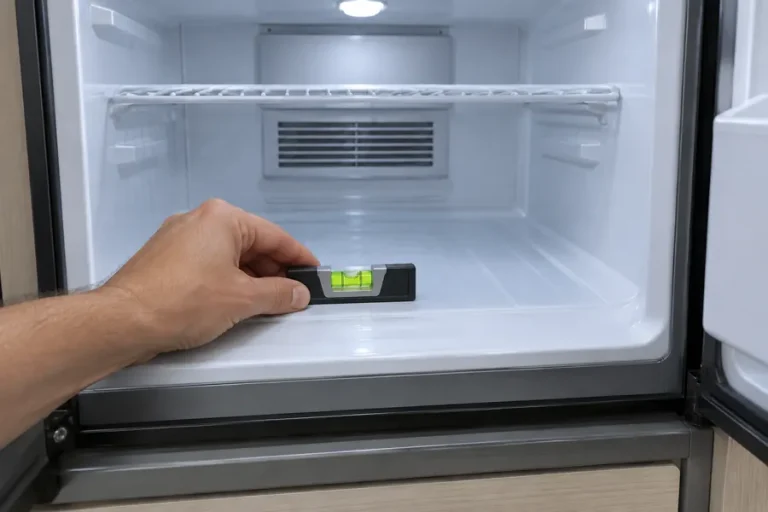
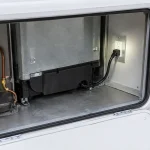
A small level on the freezer floor - Clear the outside vents Air must come in the lower vent, rise past the coils at the back, and leave through the upper vent on the roof or side wall. Norcold’s installation manual says the fridge will not cool correctly if this airflow is blocked or reduced. Open the lower vent cover and look for nests, webs, leaves, and stored items.
- Check propane and purge air Make sure the tank has gas and every valve is open, including the shutoff valve on the fridge. After a tank swap or storage, air in the line can stop the burner from lighting. On a Norcold, turn the fridge off and on to start a new 30-second try, two or three times. Dometic allows about 45 seconds per try and up to four tries.
- Check door seals and load Close the door on a dollar bill and pull it. You should feel a light drag on all four sides. Norcold says to let air move freely and not to cover shelves with plastic or paper. Dometic says not to overpack.
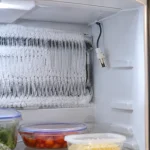
- Defrost heavy frost The metal fins inside the fridge run below freezing and collect frost. Norcold says excess frost lowers cooling. Turn the fridge off, empty it, and use pans of warm water. Never use a hair dryer, hot water, a knife or an ice pick. Dometic warns a sharp tool can puncture the cooling system.
- Check the thermistor The thermistor is a small temperature sensor clipped to the fins inside the fridge. If it slips off or gets iced over, the board reads the wrong temperature. Dometic says to clip it to the last fin on the right side and center it on the fin. On some Norcold models, a flashing temperature number means the sensor failed and a backup system is running the fridge. If only the fridge section is warm, read why the freezer stays cold while the fridge gets warm.
- Look at the burner flame This applies only on propane. Norcold says a good flame is darker blue inside and lighter blue outside, steady, and not touching the flue tube. A yellow or flickering flame, or soot, means a dirty burner, flue or jet. Burner cleaning and gas pressure (11 inches of water column) are dealer jobs.
- Test each power source Run the fridge on AC alone for a few hours, then on propane alone. If it cools on one but not the other, the problem is that heat source. If it will not cool on either, with good 12V, level, airflow and gas, suspect the cooling unit. Dometic says to turn it off and call service, and not to keep restarting it.
Stop. If you smell ammonia, or see yellow stains near the burner at the back, turn the fridge off at the panel and do not open its doors. Open the RV windows and doors and get everyone out. Read our ammonia smell guide before you do anything else.
RV fridge not cooling in hot weather
An absorption fridge sheds its heat through the coils at the back. On a very hot day that air is already warm, so the fridge loses ground. Dometic says its DM and DMA fridges should not run in temperatures above 110°F for more than 12 hours at a time.
On hot days, keep the vents fully clear and check that any vent fan runs. Dometic fits a 3 amp inline fuse on the fan wire for models with vent fans. Norcold says a side-wall upper vent needs a fridge with a fan, or cooling will be poor. We park with the fridge side in shade when we can and load cold food. If cooling got worse after the fridge was pulled out for service, ask the tech to check the baffle above it. Norcold’s installation manual uses one to stop hot air from pooling there.
Norcold vs Dometic vs 12V compressor fridges
Norcold. Bigger models show two-part codes on the display, like “no FL” or “dc LO”. Some show “no co” or “n” when the board senses the cooling unit stopped cooling. On some models you can clear it once. If it comes back after a reset, Norcold says it is not owner serviceable.
Dometic. DM and DMA models flash a CHECK light for a gas fault only, so the light tells you nothing about cooling. Models like the RM1350 show LP or E codes, where E3 means the cooling unit has malfunctioned.
12V compressor fridges. These work like a home fridge, with no burner and no boiler. They care more about battery voltage. The Norcold N15DC needs 10.9 volts to start, shuts off at 10.4 and restarts at 11.7. It allows 10° off level, and Norcold says cooling suffers above 110°F. Its fuses sit under the fridge. For a Furrion Arctic, Lippert’s hard reset is to disconnect all power, reconnect, and wait 5 to 10 minutes. For more on each brand, see our RV fridge repair guide.
Tools and parts for this fix
Only what this guide uses. For parts, match the part number in your unit's manual before you order.
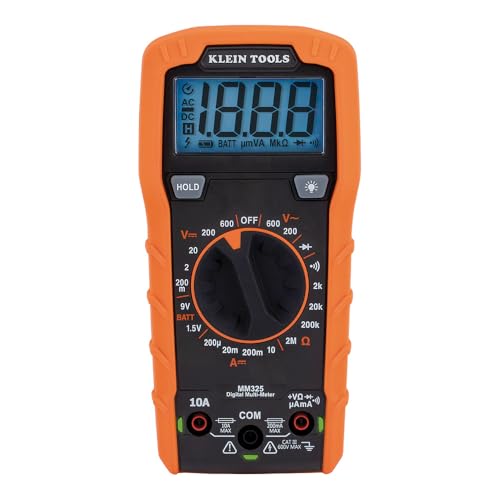
Read the house battery voltage at the posts before you blame the fridge.
Check price on Amazon
Rubbermaid Commercial fridge/freezer thermometer
Track the box temperature while you test electric and propane one at a time.
Check price on Amazon
Camco 25573 bullseye bubble level
Set it on the freezer floor to check the RV is level in both directions.
Check price on Amazon
As an Amazon Associate we earn from qualifying purchases, at no extra cost to you.
When to call an RV tech
- It will not cool on any power source, with good 12V, level and clear vents.
- You smell ammonia or see yellow residue at the back.
- The burner will not light after two or three tries (Norcold) or four (Dometic).
- Norcold shows a code it calls not owner serviceable, like “AC rE” or “Sr”, or “no co” returns after one reset.
- A fuse blows again right after you replace it.
Another appliance acting up too? Try our RV problem finder.
Common questions
Why is my RV refrigerator running but not cooling?
The most common reasons are a slope, blocked vents, or a heat source that is not doing its job. Level the RV, clear the vents, then test AC and propane one at a time. If it fails on both with good power and gas, the sealed cooling unit is the likely cause.
How do you reset an RV refrigerator?
Most RV fridges have no reset button; you turn them off and back on. On a Norcold with a display, hold ON/OFF for one second to turn it off, then press it again for a new 30-second ignition try. On Dometic DM and DMA models, turn it off for five seconds, then back on.
How long should an RV fridge take to cool down?
Norcold says to let its N64X and N84X fridges run eight hours before you load food. Dometic says a first start can take up to four hours before the cooling unit fully works. If a Norcold has not started to cool after about two hours, Norcold says to contact a dealer.
How much does RV fridge repair cost?
Many fixes here cost nothing: charging the battery, leveling, clearing vents or defrosting. Parts like heating elements, boards and sensors vary by model, and shops bill labor by the hour. A cooling unit or whole fridge is the big cost, so rule out the free causes first.
What is the average lifespan of an RV refrigerator?
Norcold and Dometic do not publish a lifespan in the manuals we checked. Norcold asks for owner checks every three to six months and a yearly dealer safety check. Keeping the fridge level, the vents clear and the burner clean avoids the most common failures.
Sources
- Norcold N62X, N64X, N82X and N84X Owner's Manual (635488C)
- Norcold N611v and N811v Installation and Owner's Manual (636158G)
- Norcold 1200 Series Owner's Manual (621823J)
- Norcold N41X and N51X Owner's Manual (635480E)
- Norcold N15DC and N20DC Owner's Manual (641013E)
- Dometic DM and DMA Refrigerators Operating Manual (3317001.000)
- Dometic DMR/DMC 7-Series Installation and Operating Instructions (Forest River copy)
- Dometic RM1350 Operating Instructions (Forest River copy)
- Furrion Arctic 8 and 10 cu. ft. Troubleshooting and Service Manual (CCD-0008122)