RV freezer cold but fridge warm: what it means
The freezer is frozen solid but the fridge below it is only cool. In an absorption fridge the freezer gets the cold first, so this usually points to frost, the sensor, airflow or weak heat, not a broken freezer.
 By Complete RV Guide team
Updated Oct 25, 2026
8 min read
Quick answer
The freezer gets the cold first, so a fridge that falls behind usually has frosted fins, a thermistor out of place, or a packed box that blocks airflow. Defrost the fins, re-clip the thermistor where the manual shows, unpack the shelves, then level the RV and clear the vents.
- Difficulty
- Easy
- Time
- 30 min plus defrost time
- Parts cost
- Usually $0A thermistor varies by model
What you'll need
- Fridge thermometer
- Glass of water
- Towels
- Pans of warm water
- Bubble level
Tool links go to Amazon. As an Amazon Associate we earn from qualifying purchases, at no extra cost to you.
Common symptoms
- Ice cream is hard in the freezer, but milk in the fridge is only cool.
- The bottom shelf is cold and the top shelf and door bins are warm.
- The fridge is fine at night and warm by late afternoon.
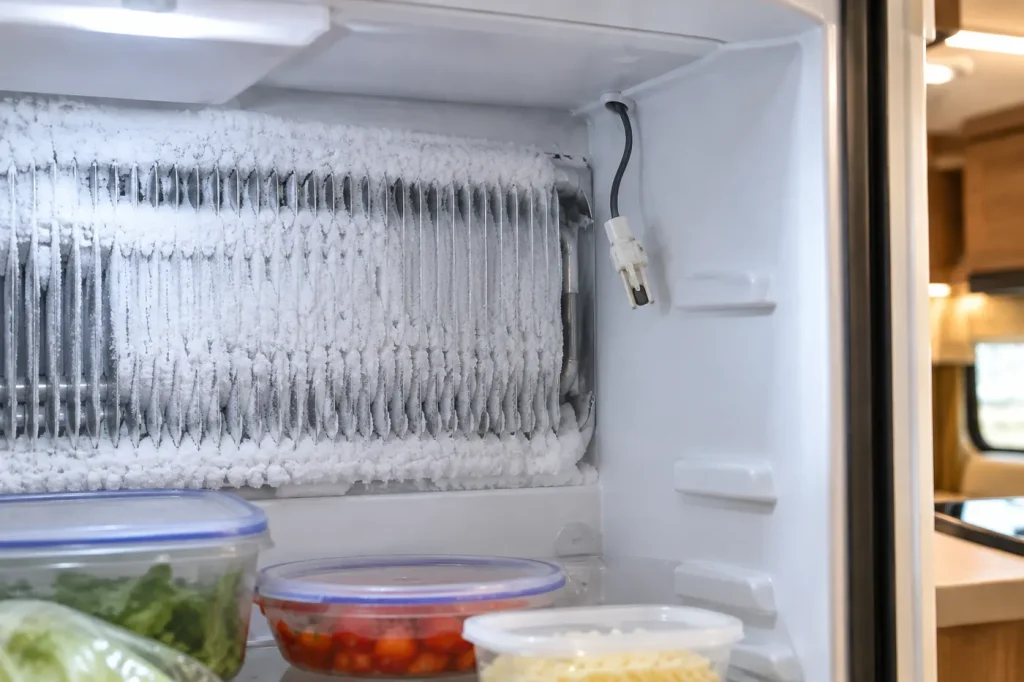
- The metal fins at the back of the fridge section are coated in thick frost.
- Food near the fins freezes while the rest of the box stays warm.
Quick checks before anything else
- Put a thermometer on the middle shelf and read it after an hour with the door shut.
- Check the temperature setting has not been turned down.
- Look for thick frost on the cooling fins inside the fridge.
- Move food so air can flow, and take plastic or paper off the shelves.
- Do the dollar-bill test on the door seal.
- Level the RV and check the outside vents.
Why is the freezer cold but the fridge warm?
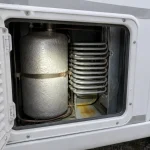
In an absorption fridge, the cold starts in the freezer. Dometic explains that liquid ammonia forms in the finned coil at the top rear, then flows by gravity into the evaporator inside the freezer section, where it evaporates and makes cold. The fins in the fridge section get what is left. So when the system is short on cold for any reason, the freezer keeps working and the fridge falls behind.
That means “freezer cold, fridge warm” is usually not a broken freezer. It is a fridge that cannot move enough cold from its fins into the box, or a system running a little weak.
- Frost on the fridge fins Ice insulates the fins, so cold cannot reach the air in the box.
- Thermistor out of place The temperature sensor reads the wrong spot and stops the cycle too soon.
- Setting too low The control was bumped toward warm.
- Packed box or bad seal Cold air cannot circulate, or warm air leaks in.
- Weak heat or airflow Not level, blocked vents, hot weather, or a dirty burner.
- Weak cooling unit An early sign of a failing sealed system, after everything else checks out.
- Heat at the boilerElectric element or propane burner
- Ammonia turns to liquidIn the finned coil at the top rear
- Freezer gets it firstLiquid flows by gravity into the freezer evaporator
- Fridge fins nextThe thermistor on these fins tells the board when to stop
- Fins clear and sensor in place?
Yes: look at heat and airflow: level, vents, burner and the heat source (steps 7 to 9).
No: defrost the fins or re-clip the sensor first (steps 5 and 6).
Step-by-step: RV fridge not cold but freezer is
Start with the free checks inside the box. Most cases end at step 5 or 6. Give the fridge time after each change, because an absorption fridge reacts slowly.
-
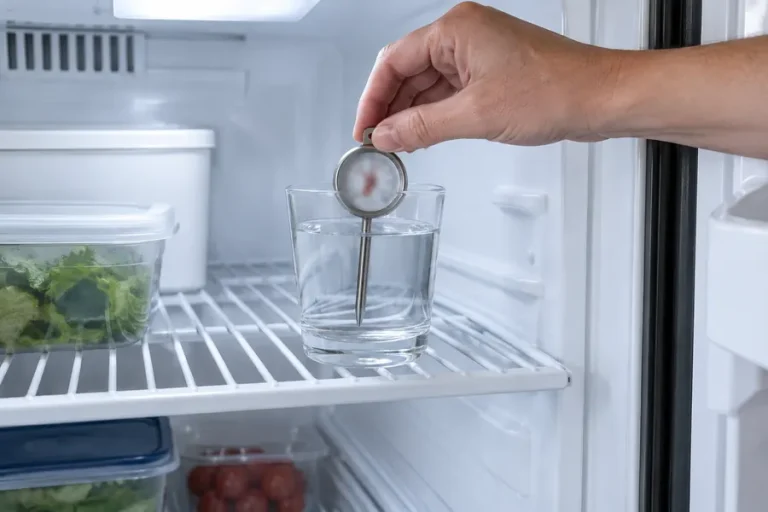
Measure the real temperature Put a fridge thermometer in a glass of water on the middle shelf, close the door, and read it after an hour. The water shows the food temperature better than an air reading. Food safety agencies say to keep a fridge at 40°F or below. Note the number, so you can tell whether each change helps.
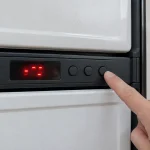
A thermometer in water reads like the food does - Check the temperature setting On Norcold models with TEMP SET, 9 is the coldest setting. On Dometic DMR and DMC fridges, 5 is the coldest. Some Dometic DM and DMA models have a factory preset and no control. Turn it one step colder and wait. Norcold’s 121X manual says to allow about an hour after each setting change before you check the food.
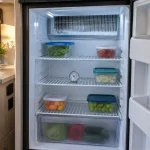
- Make room for air Norcold says to let air move freely through the whole food compartment and not to cover shelves with plastic or paper. Dometic says not to overpack, and that a stuffed fridge works harder and runs warmer. Keep food off the fins and pull items back from the walls. Let hot food cool before it goes in.
- Test the door seal Close the door on a dollar bill and pull it out. You should feel a light drag. Do this on all four sides. A loose spot lets warm, damp air in, which warms the box and builds frost fast.
-
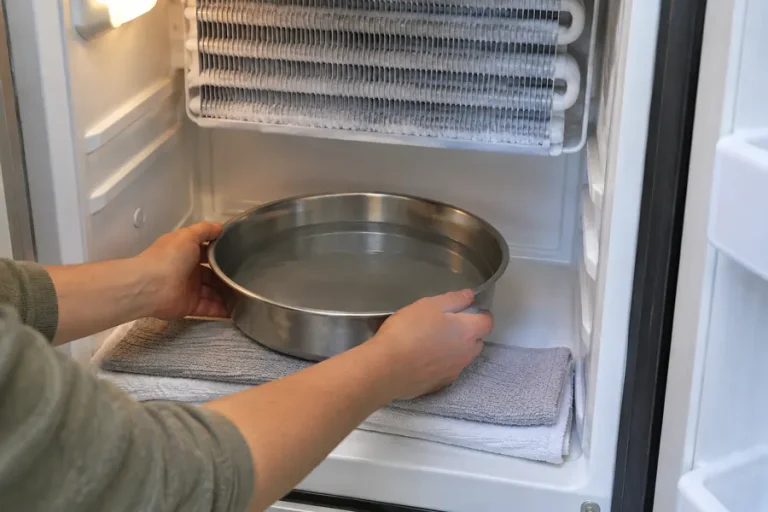
Defrost the fins The fins at the back of the fridge section run below freezing and collect frost from damp air. Norcold says excess frost lowers cooling. To defrost, turn the fridge off, empty it, and set pans of warm water inside. Do not use a hair dryer, hot water, a knife or an ice pick. Dometic warns a sharp tool can puncture the ammonia system.
Warm water and towels, never a hair dryer - Check the thermistor The thermistor is a small sensor clipped to the fins. Dometic says the bracket goes on the last fin on the right side, centered up and down, with the bulb seated in its groove. On Norcold N611v and N811v models, moving the clip changes the setting: left is colder, right is warmer, three or four fins at a time. If it fell off or got packed in ice, the board reads the wrong temperature.
- Level the RV Norcold allows 3° side to side and 6° front to back on its N64X and N84X. Dometic says to level so the RV is comfortable to live in. Out of level, liquid ammonia collects in the evaporator tubes and slows the flow.
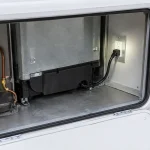
- Clear the vents and the coils Air must come in the lower outside vent and leave through the upper one, carrying heat off the coils. Clear nests and debris. In hot weather, the fridge may hold the freezer but not the box. Dometic says not to run DM and DMA models above 110°F for more than 12 hours at a time.
- Compare propane and electric Run a few hours on AC only, then on propane only, and compare thermometer readings. If one source is clearly weaker, focus there. Dometic lists a dirty burner, a clogged jet, a flue baffle out of place and low gas pressure as causes of a fridge that is not cold enough. Gas pressure should be 11 inches of water column, a check for a tech.
- Suspect the cooling unit last If the fins are clear, the sensor is placed right, it is level and vented, and both sources run weak, the sealed cooling unit may be losing capacity. Norcold says not to try to repair or recharge it. Our guide to an RV fridge not cooling covers the full test, and a tech can confirm it.
If the fridge is too cold instead, freezing lettuce and milk, the thermistor is the first suspect. Dometic’s fix for “refrigerator is too cold” is to re-seat the bracket and bulb exactly as in step 6.
Stop. If you smell ammonia or see yellow residue near the burner at the back, turn the fridge off and keep its doors closed. Air out the RV and read our guide to an ammonia smell first.
Norcold vs Dometic: sensors and settings
Norcold. Models with a display let you set 1 to 9. If the sensor fails, the board switches to a backup operating system, and on many models the temperature number flashes when you press TEMP SET. Norcold says this backup can overfreeze or thaw food, so check temperatures and book service. The flashing number is listed with the other codes in our Norcold error code guide. On N611v and N811v models there is no setting button; you move the thermistor clip instead.
Dometic. DMR and DMC models set 1 to 5. On DM and DMA models, if the board cannot read the sensor, it runs the cooling unit nonstop until a new sensor is installed. Dometic’s sensor and bracket placement is the same idea across its manuals: the last fin on the right side, centered.
Thermistors are model specific, so read the label inside the fridge before you order one. For how the whole system works, see our RV fridge repair guide.
Tools and parts for this fix
Only what this guide uses. For parts, match the part number in your unit's manual before you order.

Rubbermaid Commercial fridge/freezer thermometer
Put it in a glass of water on the middle shelf to read the real food temperature.
Check price on Amazon
Camco 25573 bullseye bubble level
Check the RV is level so liquid ammonia does not pool in the cooling tubes.
Check price on Amazon
As an Amazon Associate we earn from qualifying purchases, at no extra cost to you.
When to call an RV tech
- A Norcold shows a flashing temperature number, which means a failed sensor.
- Heavy frost keeps coming back fast, even with a good door seal.
- Both propane and electric run weak after you have done steps 1 to 8.
- The burner flame is yellow or you see soot in the burner area.
- You smell ammonia or see yellow stains at the back.
If more than one appliance is acting up, start at our RV problem finder.
Common questions
Why is my RV refrigerator not getting cold but the freezer is?
Because the freezer gets the cold first. Liquid ammonia flows into the freezer evaporator before it reaches the fins in the fridge section. Frost on those fins, a misplaced sensor, a packed box or a weak heat source leaves the fridge short while the freezer stays cold.
How do I make my Dometic RV refrigerator colder?
Turn the temperature control one step colder if your model has one; on DMR and DMC models, 5 is the coldest. Then make room for air, defrost the fins, and check that the thermistor bracket sits on the last fin on the right. Some DM and DMA models are factory preset and have no control.
How do I adjust the temperature sensor on my RV refrigerator?
On many fridges you do not move it; you use the control panel. On Norcold N611v and N811v models, Norcold says to slide the clip to another fin: left for colder, right for warmer, three or four fins at a time. Check the result with a thermometer before you move it again.
What are the symptoms of a bad RV fridge thermistor?
The fridge runs too cold or too warm for no clear reason. On many Norcold models with a display, the temperature number flashes and a backup system takes over. On Dometic DM and DMA models, the cooling unit runs nonstop, which can make the fridge too cold.
How do I fix my fridge not cooling when the freezer works?
Work from the inside out. Defrost the fins, re-seat the thermistor, unpack the shelves and check the door seal. Then level the RV and clear the vents. If it is still warm after all that, have a tech check the burner, gas pressure and cooling unit.
Sources
- Norcold N62X, N64X, N82X and N84X Owner's Manual (635488C)
- Norcold 121X Series Owner's Manual (635494E)
- Norcold N611v and N811v Installation and Owner's Manual (636158G)
- Dometic DM and DMA Refrigerators Operating Manual (3317001.000)
- Dometic Americana DM2652/DM2852/DM2662/DM2862/DM2663 Operating Instructions
- Dometic DMR/DMC 7-Series Installation and Operating Instructions (Forest River copy)