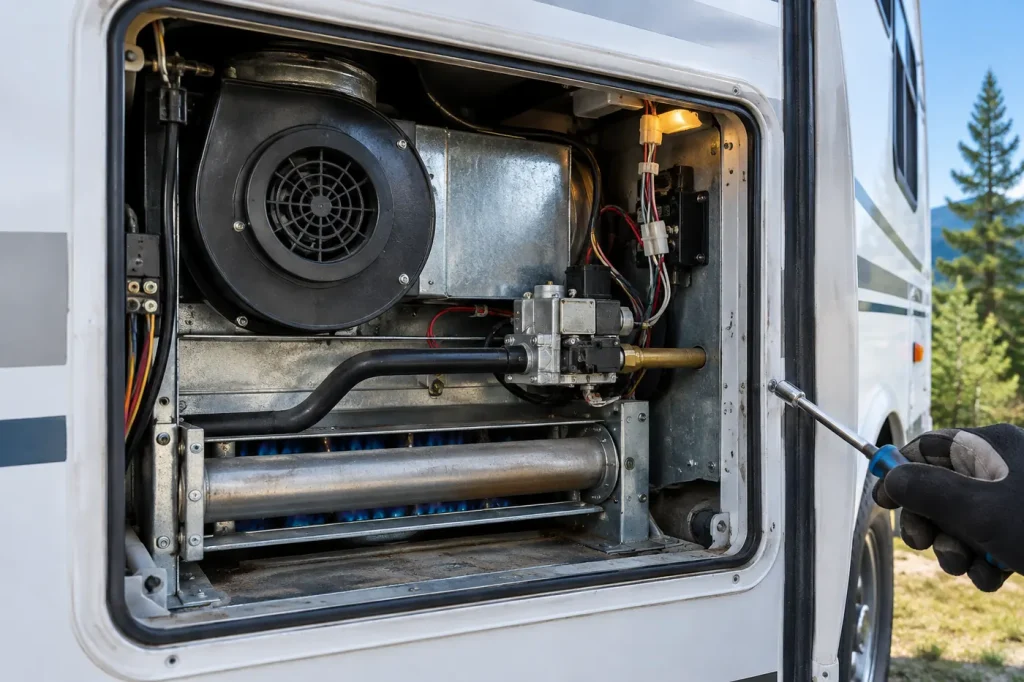
Your RV furnace is blowing cold air, clicking with no flame, or doing nothing at all, and the night is getting colder. Most RV furnace repair starts with a few cheap checks you can do yourself once you know what the furnace is trying to do. This page explains how it works, which parts fail, the specs that matter, and where DIY should stop.
How does an RV furnace work?
An RV furnace burns propane, but it runs on 12 volt DC power from your battery or converter. It is sealed, so combustion air comes from outside and exhaust goes back outside. One motor turns two fans: one feeds the burner, the other blows cabin air over the heat exchanger (the hot metal box around the flame).
- Thermostat calls for heat. The room drops below the set point and the thermostat signals the furnace.
- Blower starts. The 12V motor spins up both fans.
- Sail switch closes. The sail switch is a small paddle that moving air pushes shut. It proves there is enough airflow before any gas flows. Suburban says it closes at about 75% of normal blower speed.
- Purge, then spark. After about 15 seconds of airflow, the control board opens the gas valve and sparks an electrode. This is direct spark ignition (DSI): no pilot flame, just a spark at each start.
- Flame sensing. The board checks for flame through a sensor. If it sees one, sparking stops. If not, it tries again. After three failed tries the furnace locks out.
- Limit switch. This heat-sensitive switch opens and shuts off the gas if the furnace overheats, often because airflow is blocked.
Which RV furnace parts fail, and what are the signs?
| Part | What it does | Sign it is failing |
|---|---|---|
| Thermostat | Tells the furnace when to start and stop | Nothing happens at all, or the furnace runs at the wrong temperature |
| Blower motor | Moves cabin air and combustion air | No fan sound, a slow fan, or grinding and squealing |
| Sail switch | Proves airflow before gas flows | Blower runs but never sparks, often worse on a low battery |
| Limit switch | Shuts off gas if the furnace overheats | Burner lights, then quits after a few minutes while the fan keeps going |
| Control board | Runs the sequence, sparks, opens the gas valve | No spark with the blower running, or lockouts when gas and voltage are good |
| Gas valve | Lets propane reach the burner | Spark but no flame, while the stove lights fine |
| Electrode and flame sensor | Make the spark and confirm the flame | Flame lights and dies within seconds, or carbon on the tips |
What should I check first when my RV furnace stops working?
- Battery voltage. A healthy 12V lead-acid battery at rest reads about 12.6 volts. Suburban lists 10.5 volts as the minimum for its furnaces. We check this first, because a weak battery can slow the fan until the sail switch never closes.
- Propane. Make sure the tank has gas and its valve is open, then light a stove burner.
- Fuse. Check the furnace fuse on the 12V panel.
- Thermostat. Set it to heat and a few degrees above room temperature.
- Airflow. Clear the return-air grille, where room air flows back in, and open the vents. Suburban notes that too little return air makes the furnace cycle on its limit switch.
- Outside vent. Check the vent on the outside wall for insect nests.
Safety first. If you smell propane, do not try to light the furnace. Get everyone out, close the tank valve, and air the RV out. Keep a working carbon monoxide alarm and LP gas detector inside. Never jump or bypass the sail switch or limit switch. Turn off 12V power before you take the cover off.
RV furnace specs to know
These numbers come from the makers’ manuals. Your exact model may differ, so check the label and manual on your furnace.
| Spec | Suburban | Atwood (Dometic) |
|---|---|---|
| Power | 12V DC, works from 10.5 to 13.5 volts | 12V DC |
| Propane pressure | 11 to 14 inches of water column at the furnace | 10 to 13 inches of water column for the whole system, with all appliances running |
| Airflow proof | Sail switch closes at about 75% of normal blower speed | Sail switch |
| Lighting sequence | About 15 seconds of purge, then about 7 seconds of spark per try | Allow 30 seconds for the burner to light |
| Tries before lockout | 3 | 3 |
| How to clear a lockout | Turn the thermostat off, let the blower stop, turn it back on | Hard lockouts: thermostat or furnace power switch. Some soft lockouts retry by themselves after 1 hour |
| Fault light | No flash codes on older boards; diagnose with a meter | LED flashes: 1 = limit or airflow, 2 = flame sense, 3 = ignition lockout, steady on = board failure |
| Spark gap | 1/8 inch | See your model’s manual |
Suburban vs Atwood: how are RV furnaces different?
Most US RVs have a Suburban or an Atwood furnace. Suburban is part of Airxcel. Atwood is now owned by Dometic, and its furnaces are often called Hydroflame. Both work the same way: 12V blower, sail switch, direct spark ignition and a limit switch.
The biggest difference when you troubleshoot is the fault light. Many Atwood boards flash a code that tells you whether the problem is airflow, flame sensing or ignition. Older Suburban boards have no code, so you work through the sequence with a meter. The other difference shows up when you buy parts: boards, sail switches, motors and gas valves do not swap between brands, and often not between models of one brand. Write down the model and serial number from the furnace label before you order anything.
When should you call an RV tech for furnace repair?
- Gas valve work. If the board sends power to the valve and it does not open, the valve needs replacing, followed by a leak test.
- Gas pressure. Testing takes a manometer, a gauge that reads gas pressure in inches of water column.
- Control board diagnosis. Suburban says its boards are not field repairable, and testing one takes a meter and the wiring diagram.
- Soot, scorch marks, or a CO alarm. Shut the furnace down until someone checks the burner and heat exchanger.
Shops bill by the hour, so doing the cheap checks first means less time on the clock.
Common questions
Is there a reset button on an RV furnace?
Most RV furnaces do not have one. On Suburban furnaces, you clear a lockout by turning the thermostat off, letting the blower stop, and turning it back on. On Atwood furnaces, a hard lockout clears at the thermostat or the furnace power switch.
Why won’t my RV furnace kick on?
If nothing happens at all, the furnace is not getting a call for heat or 12V power: check the thermostat mode, the switch on the furnace, its fuse and the battery. If the fan runs but it never lights, look at airflow, propane and the igniter in that order.
Why does my RV furnace click but not ignite?
The clicking is the DSI spark, so the board and electrode are working. The problem is usually gas: an empty tank, a closed valve, air in the line after a refill, low pressure, or a dirty burner. If the stove lights fine and the furnace still will not, suspect the gas valve or board.
Can an RV furnace run without a battery?
It cannot run without 12V power, even with a full propane tank. In many RVs the converter supplies that power while you are plugged in. Off the grid, it all comes from the battery.
Why does my RV furnace blow cold air?
Some cold air is normal, because the blower runs about 15 seconds before the burner lights and keeps running after it shuts off. If it blows cold the whole time, the burner is not lighting or the board has locked out.
How much does it cost to fix an RV furnace?
Many fixes cost nothing: charging the battery, opening the propane valve, purging air from the line or clearing the vents. A blown fuse costs a few dollars. Parts like a sail switch, board or gas valve vary by brand and model, and shop labor is billed by the hour, so get the model number before you ask for a quote.
How long do RV furnaces last?
Suburban and Atwood do not publish a lifespan. Both manuals call for a yearly check: clean the burner and blower, and inspect the outside vent and the combustion chamber. A furnace that gets that care and is kept free of lint and nests avoids the most common faults.