RV furnace not working: 12 checks in the order a tech does them
Your RV furnace won't turn on, or the fan blows cold air all night. Work through these 12 checks from free and safe to tools and gas, the same order a tech uses.
 By Complete RV Guide team
Updated Oct 25, 2026
9 min read
Quick answer
Start with power and airflow: the thermostat mode, the switch on the furnace, a fuse, or a battery too weak to spin the blower fast enough to close the sail switch. Then light a stove burner to prove propane, and clear the return air and the outside vent.
- Difficulty
- Easy
- Time
- 15-60 min
- Parts cost
- Usually $0Fuses are cheap, other parts vary by furnace model
What you'll need
- Multimeter
- Flashlight
- Spare fuses
- Vacuum with brush nozzle
- Screwdriver
Tool links go to Amazon. As an Amazon Associate we earn from qualifying purchases, at no extra cost to you.
Common symptoms
- The thermostat calls for heat and nothing happens: no fan, no click.
- The fan runs, but only cold air comes out of the vents.
- The fan starts, runs for about half a minute, then stops.
- The burner lights and runs a few minutes, then the heat stops while the fan keeps blowing.
- You hear fast clicking from the furnace but get no heat.
- The fan sounds slow, or it grinds or squeals.
Quick checks before anything else
- Thermostat in Heat mode and set a few degrees above room temperature.
- The on/off switch on the furnace itself is on.
- The furnace fuse or breaker on the 12V panel is good.
- The battery reads about 12.6 volts at rest.
- The propane tank has gas, its valve is fully open, and a stove burner lights.
- The return-air grille and the floor vents are open and clear.
- The furnace vent on the outside wall is free of nests, snow and covers.
Step-by-step: RV furnace troubleshooting in the order a tech works
When your RV furnace is not working, we go from free and safe checks to tools and gas. Do the steps in order, because an early cause (like a weak battery) can fake a later one (like a bad sail switch).
- Thermostat calls for heatSet to Heat, above room temperature
- Blower starts12V motor turns both fans
- Sail switch closesAt about 75% of normal fan speed
- PurgeAbout 15 seconds of fresh air
- Spark and gasValve opens, about 7 seconds of spark
- Flame sensed?
Yes: the burner runs and the blower heats the RV until the thermostat is satisfied.
No: it tries again. After 3 failed tries it locks out. Turn the thermostat off, let the blower stop, then turn it back on.
- Set the thermostat correctly Put it in Heat, not Cool, Fan or Off, and set it a few degrees above the room temperature. A blank screen on a digital thermostat can mean no power, so check the fuse and battery next.
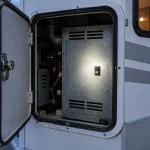
- Turn on the furnace power switch Suburban and Atwood furnaces both have an on/off switch on the furnace, separate from the thermostat. On Atwood furnaces it sits behind the outside access door, or on the left front side of the furnace on models with no outside door. If it is off, nothing else matters.
- Check the fuse or breaker The furnace runs on the 12V DC panel, which is often part of the converter. Find the fuse marked for the furnace and look for a broken metal strip inside. Replace it with one of the same amp rating. If the new one blows too, stop: Suburban’s guide points to a short or a part drawing too much current.
-
Measure battery voltage Put a meter across the battery posts. A healthy lead-acid battery at rest reads about 12.6 volts. Suburban rates its furnaces for 10.5 to 13.5 volts, and its fan control boards wait in standby if they see less than 9.5 volts. Check again while the blower runs: a big drop means a weak battery or a loose connection. Our RV battery and converter guide covers that side.
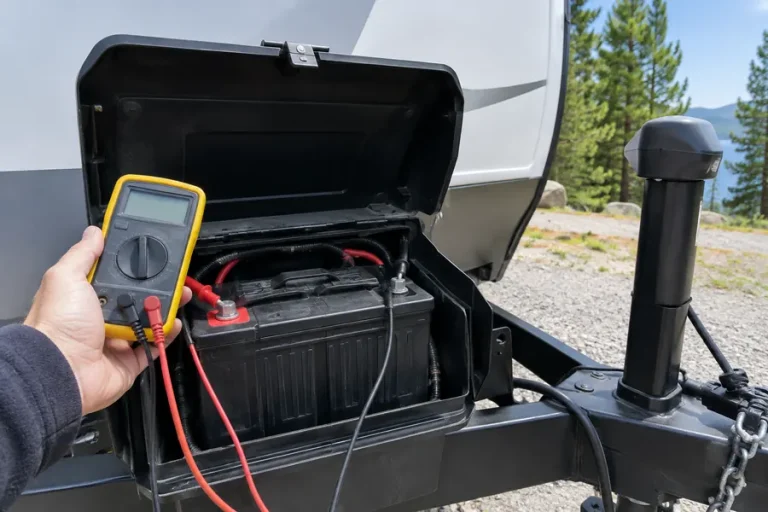
Meter probes on the battery posts -
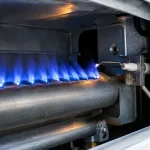
Confirm propane at the stove Check the tank level and open the tank valve all the way. Atwood says never to run the furnace with it partly closed. Then light a stove burner. If the stove will not light either, the problem is the tank, regulator or gas line, not the furnace.
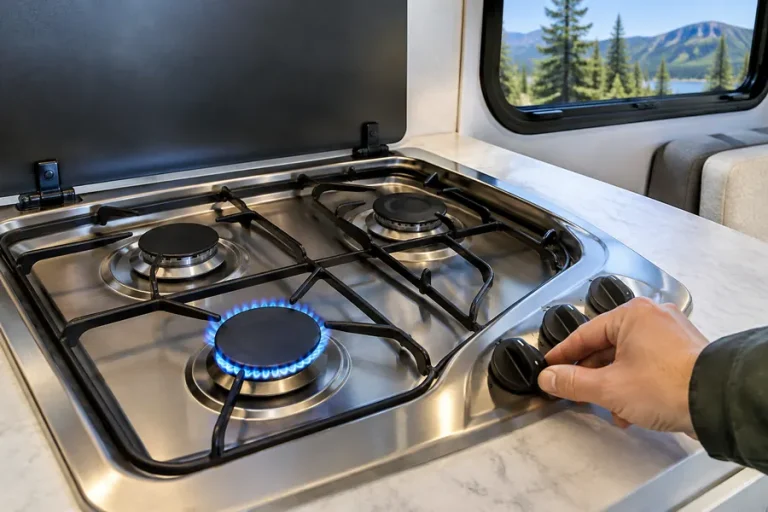
A steady blue flame means propane is reaching the coach - Clear a lockout once After failed attempts to light, the control board locks out and stops trying. On a Suburban, turn the thermostat off, wait for the blower to stop, then turn it back on. On an Atwood, reset the thermostat or turn the furnace power switch off and back on. Atwood says that after three attempts with no ignition you should shut the furnace down and call a service tech.
- Listen to the start-up Stand near the furnace. You should hear the blower spin up, then about 15 seconds of plain fan noise (the purge, which clears old gas out of the burner box), then fast ticking from the spark for up to about 7 seconds, then a soft whoosh as the burner lights. Atwood says to allow 30 seconds after the blower starts for the burner to light. Note where it stops: no fan points to steps 3, 4 and 10, and fan but no ticking points to step 11. Ticking but no flame is covered in RV furnace clicking but not igniting.
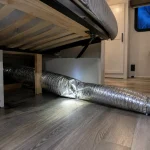
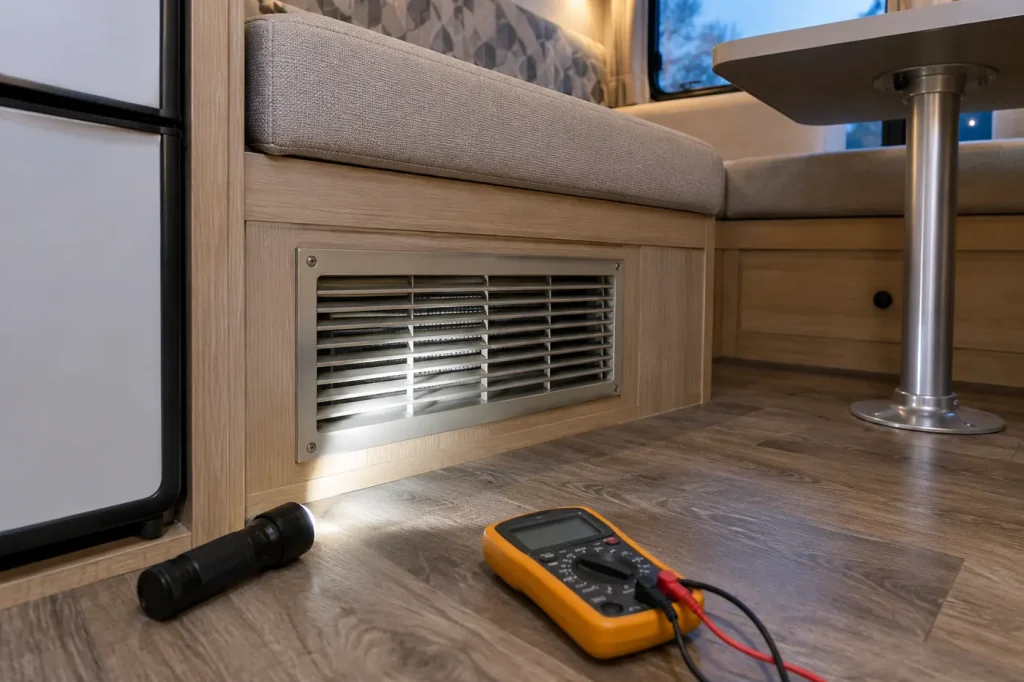
- Open up the return air The return-air grille is where room air flows back into the furnace, usually in the cabinet face under a counter, bed or sofa. Move bedding, shoes and bins away from it, and open the floor vents. Suburban says too little return air makes the furnace overheat and shut off on its limit switch. Atwood says not to use the furnace cabinet area for storage.
- Check the outside vent Find the furnace vent on the outside wall. It has an air intake and an exhaust. Look for wasp or mud dauber nests, snow, or a cover someone left on. Suburban’s flow chart names wasps in the air intake as a cause of a burner that won’t light.
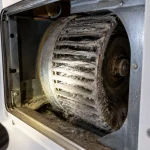
- Check the blower A slow, noisy or dead blower stops everything after it. Suburban says lint on the room-air blower wheel can make the motor drag and move too little air. Atwood notes that pet hair and carpet lint mean more frequent cleaning, and that the motor is sealed and needs no oil. Vacuum lint you can reach at the return-air opening with the power off. On many models, cleaning the wheel itself means pulling the furnace out of its cabinet and disconnecting the gas line, which is a job for a tech.
- Check the sail switch The sail switch is a small paddle that moving air pushes closed, to prove there is airflow before gas flows. The classic sign of trouble is a fan that runs about 30 seconds and stops with no ticking. Suburban’s fan control boards lock out if the sail switch stays open 30 seconds after the blower starts. Low voltage (step 4), lint (step 10) and blocked return air (step 8) all keep it open. Never jump or bypass this switch.
- Watch for limit switch cycling The limit switch is a heat-sensitive safety switch that shuts off the gas if the furnace gets too hot. If the burner lights, runs a few minutes, then goes out while the fan keeps blowing, the limit switch is likely opening. Suburban ties this to blocked return air and to ducts that are too small or full of sharp turns. On its fan control boards, if the limit stays open for 5 minutes the board locks out and you have to reset the thermostat. Fix the airflow first. If airflow is good and it still cycles, have the switch tested.
Stop. If you see black soot on or around the outside vent, do not run the furnace. Suburban says soot means incomplete combustion, which makes carbon monoxide, and Atwood says to shut the furnace down and call a qualified service tech. The same goes for any propane smell or a carbon monoxide alarm.
| What you notice | Likely area | Next step |
|---|---|---|
| No fan, no click, blank thermostat | 12V power | Steps 2 to 4 |
| Fan runs 30 seconds, then stops | Sail switch or low voltage | Steps 4, 8, 10, 11 |
| Fan runs, ticking, no flame | Ignition or gas | Step 5, then the ignition guide |
| Heats a few minutes, then cold air | Limit switch and airflow | Steps 8 and 12 |
| Fan slow or noisy | Blower or battery | Steps 4 and 10 |
Suburban vs Atwood (Dometic) furnaces
Both brands use 12V DC power, a sealed burner, a sail switch, a limit switch and direct spark ignition (DSI: a spark lights the burner each time, with no pilot flame). The differences show up when you diagnose.
Suburban. The service manual we used gives a meter-based flow chart rather than blink codes. Its boards try to light three times, with a 15-second purge and about 7 seconds of spark each time. After the third failure, a fan control board runs the blower 3 more minutes and then shuts down. Some older time-delay models keep the blower running in lockout until you turn the thermostat off.
Atwood (Dometic Hydroflame). The ignition board has an LED that flashes fault codes. Steady on means a board failure. One flash with a 3-second pause means a limit switch or airflow problem. Two flashes mean a flame sense fault. Three flashes mean ignition lockout. After a lockout the blower goes off in 3 minutes and stays off until you reset the thermostat. An ignition lockout is a “soft” lockout that the board retries after one hour. Where you can see the LED depends on the install.
Parts do not swap between brands, and often not between models of one brand. Read the model and serial number off the furnace label before you order anything. For how each part works, see our RV furnace repair guide.
Tools and parts for this fix
Only what this guide uses. For parts, match the part number in your unit's manual before you order.
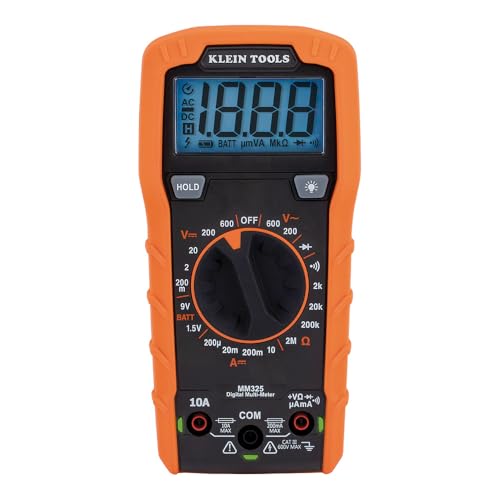
Checks that the battery reads about 12.6 volts and tests the furnace fuse for continuity.
Check price on Amazon
Bussmann ATC blade fuse assortment
Replaces a blown furnace fuse on the 12V panel with one of the same amp rating.
Check price on Amazon
As an Amazon Associate we earn from qualifying purchases, at no extra cost to you.
When to call an RV tech
- A new fuse blows again right away.
- The battery is good and 12V reaches the furnace, but the blower will not run.
- The fix needs the furnace pulled out. Suburban’s steps for that include disconnecting the gas line and a leak test afterward.
- The sail switch or limit switch needs testing or replacing.
- An Atwood LED stays on steady, or an Atwood still will not light after three attempts.
- Soot, a gas smell, or a carbon monoxide alarm at any point.
Not sure the furnace is the problem? Start from the symptom in our RV problem finder.
Common questions
What is the most common problem with an RV furnace?
We have not seen a maker publish a failure ranking, but Suburban’s own maintenance notes point at airflow. Lint on the blower wheel and the sail switch keeps the switch from closing, and a dirty burner or a blocked vent causes poor combustion. Add a weak battery, which slows the blower, and you have the cheap causes to rule out first.
Is there a reset button on an RV furnace, and how do you reset it?
Most RV furnaces have no reset button. The reset is the thermostat: on a Suburban, turn it off, let the blower stop, and turn it back on. On an Atwood, you can also turn the furnace power switch off and back on. If it keeps locking out, find the cause instead of resetting again and again.
Why is my RV furnace not kicking on?
If the furnace won’t turn on at all, start with power and the thermostat: wrong mode, the furnace switch off, a blown fuse, or low battery voltage. If the fan runs but you get no heat, the trouble is later in the start-up: the sail switch, ignition or gas. Listen to the start-up (step 7) to tell which.
How much does it cost to fix an RV furnace?
Many fixes on this list cost nothing: a switch, a fuse, a cleared vent, or a charged battery. Shops bill by the hour plus parts, and part prices vary by brand and model. Doing the free checks first, and giving the shop the model and serial number, cuts the time on the clock.
How long do RV furnaces last?
Neither Suburban nor Atwood gives a lifespan in the manuals we checked. They do give upkeep: Suburban says to clean the burner and inspect the vent at least once a year, even if the furnace sat unused, and Atwood calls for a yearly inspection by a qualified tech. Switches, motors and boards can be replaced. A combustion chamber with holes or heavy rust needs a tech’s verdict before you run it again.
Sources
- Suburban RV Furnace Service Manual (Airxcel/Suburban, dealer-hosted copy)
- Atwood (Dometic) Hydroflame AFM/AFMD Technical Installation Manual, Lit. 32471 (Forest River copy)
- Atwood (Dometic) Hydroflame AFL Series (AFLD35/40) Technical Installation Manual, Lit. 32472 (NHTSA copy)
- Atwood Hydroflame AFS/AFM/AFL User's Information Manual, Lit. 31973 (Gulf Stream Coach copy)