How to use the calculator
- Tick your 12 V loads Check each 12 volt item you use and set its amps and hours a day. The furnace blower, water pump and fridge controls are ticked to start. If your unit’s label shows a different amp figure, type that in.
- Tick what runs on the inverter Add the 120 volt things you plug in while off hookups, with watts and hours a day. The hours in both lists are example values, so change them to match how you camp.
- Pick your battery type Lithium (LiFePO4) or flooded/AGM lead-acid. This sets how much of the bank you use: 80% for lithium, 50% for lead-acid.
- Enter days and your bank Type the days you want to go without charging (2 to start) and the amp hours of the bank you have now (200 Ah to start).
- Set sun hours Enter the peak sun hours a day where you camp (4 to start). The tool shows the solar watts that would put back one day’s use.
How the calculator works
The tool turns every load into watt hours (Wh) a day, then into amp hours (Ah) at 12 volts.
- A 12 V load uses amps x hours x 12.
- A 120 V load uses watts x hours / 0.9, because the inverter loses some power. Renogy rates its 2000 W 12 V inverter at over 90% efficient and Victron lists 91% for its Phoenix 12/1200, so we use 90%.
- Bank you need = Ah a day x days / usable share, rounded up to the next 10 Ah.
- Days your bank lasts = bank Ah x usable share / Ah a day.
- Solar watts = Wh a day / (sun hours x 0.86), rounded up to the next 50 W. The 0.86 takes off 14%, the default system loss in NREL’s PVWatts model for dirt, shading, wiring and similar losses.
With the default values (lithium, 2 days, 200 Ah, 4 sun hours):
12 V loads. Furnace blower 5.5 A x 6 h = 33 Ah. Water pump 7.5 A x 0.3 h = 2.25 Ah. Fridge controls on propane 0.76 A x 24 h = 18.24 Ah. Total 53.49 Ah, or about 642 Wh.
120 V loads. Coffee maker 1,200 W x 0.25 h = 300 Wh, laptop 50 W x 3 h = 150 Wh, TV 120 W x 3 h = 360 Wh. That is 810 Wh, and 810 / 0.9 = 900 Wh from the battery.
Total. 642 + 900 = 1,542 Wh a day, and 1,542 / 12 = about 128 Ah a day.
Bank. 128.5 x 2 / 0.8 = 321 Ah, shown as 330 Ah of lithium. Lead-acid needs 128.5 x 2 / 0.5 = 514 Ah, shown as 520 Ah. The 200 Ah lithium bank gives 160 usable Ah, which covers 160 / 128.5 = about 1.2 days, so the tool marks it short.
Solar. 1,542 / (4 x 0.86) = 448 W, shown as about 450 W of panels.
To see the battery current a 120 V load pulls while it runs, use the RV inverter size calculator.
Typical RV loads and what they take from the battery
These figures sit behind the calculator’s lists. The 120 V rows include the 90% inverter loss, and the hours are examples.
| Load (model) | Rated draw | Example hours a day | Battery use a day |
|---|---|---|---|
| Furnace blower (Suburban NT-30SP) | 5.5 A | 6 | 33 Ah |
| Water pump (SHURflo 4008-101-A65) | 7.5 A max | 0.3 | 2.3 Ah |
| Absorption fridge controls on propane (Norcold N1095) | 0.76 A | 24 | 18 Ah |
| 12 V compressor fridge (Dometic CRX65) | 5.5 A rated | 10 | 55 Ah |
| Roof vent fan (MaxxFan Deluxe 7500Ki40) | 2 A | 8 | 16 Ah |
| Microwave (Furrion FMCM15AA-BS) | 1,500 W input | 0.25 | 35 Ah |
| Coffee maker (DOE) | 1,200 W | 0.25 | 28 Ah |
| Flat screen TV (DOE) | 120 W | 3 | 33 Ah |
| Laptop (DOE) | 50 W | 3 | 14 Ah |
| Space heater (DOE) | 1,500 W | 4 | 556 Ah |
The Norcold figure adds its gas valve (0.146 A), divider heater (0.25 A) and fan (0.36 A). Dometic’s 5.5 A is the CRX65’s rated current, not an average, and the compressor cycles, so 10 hours is a guess. The DOE wattages are nameplate figures, taken from the top of its ranges where it gives one.
Is a 100Ah battery enough for an RV?
For the default day in this calculator, no. A 100 Ah lithium battery gives about 80 usable Ah against 128.5 Ah of use, so it lasts about 0.6 days. A 100 Ah lead-acid battery gives 50 usable Ah, about 0.4 days.
It can be enough for light use. Drop the coffee maker, TV and laptop and the day falls to 53.5 Ah, so 100 Ah of lithium lasts about 1.5 days. In summer with the furnace off, the pump and fridge controls use 20.5 Ah, and it lasts close to 4 days.
Why we plan on 80% for lithium: Renogy recommends not going past 80% depth of discharge, and Victron’s data shows 2,500 cycles at 80% versus 5,000 at 50%. Battle Born rates its BB10012 for 100%, but we would rather keep a margin. For lead-acid, Trojan recommends discharges of 50% or less, and Lifeline says to keep the average no greater than 50% and size the bank at twice the load.
How much solar do you need for your RV?
Divide your daily watt hours by sun hours x 0.86. For the example day that is about 450 W of panels at 4 sun hours.
Sun hours move the answer most. NREL’s US solar map gives daily sunlight in kWh per square meter per day, the same number as peak sun hours, and its legend runs from under 4.00 to 5.75 and up, highest in the Southwest. Our 4 hour default is an example near the low end of that range. At 5.75 sun hours the same day needs 1,542 / (5.75 x 0.86) = 312 W.
The tool does not add battery charging losses, and Victron lists 92% round trip efficiency for its lithium batteries, so round your panel number up. For cloudy stretches, the RV generator size calculator sizes a backup. If your bank never fills even on shore power, see RV battery not charging when plugged in and our RV electrical problems guide.
Tools and parts for this fix
Only what this guide uses. For parts, match the part number in your unit's manual before you order.

Victron SmartShunt 500A battery monitor
Measures the amp hours you actually use each day so you can check the calculator's estimate.
Check price on Amazon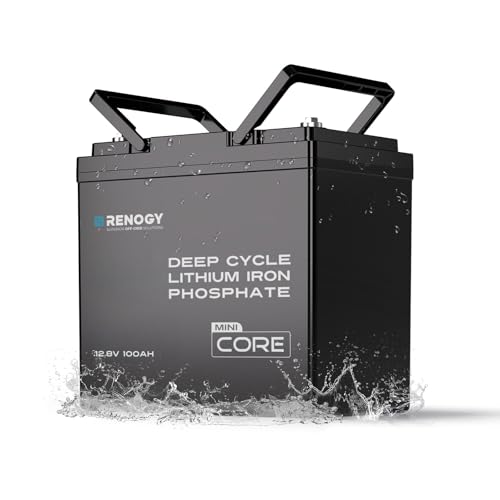
Renogy 12V 100Ah LiFePO4 battery
Each 100Ah LiFePO4 battery gives about 80 to 100 usable amp hours toward your calculated daily need.
Check price on Amazon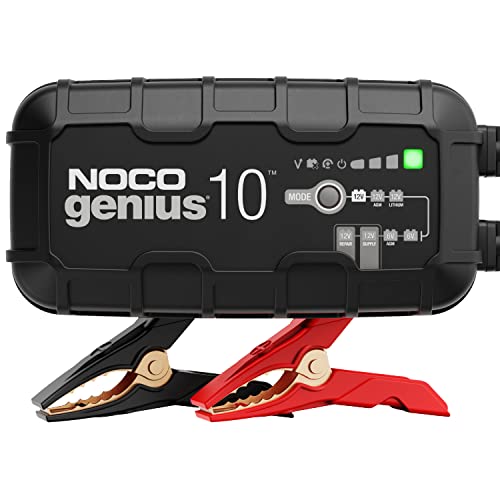
NOCO GENIUS10 smart battery charger
Recharges the amp hours the calculator says you used, from shore power, on lead-acid or lithium.
Check price on Amazon
As an Amazon Associate we earn from qualifying purchases, at no extra cost to you.
Common questions
How do I calculate the battery size needed for my RV?
Multiply the amp hours you use a day by the days between charges, then divide by the usable share of your battery type. With the default loads that is 128.5 x 2 / 0.8 = 321 Ah of lithium, or 514 Ah of lead-acid at 50%. For 120 V loads, divide watt hours by 0.9 for the inverter, then by 12.
How long will a 200Ah battery run a 12V refrigerator?
A 200 Ah lithium battery runs a Dometic CRX65 for about 2.9 days if the compressor runs 10 hours a day: 5.5 A x 10 h = 55 Ah, and 160 usable Ah / 55 = 2.9. Running nonstop, it would use 132 Ah a day, about 1.2 days. On lead-acid those become 1.8 and 0.8 days. An absorption fridge on propane draws only about 18 Ah a day for its controls, so the lithium bank lasts close to 9 days; check your gas with the RV propane usage calculator.
How much electricity does an RV use per day?
Our example day off hookups uses about 1,542 Wh, or 128 Ah at 12 V, and the furnace blower alone is 33 Ah of that. Electric heat is the big one: a 1,500 W space heater for 4 hours takes about 556 Ah through an inverter, more than four times the whole example day.
How many solar panels are needed to run a RV?
For the example day you need about 450 W of panels at 4 sun hours. Divide your solar watts by the watt rating of the panels you plan to buy and round up.
Is 400W solar enough for RV?
For the example day it is a little short at 4 sun hours: 400 x 4 x 0.86 = 1,376 Wh, about 89% of the 1,542 Wh used. At 5.75 sun hours the same panels give 1,978 Wh, which covers it. For the 12 V loads alone, at 642 Wh, 400 W is plenty.