How to use the calculator
- Pick where you are plugged in Choose 30 amp RV, 50 amp RV, 20 amp outlet or 15 amp outlet. A 50 amp RV on a 30 amp pedestal through an adapter counts as 30 amp, because that is all the pedestal gives.
- Tick what runs at the same time The list starts with a rooftop AC, the microwave and the fridge turned on. Tick the second AC, electric water heater, converter or heat strip if they can be on at the same moment.
- Match the amps to your labels Each box holds a figure from a maker’s spec sheet. Type in the amps from your own unit’s data plate for a closer answer.
- Add anything missing Tap “Add your own” for a coffee maker or space heater, and enter the amps from its label.
- Read the verdict It reads Fits, Tight or Too much, shows the amps left over, and names a load to turn off when you are over.
How the calculator works
The math is plain addition. The calculator adds the amps of every ticked load and compares the total with what your hookup supplies at 120 volts:
- 30 amp RV: 30 A, which is 3,600 W (30 x 120).
- 50 amp RV: 100 A, because a 50 amp RV gets two separate 50 A legs at 120 V. Southwire rates its 50 amp Surge Guard at 12,000 W.
- 20 and 15 amp outlets: 20 A (2,400 W) and 15 A (1,800 W).
It then divides your total by that limit. At 80% or less it reads “Fits,” above 80% and up to 100% “Tight,” and over 100% “Too much.” When you are over, it names the smallest single load that gets you back under the limit once it is off. If no one load is big enough, it tells you to turn off the two biggest or run them one at a time.
Worked example with the starting values. The rooftop AC is 14.9 A, the microwave 12.5 A and the fridge 2.6 A. 14.9 A + 12.5 A + 2.6 A = 30.0 A, which is 100% of 30 A. The result reads “Tight” with 0 A left over. Now tick the water heater on electric at 12 A: 30.0 A + 12 A = 42.0 A, which is 12 A over. The calculator tells you to turn off the water heater, the smallest load that covers those 12 A.
Typical amp draw of RV appliances
These are the running amps behind the calculator’s list, plus two other common rooftop units.
| Appliance and model | Amps | Where the number comes from |
|---|---|---|
| Rooftop AC 13,500 BTU, Dometic Brisk II B57915 | 14.9 A | 12.4 A compressor + 2.5 A fan |
| Rooftop AC 15,000 BTU, Dometic Brisk II B59516 | 15.3 A | 13.3 A compressor + 2 A fan |
| Rooftop AC 13,500 BTU, Furrion Chill FACR13SA | 13.1 A | Cooling amps in Furrion’s spec table |
| Rooftop AC 15,000 BTU, Coleman-Mach Mach 15 | 13.9 A | Cooling amps on Coleman-Mach’s product page |
| Microwave, Furrion FMCM15AA-BS | 12.5 A | 1,500 W input ÷ 120 V |
| Water heater element, Suburban SW6DE | 12 A | 1,440 W element ÷ 120 V |
| Fridge on electric, Norcold N611V / N811V | 2.3 to 2.6 A | Norcold’s AC heater rating |
| Converter, WFCO WF-8955 | 11 A | Maximum input current at 105 V |
| AC heat strip, Furrion Chill | 12.5 A | 1,500 W ÷ 120 V |
Dometic prints compressor and fan amps separately, so we add them. The start-up surge is what trips a breaker that is already near its limit. Dometic lists the locked rotor current, the draw of a stalled or starting compressor, at 68 A for the 13,500 BTU Brisk II and 70 A for the 15,000 BTU model.
Is 30 amps enough for an RV?
For most trips, yes, if you run one big load at a time. A 30 amp RV gets 3,600 W at 120 V, and one 13,500 BTU rooftop AC takes about half of it at 14.9 A. The fridge adds 2.6 A, and the converter up to 11 A at full output. The trouble starts when heavy loads overlap. AC, microwave and electric water heater come to 14.9 + 12.5 + 12 = 39.4 A, which is 9.4 A more than the pedestal gives.
Our rule on 30 amp: one AC at a time, and the water heater on propane while you cook. If it will not light on gas, see RV water heater not working. If you have two ACs or spend summers in the heat, 30 amp will feel tight every day. Our RV electrical problems hub covers faults that look like an overload but are not.
Can you run two ACs on 30 amp?
No. Two ACs running at once do not fit on 30 amp, even with nothing else on. The 13,500 BTU Brisk II at 14.9 A plus the 15,000 BTU Brisk II at 15.3 A comes to 30.2 A. Add the fridge and you are at 32.8 A.
A soft starter does not change that. Micro-Air says its EasyStart Breeze cuts starting current by up to 75%, which helps one AC start on limited power. The running amps stay the same, and they are what put two ACs over 30 A. On a 50 amp pedestal, the same two ACs plus the microwave, fridge and water heater come to 57.3 A of the 100 A available. The calculator assumes the loads are spread across both legs, so one leg can still trip if both ACs are wired to it.
Stop. A breaker that trips is protecting your cord and wiring. Never swap in a bigger breaker, and stop using any plug or adapter that feels hot or shows scorch marks. If the RV has no power at all after a trip, work through RV has no power when plugged in before you reset again.
Tools and parts for this fix
Only what this guide uses. For parts, match the part number in your unit's manual before you order.

Progressive Industries EMS-PT30X surge protector
Shuts off power on low voltage or miswiring when your calculated load runs close to 30 amps.
Check price on Amazon
Micro-Air EasyStart Breeze 399 soft start
Cuts the AC's startup surge so a load near 30 amps does not trip the main breaker.
Check price on Amazon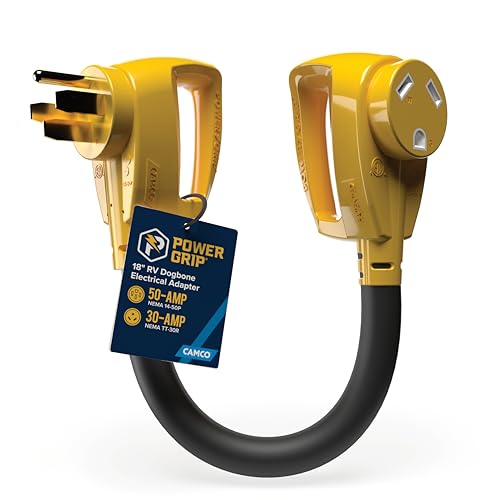
Camco 50A to 30A dogbone adapter
Lets a 30 amp RV plug into a 50 amp pedestal; your load limit stays 30 amps.
Check price on Amazon
As an Amazon Associate we earn from qualifying purchases, at no extra cost to you.
Common questions
What can I run on 30 amp in my RV?
You can run one rooftop AC, the fridge and your 12 volt lights, plus one more big load such as the microwave for a short time. AC at 14.9 A, fridge at 2.6 A and microwave at 12.5 A add up to exactly 30 A. Leave the electric water heater and a second AC off.
Can I run my RV air conditioner on 30 amp?
Yes. One rooftop AC uses about half of a 30 amp service: 14.9 A for a 13,500 BTU Dometic Brisk II and 15.3 A for the 15,000 BTU model. Dometic calls for each AC to have its own 20 A time delay breaker or fuse. If yours trips when the compressor kicks on, see RV AC keeps tripping the breaker.
How do I know if my RV needs 30 amp or 50 amp?
Check the rating on your shore cord plug or the main breaker in your power panel; it reads 30 or 50. A 50 amp RV has two 50 A legs at 120 V, 100 A in all, and it is the one to have if you run two ACs, since two ACs alone pass 30 A. A 30 amp RV cannot take more than 30 A, so the answer there is to plan your loads.
How big of a generator is needed to run a 30 amp RV?
About 3,600 running watts covers everything a 30 amp RV can draw, and a bigger generator will not push more through the 30 amp cord. Dometic’s guide is 3.5 kW for one rooftop AC and 5 kW for two, and it notes that generators lose power at high altitude. Cummins Onan’s QG 4000 is rated at 4,000 W with a 30 A breaker. Our RV generator size calculator checks a portable model against your loads.
Why does the calculator warn above 80%?
Loads that run for hours are best kept at or under 80% of the breaker rating. That is common practice based on the National Electrical Code’s rule of sizing circuits for 125% of a continuous load, since 1 ÷ 1.25 = 0.8. On 30 amp that is 24 A: one AC plus the fridge (17.5 A) fits, while AC plus microwave (27.4 A) goes over, so keep the microwave run short.